
Pulp Fiction, 1928 · page 59 of 99
Amazing Stories — page 59: what you’re looking at
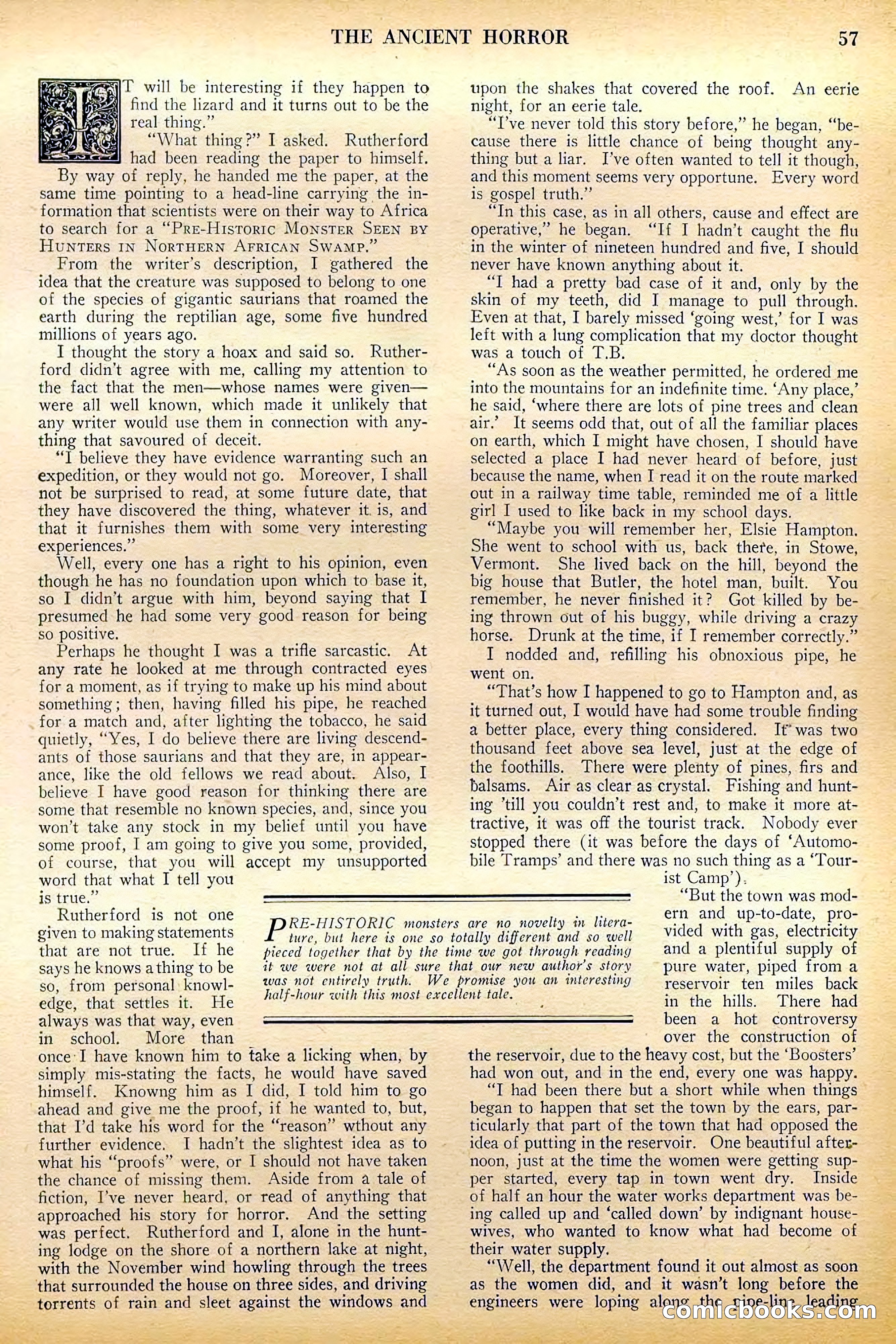
A restored page from Pulp Fiction, 1928. Page through the whole issue in the reader above.
📄 Transcribed text from this page (OCR, searchable)
Machine-transcribed from the original scan — historical spelling and the odd misread are preserved.
THE ANCIENT HORROR a7 Gol | will be interesting if they happen to find the lizard and it turns out to be the real thing.” 4] = “What thing?” I asked. Rutherford ==4) had been reading the paper to himself. By way of reply, he handed me the paper, at the same time pointing to a head-line carrying the in- formation that scientists were on their way to Africa to search for a “Pre-Historrc Monster SEEN BY Hunters IN NorTHERN AFRICAN SWAMP.” From the writer's description, I gathered the idea that the creature was supposed to belong to one of the species of gigantic saurians that roamed the earth during the reptilian age, some five hundred millions of years ago. I thought the story a hoax and said so. Ruther- ford didn’t agree with me, calling my attention to the fact that the men—whose names were given— were all well known, which made it unlikely that any writer would use them in connection with any- thing that savoured of deceit. “T believe they have evidence warranting such an expedition, or they would not go. Moreover, I shall not be surprised to read, at some future date, that they have discovered the thing, whatever it. is, and that it furnishes them with some very interesting experiences.” Well, every one has a right to his opinion, even though he has no foundation upon which to base it, so E didn’t argue with him, beyond saying that I presumed he had some very good reason for being SO positive. Perhaps he thought I was a trifle sarcastic. At any rate he looked at me through contracted eyes for a moment, as if trying to make up his mind about something ; then, having filled his pipe, he reached for a match and, after lighting the tobacco, he said quietly, “Yes, I do believe there are living descend- ants of those saurians and that they are, in appear- ance, like the old fellows we read about. Also, I believe I have good reason for thinking there are some that resemble no known species, and, since you won't take any stock in my belief until you have some proof, I am going to give you some, provided, of course, that you will accept my unsupported word that what I tell you is true.” Rutherford is not one given to making statements that are not true. If he says he knows athing to be so, from personal knowl- edge, that settles it. He always was that way, even in school. More than _ once’ I have known him to take a licking when, by simply mis-stating the facts, he would have saved himself. Knowng him as if did, I told him to go ahead and give me the proof, if he wanted to, but, that I’d take his word for the “reason” wthout any further evidence. I hadn’t the slightest idea as to what his “proofs” were, or I should not have taken the chance of missing them. Aside from a tale of fiction, I’ve never heard, or tread of anything that approached his story for horror. And the setting was perfect. Rutherford and I, alone in the hunt- ing lodge on the shore of a northern lake at night, with the November wind howling through the trees that surrounded the house on three sides, and driving torrents of rain and sleet against the windows and mY —_ PP RE-HISTORIC monsters are no novelty in litera- ture, but here is one so totally different and so well pieced together that by the time we got through reading it we were not at all sure that our new author's story was not entirely truth. We promise you an interesting half-hour with this most excellent tale. Koy ee ee a — upon the shakes that covered the roof. An eerie night, for an eerie tale. “T’ve never told this story before,” he began, “be- cause there is little chance of being thought any- thing but a liar. I’ve often wanted to tell it though, and this moment seems very opportune. Every word is gospel truth.” “Tn this case, as in all others, cause and effect are operative,” he began. “If I hadn’t caught the flu in the winter of nineteen hundred and five, I should never have known anything about it. “I had a pretty bad case of it and, only by the skin of my teeth, did I manage to pull through, Even at that, I barely missed ‘going west,’ for I was left with a lung complication that my doctor thought was a touch of T.B. ; “As soon as the weather permitted, he ordered me into the mountains for an indefinite time. ‘Any place,’ he said, ‘where there are lots of pine trees and clean air.’ It seems odd that, out of all the familiar places on earth, which I might have chosen, I should have selected a place I had never heard of before, just because the name, when I read it on the route marked out in a railway time table, reminded me of a little girl I used to like back in my school days. “Maybe you will remember her, Elsie Hampton. She went to school with us, back there, in Stowe, Vermont. She lived back on the hill, beyond the big house that Butler, the hotel man, built. You remember, he never finished it? Got killed by be- ing thrown out of his buggy, while driving a crazy horse. Drunk at the time, if I remember correctly.” I nodded and, refilling his obnoxious pipe, he went on. “That’s how I happened to go to Hampton and, as it turned out, I would have had some trouble finding a better place, every thing considered. It was two thousand feet above sea level, just at the edge of the foothills. There were plenty of pines, firs and balsams. Air as clear as crystal. Fishing and hunt- ing ‘till you couldn’t rest and, to make it more at- tractive, it was off the tourist track. Nobody ever stopped there (it was before the days of ‘Automo- bile Tramps’ and there was no such thing as a ‘Tour- ist Camp’) “But the town was mod- ern and up-to-date, pro- vided with gas, electricity and a plentiful supply of pure water, piped from a reservoir ten miles back in the hills. There had been a hot controversy over the construction of the reservoir, due to the heavy cost, but the ‘Boosters’ had won out, and in the end, every one was happy. “T had been there but a short while when things began to happen that set the town by the ears, par- ticularly that part of the town that had opposed the idea of putting in the reservoir. One beautiful after- noon, just at the time the women were getting sup- per started, every tap in town went dry, Inside of half an hour the water works department was be- ing called up and ‘called down’ by indignant house- wives, who wanted to know what had become of their water supply. “Well, the department found it out almost as soon — = as the women did, and it wasn’t long before the — engineers were = lene pe ote Backer’ aS Seam