
Pulp Fiction, 1928 · page 45 of 99
Amazing Stories — page 45: what you’re looking at
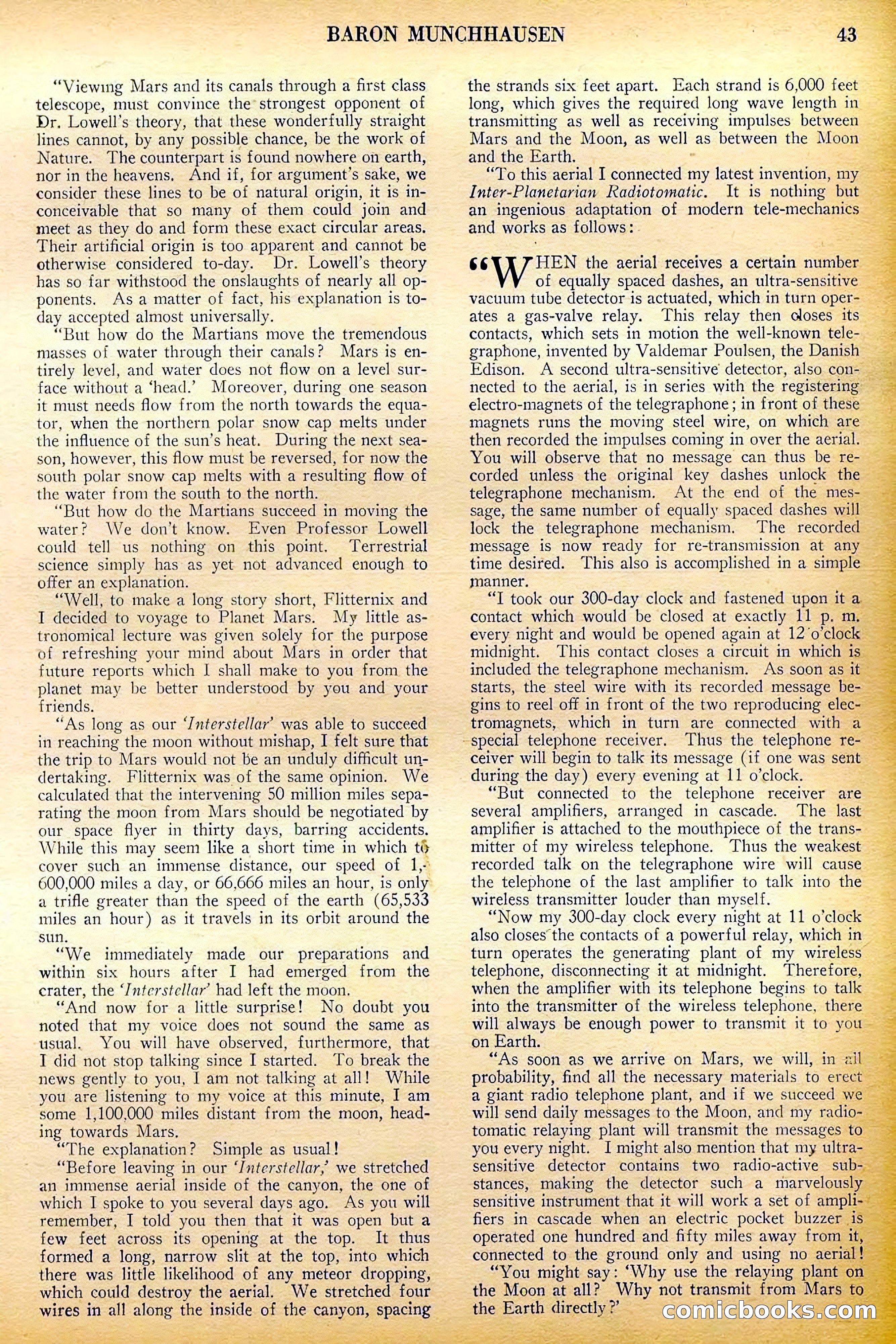
A restored page from Pulp Fiction, 1928. Page through the whole issue in the reader above.
📄 Transcribed text from this page (OCR, searchable)
Machine-transcribed from the original scan — historical spelling and the odd misread are preserved.
BARON MUNCHHAUSEN . | ee “Viewing Mars and its canals through a first class telescope, must convince the strongest opponent of Dr. Lowell's theory, that these wonderfully straight lines cannot, by any possible chance, be the work of Nature. The counterpart is found nowhere on earth, nor in the heavens, And if, for argument’s sake, we consider these lines to be of natural origin, it is in- conceivable that so many of them could join and meet as they do and form these exact circular areas, Their artificial origin is too apparent and cannot be otherwise considered to-day. Dr. Lowell’s theory has so far withstood the onslaughts of nearly all op- ponents. Asa matter of fact, his explanation is to- day accepted almost universally. “But how do the Martians move the tremendous masses of water through their canals? Mars is en- tirely level, and water does not flow on a level sur- face without a ‘head.’ Moreover, during one season it must needs flow from the north towards the equa- tor, when the northern polar snow cap melts under the influence of the sun’s heat. During the next sea- son, however, this flow must be reversed, for now the south polar snow cap melts with a resulting flow of the water from the south to the north. “But how do the Martians succeed in moving the water? We don’t know. Even Professor Lowell could tell us nothing on this point. Terrestrial science simply has as yet not advanced enough to offer an explanation. “Well, to make a long story short, Flitternix and I decided to voyage to Planet Mars. My little as- tronomical lecture was given solely for the purpose of refreshing your mind about Mars in order that future reports which | shall make to you from the planet may be better understood by you and your friends. “As long as our ‘Interstellar’ was able to succeed in reaching the moon without mishap, I felt sure that the trip to Mars would not be an unduly difficult un- dertaking. Flitternix was of the same opinion. We calculated that the intervening 50 million miles sepa- rating the moon from Mars should be negotiated by our space flyer in thirty days, barring accidents. While this may seem like a short tume in which té cover such an immense distance, our speed of 1,- 600,000 miles a day, or 66,666 miles an hour, is only a trifle greater than the speed of the earth (65, 533 miles an hour) as it travels in its orbit around the sun. “We immediately made our preparations and within six hours after I had emerged from the crater, the ‘Interstellar’ had left the moon. “And now for a little surprise! No doubt you noted that my voice does not sound the same as ustial. You will have observed, furthermore, that I did not stop talking since I started. To break the news gently to you, I am not talking at all! While you are listening to my voice at this minute, I am some 1,100,000 miles distant from the moon, head- ing towards Mars, “The explanation? Simple as usual! “Before leaving in our ‘Interstellar, we stretched an immense aerial inside of the canyon, the one of which I spoke to you several days ago. As you will remember, I told you then that it was open but a few feet across its opening at the top. It thus formed a long, narrow slit at the top, into which there was little likelihood of any meteor dropping, which could destroy the aerial. We stretched four me wires in all along the inside of ue canyon els “ RE ee ee neice Si Seee ~special telephone receiver. the strands six feet apart. Each strand is 6,000 feet long, which gives the required long wave length in transmitting as well as receiving impulses between Mars and the Moon, as well as between the Moon _ and the Earth. ; “To this aerial I connected my latest invention, my Inter-Planetarian Radiotomatic. It is nothing but — an ingenious adaptation of modern tele- mechanics — = and works as follows: 66 HEN the aerial receives a certain number _ of equally spaced dashes, an ultra-sensitive vacuum tube detector is actuated, which in turn oper- ates a gas-valve relay. This relay then closes its contacts, which sets in motion the well-known tele- _ graphone, invented by Valdemar Poulsen, the Danish _ Edison. A second ultra-sensitive detector, also con- nected to the aerial, is in series with the registering electro-magnets of the telegraphone; in front of these magnets runs the moving steel wire, on which are ee then recorded the impulses coming in over the aerial. | You will observe that no message can thus be re-_ corded unless the original key dashes unlock hes telegraphone mechanism. At the end of the mes- — sage, the same number of equally spaced dashes will lock the telegraphone mechanism. The recorded - z message is now ready for re-transmission at any — time desired. This also is accomplished in a simple _ = manner. ome “T took our 300-day clock and fastened upon it a — contact which would be closed at exactly 11 p, jee every night and would be opened again at 12 o'clock — midnight. This contact closes a circuit in which is — included the telegraphone mechanism. As soon as it starts, the steel wire with its recorded message be- gins to reel off in front of the two reproducing elec- — tromagnets, which in turn are connected with a — Thus the telephone re- — ceiver will begin to talk its message (if one was sent — ; during the day) every evening at 11 o'clock. ee “But connected to the telephone receiver are several amplifiers, arranged in cascade. The last amplifier is attached to the mouthpiece of the trans- mitter of my wireless telephone. Thus the weakest recorded talk on the telegraphone wire will cause ~ the telephone of the last amplifier to talk into the wireless transmitter louder than myself. “Now my 300-day clock every night at 11 o’clock — also closes the contacts of a powerful relay, which in | turn operates the generating plant of my wireless _ me telephone, disconnecting it at midnight. Therefore, 3 when the amplifier with its telephone begins to talk — into the transmitter of the wireless telephone, there will always be enough power to transmit it to ‘you on Earth. ss “As soon as we arrive on Mars, we will, in . Re probability, find all the necessary materials to e a giant radio telephone plant, and if we succeed ) will send daily messages to the Moon, and my radi tomatic relaying plant will transmit the messages you every night. I might also mention that my ultr sensitive detector contains two radio-active su stances, making the detector such a marvelo sensitive Sreune Es that it will work a set of am operated c one hundred and fifty miles away fr connected to the ground only and using no- “You might say: “Why use the relaying pla the Moon at all? aoe not transmit fror M