
Pulp Fiction, 1928 · page 43 of 99
Amazing Stories — page 43: what you’re looking at
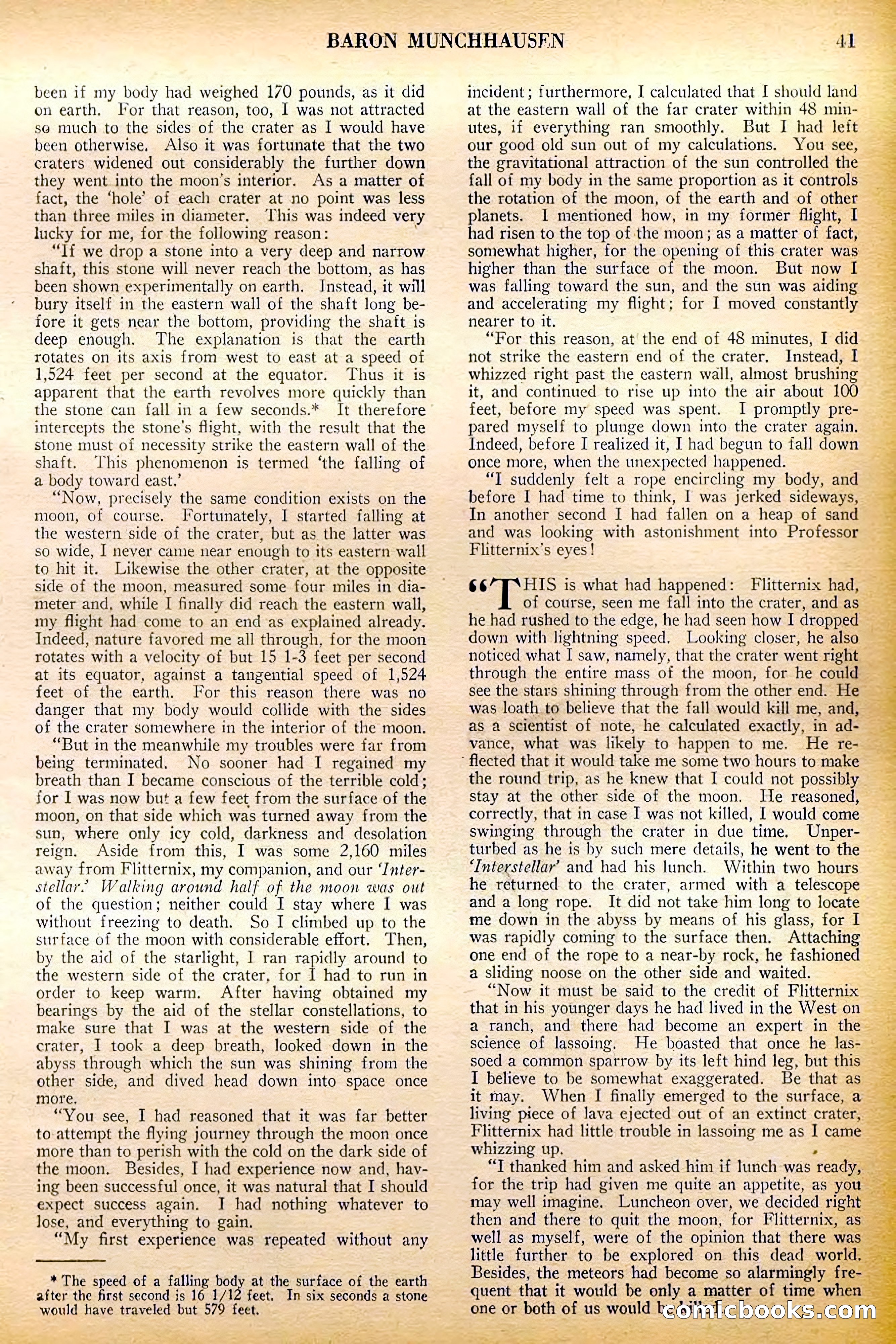
A restored page from Pulp Fiction, 1928. Page through the whole issue in the reader above.
📄 Transcribed text from this page (OCR, searchable)
Machine-transcribed from the original scan — historical spelling and the odd misread are preserved.
BARON MUNCHHAUSEN AL been if my body had weighed 170 pounds, as it did on earth. Il‘or that reason, too, I was not attracted se much to the sides of the crater as I would have been otherwise. Also it was fortunate that the two craters widened out considerably the further down they went into the moon’s interior. As a matter of fact, the ‘hole’ of each crater at no point was less than three miles in diameter, This was indeed very lucky for me, for the following reason: “If we drop a stone into a very deep and narrow shaft, this stone will never reach the bottom, as has been shown experimentally on earth. Instead, it will bury itself in the eastern wall of the shaft long be- fore it gets near the bottom, providing the shaft is deep enough. The explanation is that the earth rotates on its axis from west to east at a speed of 1,524 feet per second at the equator. Thus it is apparent that the earth revolves more quickly than the stone can fall in a few seconds.* It therefore intercepts the stone's flight, with the result that the stone must of necessity strike the eastern wall of the shaft. This phenomenon is termed ‘the falling of a body toward east.’ “Now, precisely the same condition exists on the moon, of course. Jl*ortunately, I started falling at the western side of the crater, but as the latter was so wide, I never came near enough to its eastern wall to hit it. Likewise the other crater, at the opposite side of the moon, measured some four miles in dia- meter and, while I finally did reach the eastern wall, my flight had come to an end as explained already. Indeed, nature favored me all through, for the moon rotates with a velocity of but 15 1-3 feet per second at its equator, against a tangential speed of 1,524 feet of the earth. For this reason there was no danger that my body would collide with the sides of the crater somewhere in the interior of the moon. “But in the meanwhile my troubles were far from being terminated. No sooner had I regained my breath than I became conscious of the terrible cold; for I was now but a few feet from the surface of the moon, on that side which was turned away from the sun, where only icy cold, darkness and desolation reign. Aside from this, I was some 2,160 miles away from Flitternix, my companion, and our ‘Tnter- stellar” Walking around half of the moon was out of the question; neither could I stay where I was without freezing to death. So I climbed up to the surface of the moon with considerable effort. Then, by the aid of the starlight, I ran rapidly around to the western side of the crater, for I had to run in order to keep warm. After having obtained my bearings by the aid of the stellar constellations, to make sure that I was at the western side of the crater, I took a deep breath, looked down in the abyss through which the sun was shining from the other side, and dived head down into space once more. “You see, I had reasoned that it was far better to-attempt the flying journey through the moon once more than to perish with the cold on the dark side of the moon. Besides, I had experience now and, hay- ing been successful once, it was natural that I should expect success again. I had nothing whatever to lose, and everything to gain. “My first experience was repeated without any * The speed of a falling body at the surface of the earth after the first second is 16 1/12 feet. In six seconds a stone would have traveled but 579 feet. ~ Dagpne - > ee Pa eo a ~ be 3 ee ~ one or Thoth of us would Lcomich incident ; furthermore, I calctilated that I should land at the eastern wall of the far crater within 48 min- utes, if everything ran smoothly. But I had left our good old sun out of my calculations. You see, the gravitational attraction of the sun controlled the — fall of my body in the same proportion as it controls — the rotation of the moon, of the earth and of other — planets. I mentioned how, in my former flight, I had risen to the top of the moon; as a matter of fact, — somewhat higher, for the opening of this crater was _ higher than the surface of the moon. But now I was falling toward the sun, and the sun was aiding and accelerating my flight; for I moved constantly nearer to it. “For this reason, at the end of 48 minutes, I did not strike the eastern end of the crater. Instead, I — whizzed right past the eastern wall, almost brushing it, and continued to rise up into the air about 100 feet, before my speed was spent. I promptly pre- pared myself to plunge down into the crater again. Indeed, before I realized it, I had begun to fall down once more, when the unexpected happened. “T suddenly felt a rope encircling my body, and _ before I had time to think, I was jerked sideways, _ In another second I had fallen on a heap of sand ~ and was looking with astonishment into Professor Flitternix’s eyes! Flitternix had, = of course, seen me fall into the crater, and as he had rushed to the edge, he had seen how I dropped down with lightning speed. Looking closer, he also noticed what I saw, namely, that the crater went right. co 66 HIS is what had happened: see the stars riniig through from the other end. He: 3 was loath to believe that the fall would kill me, and, — as a scientist of note, he calculated exactly, in ade vance, what was likely to happen to me. He re- - flected that it would take me some two hours to make ~ the round trip, as he knew that I could not possibly stay at the other side of the moon. He reasoned, — correctly, that in case I was not killed, I would come swinging through the crater in due time. Unper- turbed as he is by such mere details, he went to the ‘Interstellar’ and had his lunch. Within two hours he returned to the crater, armed with a telescope and a long rope. It did not take him long to locate __ me down in the abyss by means of his glass, for 1 was rapidly coming to the surface then. Attaching = one end of the rope to a near-by rock, he fashioned __ a sliding noose on the other side and waited. ~ “Now it must be said to the credit of Flitternix that in his younger days he had lived in the West on — a ranch, and there had become an expert in the — science of lassoing. He boasted that once he las- soed a common sparrow by its left hind leg, but this _ I believe to be somewhat exaggerated. Be that as _ it may. When I finally emerged to the surface, a living piece of lava ejected out of an extinct crater, Flitternix had little trouble in lassoing me as I came — whizzing up. = “T thanked him and asked him if lunch was ‘read for the trip had given me quite an appetite, as yc may well imagine. Luncheon over, we decided rig then and there to quit the moon, for Flitternix, well as myself, were of the opinion that there w little further to be seuplored on this dead ‘wo quent that it would be only a matter of tim