
Pulp Fiction, 1928 · page 31 of 99
Amazing Stories — page 31: what you’re looking at
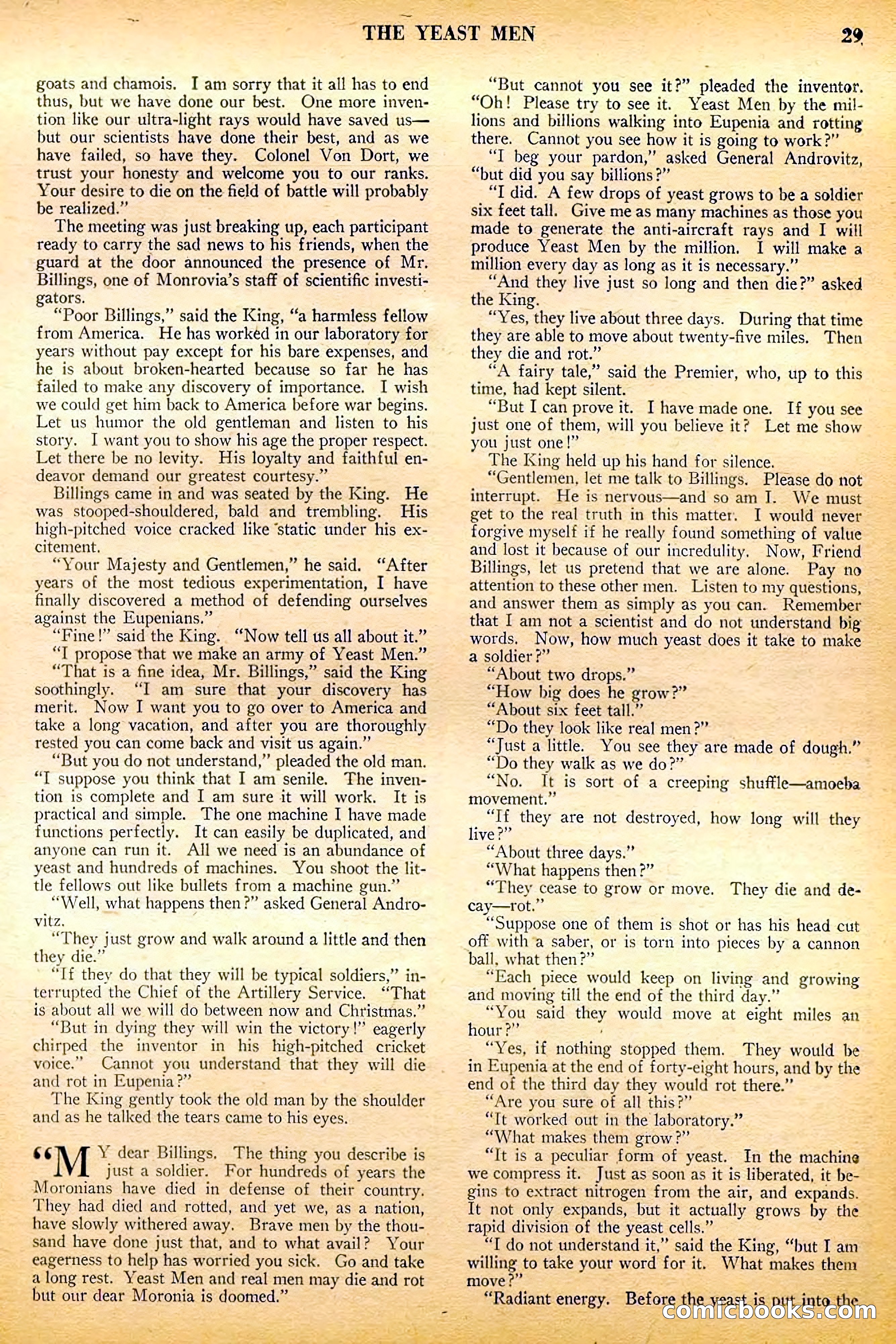
A restored page from Pulp Fiction, 1928. Page through the whole issue in the reader above.
📄 Transcribed text from this page (OCR, searchable)
Machine-transcribed from the original scan — historical spelling and the odd misread are preserved.
ae Sr tio m in ie ey ae ees fg ante FN Bite SR i ni lly An mee eta Rie but our dear Moronia is doomed.” goats and chamois. I am sorry that it all has to end thus, but we have done our best. One more inven- tion like our ultra-light rays would have saved us— but our scientists have done their best, and as we have failed, so have they. Colonel Von Dort, we trust your honesty and welcome you to our ranks. Your desire to die on the field of battle will probably be realized.” The meeting was just breaking up, each participant ready to carry the sad news to his friends, when the guard at the door announced the presence of Mr. Billings, one of Monrovia’s staff of scientific investi- gators. “Poor Billings,” said the King, “a harmless fellow from America. He has worked in our laboratory for years without pay except for his bare expenses, and he is about broken-hearted because so far he has failed to make any discovery of importance. I wish we could get him back to America before war begins. Let us humor the old gentleman and listen to his story. I want you to show his age the proper respect. Let there be no levity. His loyalty and faithful en- deavor demand our greatest courtesy.” Billings came in and was seated by the King. He was stooped-shouldered, bald and trembling. His high-pitched voice cracked like ‘static under his ex- citement. “Your Majesty and Gentlemen,” he said. “After years of the most tedious experimentation, I have finally discovered a method of defending ourselves against the Eupenians.” “Fine!” said the King. “Now tell us all about it.” “I propose that we make an army of Yeast Men.” “That is a fine idea, Mr. Billings,” said the King soothingly. “I am sure that your discovery has merit. Now I want you to go over to America and take a long vacation, and after you are thoroughly rested you can come back and visit us again.” “But you do not understand,” pleaded the old man. “T suppose you think that I am senile. The inven- tion is complete and I am sure it will work. It is practical and simple. The one machine I have made functions perfectly. It can easily be duplicated, and anyone can run it. All we need is an abundance of yeast and hundreds of machines. You shoot the lit- tle fellows out like bullets from a machine gun.” “Well, what happens then?” asked General Andro- vitz. “They just grow and walk around a little and then they die.” “If they do that they will be typical soldiers,” in- terrupted the Chief of the Artillery Service. ‘That is about all we will do between now and Christmas.” “But in dying they will win the victory!” eagerly chirped the inventor in his high-pitched cricket voice.” Cannot you understand that they will die and rot in Eupenia ?” The King gently took the old man by the shoulder and as he talked the tears came to his eyes. 6eé Y dear Billings. The thing you describe is just a soldier. For hundreds of years the Moronians have died in defense of their country. They had died and rotted, and yet we, as a nation, have slowly withered away. Brave men by the thou- sand have done just that, and to what avail? Your eagetness to help has worried you sick. Go and take a long rest. Yeast Men and real men may die and rot Ps « x “THE YEAST MEN | 29 “But cannot you see it?” pleaded the inventor. “Oh! Please try to see it. Yeast Men by the mil- lions and billions walking into Eupenia and rotting there. Cannot you see how it is going to work?” “I beg your pardon,’’ asked General Androvitz, “but did you say billions?” “I did. A few drops of yeast grows to be a soldier six feet tall. Give me as many machines as those you made to generate the anti-aircraft rays and I will produce Yeast Men by the million. I will make a million every day as long as it is necessary.” “And they live just so long and then die?” asked the King. “Yes, they live about three days. During that time they are able to move about twenty-five miles. Then they die and rot.” “A fairy tale,” said the Premier, who, up to this time, had kept silent. “But I can prove it. I have made one. If you see just one of them, will you believe it? Let me show you just one!” The King held up his hand for silence. “Gentlemen, let me talk to Billings. Please do not interrupt. He is nervous—and so am I. We must get to the real truth in this matter. I would never forgive myself if he really found something of value and lost it because of our incredulity. Now, Friend Billings, let us pretend that we are alone. Pay no attention to these other men. Listen to my questions, and answer them as simply as you can. Remember that I am not a scientist and do not understand big words, Now, how much yeast does it take to make a soldier ?” “About two drops.” “How big does he grow?” “About six feet tall.” “Do they look like real men ?” “Just a little. You see they are made of dough.” “Do they walk as we do?” “No. It is sort of a creeping shuffle—amoeba movement.” “If they are not destroyed, how long will they live?” “About three days.” “What happens then ?” “They cease to grow or move. They die and de- cay—rot.” “Suppose one of them is shot or has his head cut off witha saber, or is torn into pieces by a cannon ball, what then?” “Each piece would keep on living and growing and moving till the end of the third day.” “You said they would move at eight miles an hour?” “Yes, if nothing stopped them. They would be in Eupenia at the end of forty-eight hours, and by the end of the third day they would rot there.” “Are you sure of all this?” “Tt worked out in the laboratory.” “What makes them grow?” “Tt is a peculiar form of yeast. In the machine we compress it. Just as soon as it is liberated, it be- gins to extract nitrogen from the air, and expands. It not only expands, but it actually grows by the — rapid division of the yeast cells.” “T do not understand it,” said the King, “but I am — What makes them willing to take your word for it. move?” a : “ce , t g - OE eomi La FE Si Pine a ad