
Pulp Fiction, 1928 · page 27 of 99
Amazing Stories — page 27: what you’re looking at
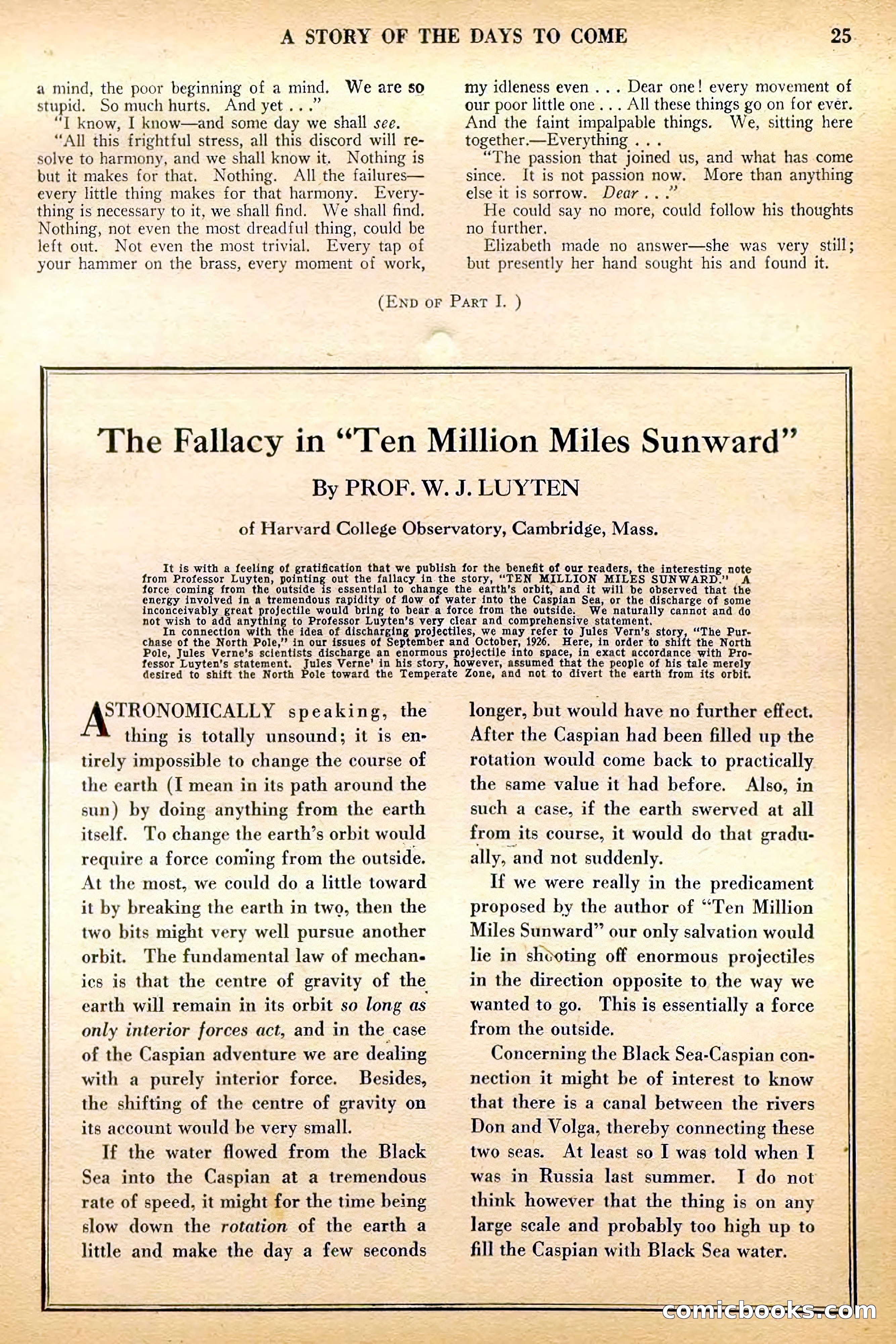
A restored page from Pulp Fiction, 1928. Page through the whole issue in the reader above.
📄 Transcribed text from this page (OCR, searchable)
Machine-transcribed from the original scan — historical spelling and the odd misread are preserved.
A STORY OF THE DAYS TO COME 25 a mind, the poor beginning of a mind. We are so stupid. So much hurts. And yet...” “T know, I know—and some day we shall see. “All this frightful stress, all this discord will re- solve to harmony, and we shall know it. Nothing is but it makes for that. Nothing. All the failures— every little thing makes for that harmony. Every- thing is necessary to it, we shall find. We shall find. Nothing, not even the most dreadful thing, could be left out. Not even the most trivial. Every tap of your hammer on the brass, every moment of work, my idleness even ... Dear one! every movement of our poor little one... All these things go on for ever. And the faint impalpable things. We, sitting here together.—Everything ... “The passion that joined us, and what has come since. It is not passion now. More than anything else it is sorrow. Dear...” He could say no more, could follow his thoughts no further, Elizabeth made no answer—she was very still; but presently her hand sought his and found it. (Enp or Part I. ) The Fallacy in “Ten Million Miles Sunward” By PROF. W. J. LUYTEN of Harvard College Observatory, Cambridge, Mass. It is with a feeling of gratification that we publish for the benefit of our readers, the interesting note from Professor Luyten, pone ae. out the fallacy in the story, “TEN MILLION MILES SUNWARD.” A force coming from the outside is essential to change the earth's orbit, and it will be observed that the energy involved in a tremendous rapidity of flow of water into the Caspian Sea, or the discharge of some inconceivably great pralec te would bring to bear a force from the outside. We naturally cannot and do not wish to add anything to Professor Luyten’s very clear and comprehensive statement, In connection with the idea of discharging projectiles, we may refer to Jules Vern’s story, “The Pur- chase of the North Pole,” in our issues of September and October, 1926, Here, in order to s. the North Pole, Jules Verne’s scientists discharge an enormous projectile into space, in exact accordance with Pro- fessor Luyten’s statement. Jules Verne’ in his story, however, assumed that the people of his tale merel desired to shift the North Pole toward the Temperate Zone, and not to divert the earth from its orbit. STRONOMICALLY speaking, the thing is totally unsound; it is en- tirely impossible to change the course of the earth (I mean in its path around the sun) by doing anything from the earth itself. To change the earth’s orbit would require a force coming from the outside. At the most, we could do a little toward it by breaking the earth in two, then the two bits might very well pursue another orbit. The fundamental law of mechan. ics is that the centre of gravity of the earth will remain in its orbit so long as only interior forces act, and in the case of the Caspian adventure we are dealing with a purely interior force. Besides, the shifting of the centre of gravity on its account would be very small. If the water flowed from the Black Sea into the Caspian at a tremendous rate of speed, it might for the time being slow down the rotation of the earth a little and make the day a few seconds longer, but would have no further effect. After the Caspian had been filled up the rotation would come back to practically the same value it had before. Also, in such a case, if the earth swerved at all from its course, it would do that gradu- ally, and not suddenly. If we were really in the predicament proposed by the author of “Ten Million Miles Sunward” our only salvation would lie in shooting off enormous projectiles in the direction opposite to the way we wanted to go. This is essentially a force from the outside. Concerning the Black Sea-Caspian con- nection it might be of interest to know that there is a canal between the rivers Don and Volga, thereby connecting these two seas. At least so I was told when I was in Russia last summer. I do not think however that the thing is on any large scale and probably too high up to fill the Caspian with Black Sea water. —= COmiGcDOCk