
Pulp Fiction, 1928 · page 18 of 99
Amazing Stories — page 18: what you’re looking at
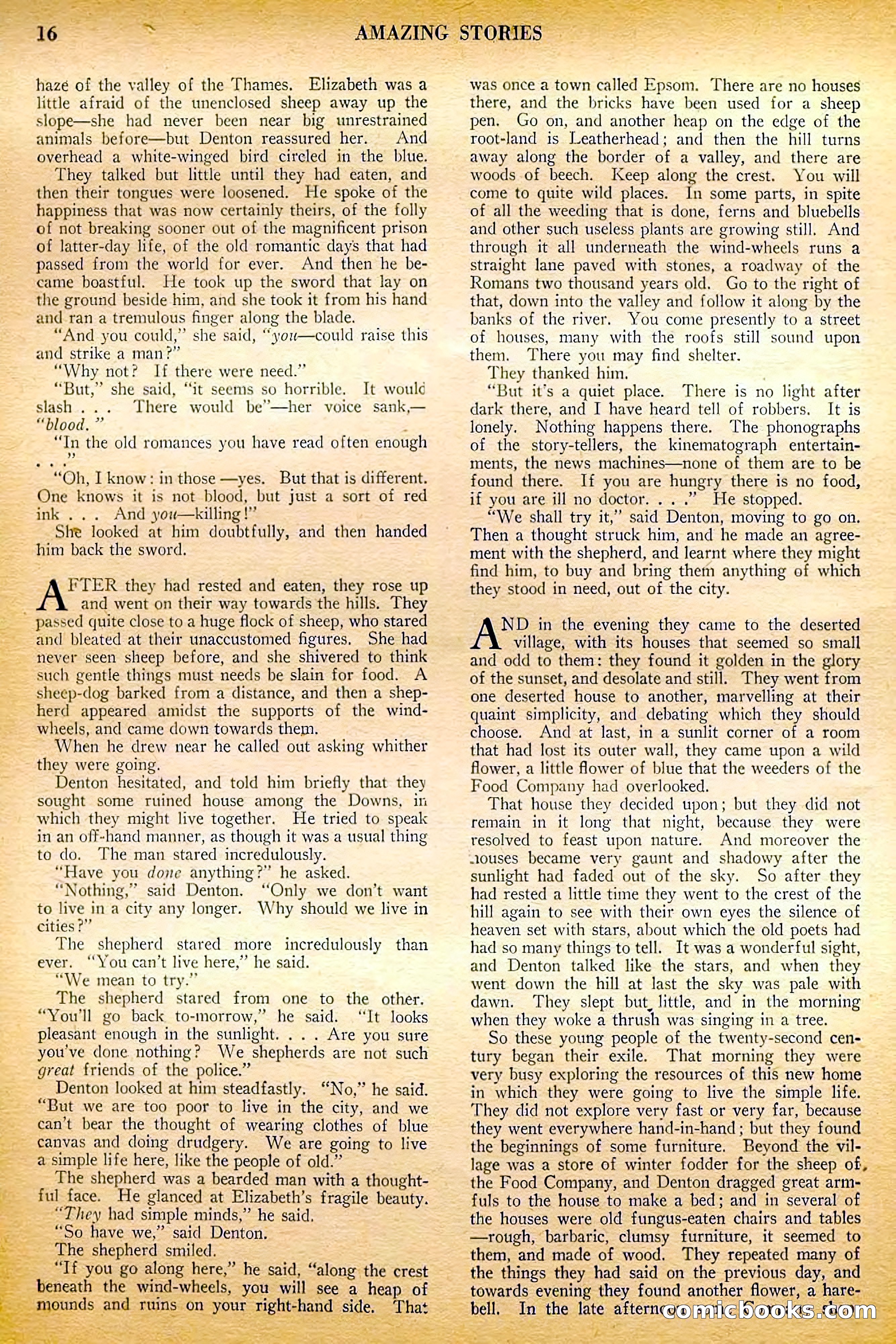
A restored page from Pulp Fiction, 1928. Page through the whole issue in the reader above.
📄 Transcribed text from this page (OCR, searchable)
Machine-transcribed from the original scan — historical spelling and the odd misread are preserved.
f NADAS Bit i iN b Nes ' ; ¥. : hazé of the valley of the Thames. Elizabeth was a little afraid of the unenclosed sheep away up the slope—she had never been near big unrestrained animals before—but Denton reassured her. And overhead a white-winged bird cireled in the blue. They talked but little until they had eaten, and then their tongues were loosened. He spoke of the happiness that was now certainly theirs, of the folly of not breaking sooner out of the magnificent prison of latter-day life, of the old romantic days that had passed from the world for ever. And then he be- came boastful. He took up the sword that lay on the ground beside him, and she took it from his hand and ran a tremulous finger along the blade. “And you could,” she said, “you—could raise this and strike a man?” “Why not? If there were need.” “But,” she said, “it seems so horrible. It would slash... There would be”’—her voice sank,— “blood, ” “In the old romances you have read often enough “Oh, I know: in those —yes. But that is different. One knows it is not blood, but just a sort of red ink... And you—killing !” She looked at him doubtfully, and then handed SS back the sword. FTER they had rested and eaten, they rose up and went on their way towards the hills. They ~~ passed quite close to a huge flock of sheep, who stared and bleated at their unaccustomed figures. She had never seen sheep before, and she shivered to think such gentle things must needs be slain for food. A _ sheep-dog barked from a distance, and then a shep- _ herd appeared amidst the supports of the wind- wheels, and came down towards them. When he drew near he called out asking whither they were going. ome —,- == -—% ne Denton hesitated, and told him briefly that they sought some ruined house among the Downs, in which they might live together. He tried to speak in an off-hand manner, as though it was a usual thing to do. The man stared incredulously. “Have you done anything?” he asked. “Nothing,” said Denton. “Only we don’t want to live in a city any longer. Why should we live in Cities ?” The shepherd stared more incredulously than ever. ‘You can’t live here,” he said. “We mean to try.” The shepherd stared from one to the other. “You'll go back to-morrow,” he said. “It looks pleasant enough in the sunlight. Are you sure you've done nothing ? We ‘shepherds are not such great friends of the police.” Denton looked at him steadfastly. “No,” he said. “But we are too poor to live in the city, and we can’t bear the thought of wearing clothes of blue canvas and doing drudgery. We are going to live a simple life here, like the people of old.” The shepherd was a bearded man with a thought- _ ful face. He glanced at Elizabeth’s fragile beauty. . See had simple minds,” he said, I oe 90° have we,” said Denton, : eet snuled.. was once a town called Epsom. There are no houses there, and the bricks have been used for a sheep pen. Go on, and another heap on the edge of the root-land is Leatherhead; and then the hill turns away along the border of a valley, and there are woods of beech. Keep along the crest. You will come to quite wild places. In some parts, in spite of all the weeding that is done, ferns and bluebells and other such useless plants are growing still. And through it all underneath the wind-wheels runs a straight lane paved with stones, a roadway of the Romans two thousand years old. Go to the right of that, down into the valley and follow it along by the banks of the river. You come presently to a street of houses, many with the roofs still sound upon them. There you may find shelter. They thanked him. “But it’s a quiet place. There is no light after dark there, and I have heard tell of robbers. It is lonely. Nothing happens there. The phonographs of the story-tellers, the kinematograph entertain- ments, the news machines—none of them are to be found there. If you are hungry there is no food, if you are ill no doctor... .” He stopped. “We shall try it,” said Denton, moving to go on. Then a thought struck him, and he made an agree- ment with the shepherd, and learnt where they might find him, to buy and bring them anything of which they stood in need, out of the city. ND in the evening they came to the deserted village, with its houses that seemed so small and odd to them: they found it golden in the glory of the sunset, and desolate and still. They went from one deserted house to another, marvelling at their quaint simplicity, and debating which they should choose. And at last, in a sunlit corner of a room that had lost its outer wall, they came upon a wild flower, a little flower of blue that the weeders of the Food Company had overlooked. That house they decided upon; but they did not remain in it long that night, because they were resolved to feast upon nature. And moreover the -louses became very gaunt and shadowy after the sunlight had faded out of the sky. So after they had rested a little time they went to the crest of the hill again to see with their own eyes the silence of heaven set with stars, about which the old poets had had so many things to tell. It was a wonderful sight, and Denton talked like the stars, and when they went down the hill at last the sky was pale with dawn. They slept but, little, and in the morning | when they woke a thrush was singing in a tree. So these young people of the twenty-second cen- tury began their exile. That morning they were very busy exploring the resources of this new home in which they were going to live the simple life. They did not explore very fast or very far, because they went everywhere hand-in-hand; but they found the beginnings of some furniture. ‘Beyond the vil- lage was a store of winter fodder for the sheep of, the Food Company, and Denton dragged great arm- fuls to the house to make a bed; and in several of — the houses were old fungus-eaten chairs and tables — = -—rough, barbaric, clumsy furniture, it seemed to_ Ss them, and made of. wood. They repeated many 0 the Cos eae had said on the previous day, and | they f found another fla