
Pulp Fiction, 1928 · page 15 of 99
Amazing Stories — page 15: what you’re looking at
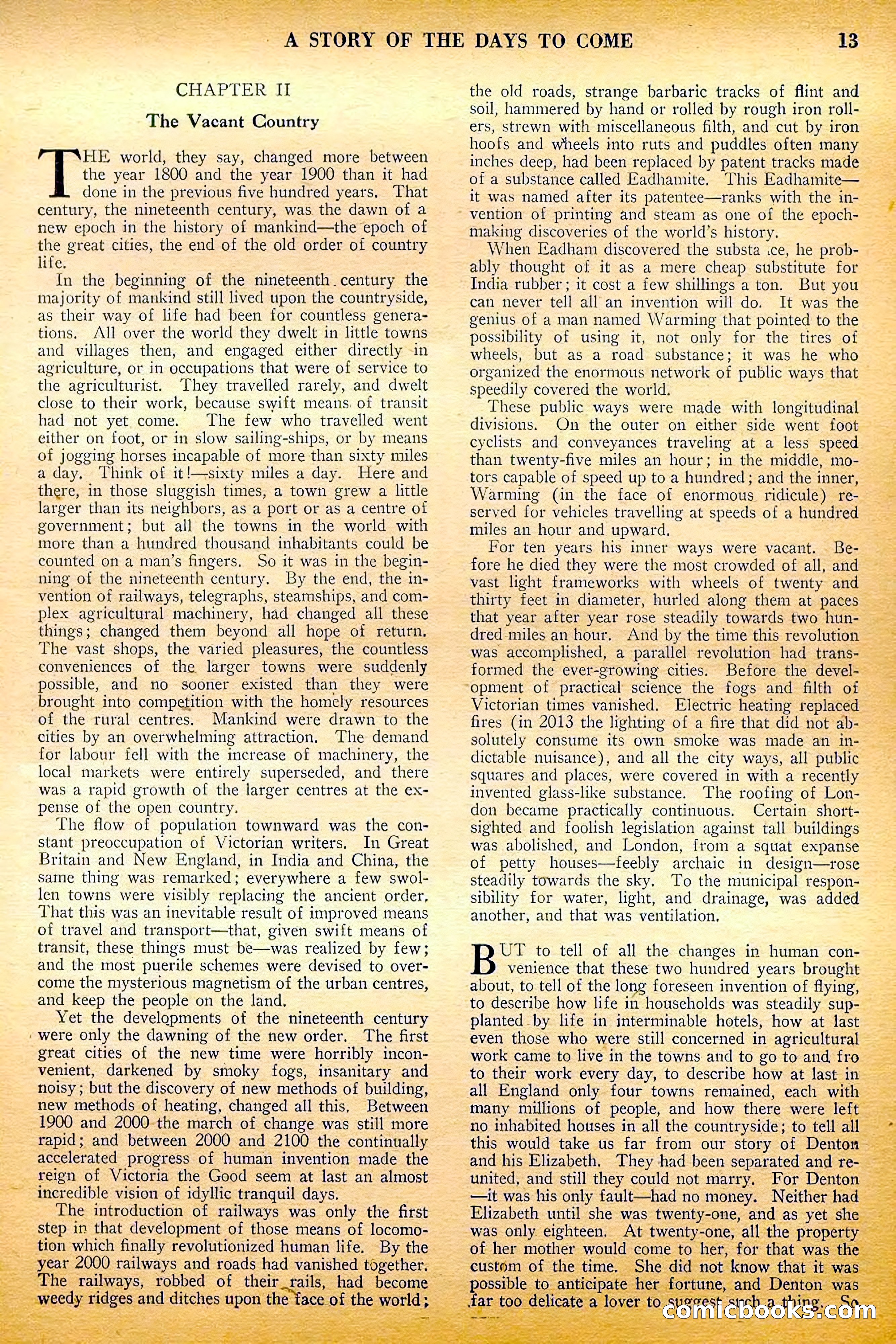
A restored page from Pulp Fiction, 1928. Page through the whole issue in the reader above.
📄 Transcribed text from this page (OCR, searchable)
Machine-transcribed from the original scan — historical spelling and the odd misread are preserved.
CHAPTER II The Vacant Country the year 1800 and the year 1900 than it had done in the previous five hundred years. That century, the nineteenth century, was the dawn of a new epoch in the history of mankind—the epoch of the great cities, the end of the old order of country life. In the beginning of the nineteenth century the majority of mankind still lived upon the countryside, as their way of life had been for countless genera- tions. All over the world they dwelt in little towns and villages then, and engaged either directly -in agriculture, or in occupations that were of service to the agriculturist. They travelled rarely, and dwelt close to their work, because swift means. of transit had not yet come. The few who travelled went either on foot, or in slow sailing-ships, or by means of jogging horses incapable of more than sixty miles a day. Think of it!—sixty miles a day. Here and there, in those sluggish times, a town grew a little larger than its neighbors, as a port or as a centre of government; but all the towns in the world with more than a hundred thousand inhabitants could be counted on a man’s fingers. So it was in the begin- ning of the nineteenth century. By the end, the in- vention of railways, telegraphs, steamships, and com- plex agricultural machinery, had changed all these things; changed them beyond all hope of return. The vast shops, the varied pleasures, the countless conveniences of the larger towns were suddenly possible, and no sooner existed than they were brought into competition with the homely resources of the rural centres, Mankind were drawn to the cities by an overwhelming attraction. The demand for labour fell with the increase of machinery, the local markets were entirely superseded, and there was a rapid growth of the larger centres at the ex- pense of the open country. The flow of population townward was the con- stant preoccupation of Victorian writers. In Great Britain and New England, in India and China, the same thing was remarked; everywhere a few swol- len towns were visibly replacing the ancient order, That this was an inevitable result of improved means of travel and transport—that, given swift means of transit, these things must be—was realized by few; and the most puerile schemes were devised to over- come the mysterious magnetism of the urban centres, and keep the people on the land. Yet the developments of the nineteenth century - were only the dawning of the new order. The first great cities of the new time were horribly incon- venient, darkened by smoky fogs, insanitary and noisy ; but the discovery of new methods of building, new methods of heating, changed all this, Between 1900 and 2000-the march of change was still more rapid; and between 2000 and 2100 the continually accelerated progress of human invention made the _ reign of Victoria the Good seem at last an almost “incredible vision of idyllic tranquil days. The introduction of railways was only the first step in that development of those means of locomo- on une finally pevoniueniged human life. "Tite world, they say, changed more between the old roads, strange barbaric tracks of flint and soil, hammered by hand or rolled by rough iron roll- ers, strewn with miscellaneous filth, and cut by iron hoofs and wheels into ruts and puddles often many inches deep, had been replaced by patent tracks made — of a substance called Hadhamite. making discoveries of the world’s history. When Eadham discovered the substa .ce, he prob- ably thought of it as a mere cheap substitute for India rubber ; it cost a few shillings a ton. But you can never tell all an invention will do. It was the genius of a man named Warming that pointed to the possibility of using it, not only for the tires of wheels, but as a road substance; it was he who This Eadhamite— it was named after its patentee—ranks with the ne ~ vention of printing and steam as one of the epoch- — ies Ard organized the enormous network of public ways that — speedily covered the world. These public ways were made with longitudinal divisions. On the outer on either side went foot cyclists and conveyances traveling at a less oe than twenty-five miles an hour; in the middle, mo-_ tors capable of speed up to a hundred; and the inner, Warming (in the face of enormous ridicule) ae served for vehicles tr avelling at speeds of a hundred | miles an hour and upward. For ten years his inner ways were vacant. fore he died they were the most crowded of all, and — vast light frameworks with wheels of twenty and thirty feet in diameter, hurled along them at paces — that year after year rose steadily towards two hun-— dred miles an hour, And by the time this revolution > 7a a 2 was accomplished, a parallel revolution had trans- formed the ever-growing cities. Before the devel- “opment of practical science the fogs and filth of © Victorian times vanished. Electric heating replaced fires (in 2013 the lighting of a fire that did not ab- solutely consume its own smoke was made an in- dictable nuisance), and all the city ways, all public squares and places, were covered in with a recently invented glass-like substance. The roofing of Lon- don became practically continuous. Certain short- sighted and foolish legislation against tall buildings was abolished, and London, from a squat expanse of petty houses—feebly archaic in design—rose steadily towards the sky, To the municipal respon- sibility for water, light, and drainage, was added another, and that was ventilation. UT to tell of all the changes in human con- venience that these two hundred years brought about, to tell of the long foreseen invention of flying, planted by life in interminable hotels, how at last even those who were still concerned in agricultural _ wal soe to describe how life in households was steadily sup-— es == work came to live in the towns and to go to and fro to their work every day, to describe how at last all England only four towns remained, each many millions of people, and how there were no inhabited houses in all the countryside; to tel al this would take us far from our story of D ton and his Elizabeth. They had been separated an united, and still ae could not marr ae For Dento