
Pulp Fiction, 1927 · page 88 of 107
Amazing Stories, August 1927 — page 88: what you’re looking at
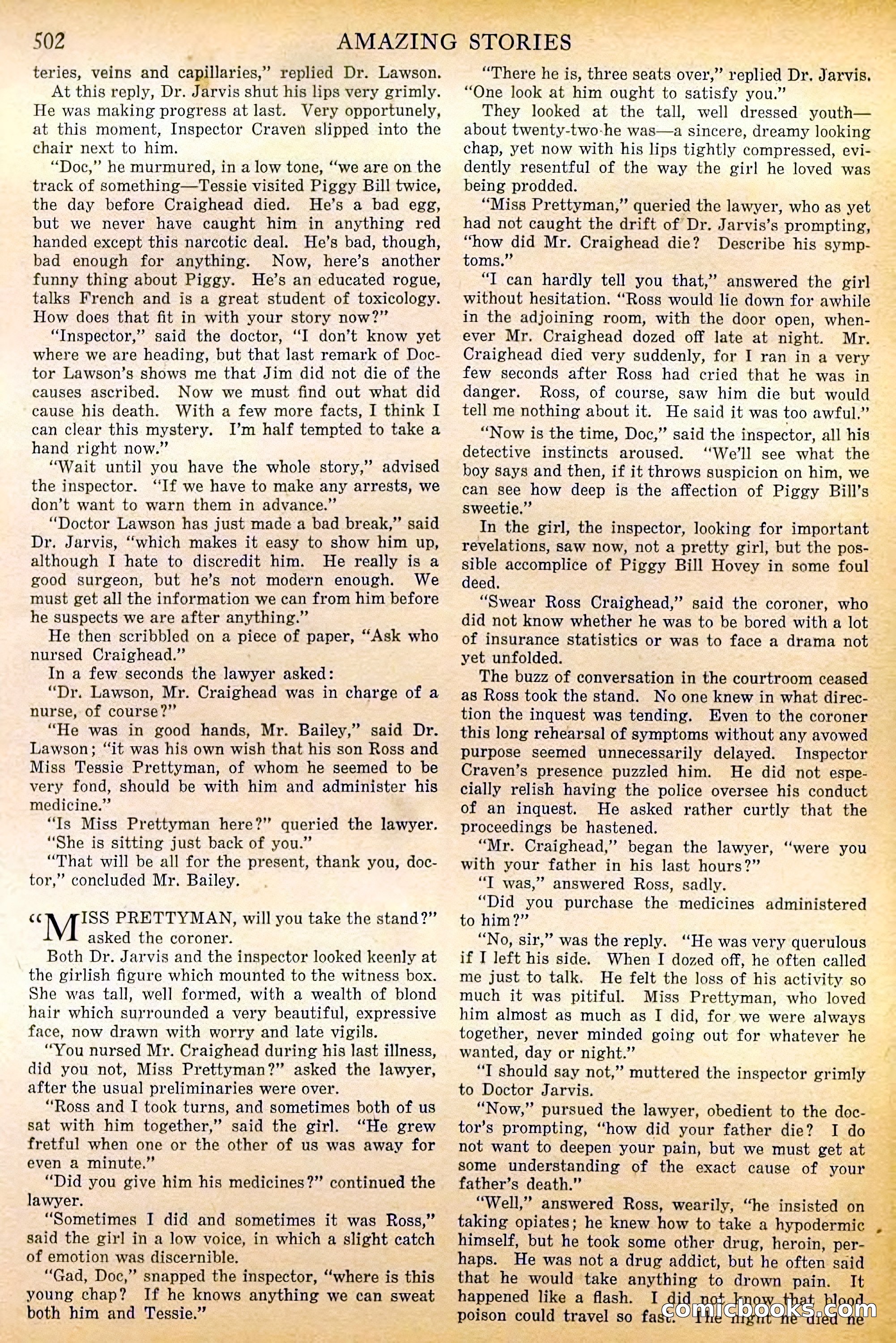
A restored page from Pulp Fiction, 1927. Page through the whole issue in the reader above.
📄 Transcribed text from this page (OCR, searchable)
Machine-transcribed from the original scan — historical spelling and the odd misread are preserved.
502 teries, veins and capillaries,” replied Dr. Lawson. At this reply, Dr. Jarvis shut his lips very grimly. He was making progress at last. Very opportunely, at this moment, Inspector Craven slipped into the chair next to him. “Doc,” he murmured, in a low tone, “we are on the track of something—Tessie visited Piggy Bill twice, the day before Craighead died. He’s a bad egg, but we never have caught him in anything red handed except this narcotic deal. He’s bad, though, bad enough for anything. Now, here’s another funny thing about Piggy. He’s an educated rogue, talks French and is a great student of toxicology. How does that fit in with your story now?” “Inspector,” said the doctor, “I don’t know yet where we are heading, but that last remark of Doc- tor Lawson’s shows me that Jim did not die of the causes ascribed. Now we must find out what did cause his death. With a few more facts, I think I can clear this mystery. I’m half tempted to take a hand right now.” “Wait until you have the whole story,” advised the inspector. “If we have to make any arrests, we don’t want to warn them in advance.” “Doctor Lawson has just made a bad break,”’ said Dr. Jarvis, ‘which makes it easy to show him up, although I hate to discredit him. He really is a good surgeon, but he’s not modern enough. We must get all the information we can from him before he suspects we are after anything.” He then scribbled on a piece of paper, “Ask who nursed Craighead.” In a few seconds the lawyer asked: “Dy. Lawson, Mr. Craighead was in charge of a nurse, of course?” “He was in good hands, Mr. Bailey,” said Dr. Lawson; “it was his own wish that his son Ross and Miss Tessie Prettyman, of whom he seemed to be very fond, should be with him and administer his medicine.” “Ts Miss Prettyman here?’’ queried the lawyer. “She is sitting just back of you.” “That will be all for the present, thank you, doc- tor,” concluded Mr. Bailey. <9 ISS PRETTYMAN, will you take the stand?” asked the coroner. Both Dr. Jarvis and the inspector looked keenly at the girlish figure which mounted to the witness box. She was tall, well formed, with a wealth of blond hair which surrounded a very beautiful, expressive face, now drawn with worry and late vigils. “You nursed Mr. Craighead during his last illness, did you not, Miss Prettyman?” asked the lawyer, after the usual preliminaries were over. “Ross and I took turns, and sometimes both of us sat with him together,” said the girl. “He grew fretful when one or the other of us was away for even a minute.” “Did you give him his medicines?” continued the lawyer. “Sometimes I did and sometimes it was Ross,” said the girl in a low voice, in which a slight catch of emotion was discernible. “Gad, Doc,” snapped the inspector, “where is this young chap? If he knows anything we can sweat both him and Tessie.” “There he is, three seats over,” replied Dr. Jarvis, “One look at him ought to satisfy you.” They looked at the tall, well dressed youth— chap, yet now with his lips tightly compressed, evi- dently resentful of the way the girl he loved was being prodded. “Miss Prettyman,” queried the lawyer, who as yet had not caught the drift of Dr. Jarvis’s prompting, “how did Mr. Craighead die? Describe his symp- toms.” “T can hardly tell you that,’ answered the girl without hesitation. “Ross would lie down for awhile in the adjoining room, with the door open, when- ever Mr. Craighead dozed off late at night. Mr. Craighead died very suddenly, for I ran in a very few seconds after Ross had cried that he was in danger. Ross, of course, saw him die but would tell me nothing about it. He said it was too awful.” “Now is the time, Doc,” said the inspector, all his detective instincts aroused. ‘‘We’ll see what the boy says and then, if it throws suspicion on him, we can see how deep is the affection of Piggy Bill’s sweetie.” In the girl, the inspector, looking for important revelations, saw now, not a pretty girl, but the pos- sible accomplice of Piggy Bill Hovey in some foul deed. “Swear Ross Craighead,” said the coroner, who did not know whether he was to be bored with a lot of insurance statistics or was to face a drama not yet unfolded. The buzz of conversation in the courtroom ceased as Ross took the stand. No one knew in what direc- tion the inquest was tending. Even to the coroner this long rehearsal of symptoms without any avowed purpose seemed unnecessarily delayed. Inspector Craven’s presence puzzled him. He did not espe- cially relish having the police oversee his conduct of an inquest. He asked rather curtly that the proceedings be hastened. “Mr. Craighead,” began the lawyer, with your father in his last hours?” “T was,” answered Ross, sadly. “Did you purchase the medicines administered to him?” “No, sir,” was the reply. ‘He was very querulous if I left his side. When I dozed off, he often called me just to talk. He felt the loss of his activity so much it was pitiful. Miss Prettyman, who loved him almost as much as I did, for we were always together, never minded going out for whatever he wanted, day or night.” “T should say not,” muttered the inspector grimly to Doctor Jarvis. “Now,” pursued the lawyer, obedient to the doc- tor’s prompting, “how did your father die? I do not want to deepen your pain, but we must get at some understanding of the exact cause of your father’s death.” “Well,” answered Ross, wearily, “he insisted on taking opiates; he knew how to take a hypodermic “were you himself, but he took some other drug, heroin, per- haps. He was not a drug addict, but he often sai that he would take anything to drown pain. — happened like a flash. 0 a poison could: travel : so fa AMAZING STORIES 2 3