
Pulp Fiction, 1927 · page 85 of 107
Amazing Stories, August 1927 — page 85: what you’re looking at
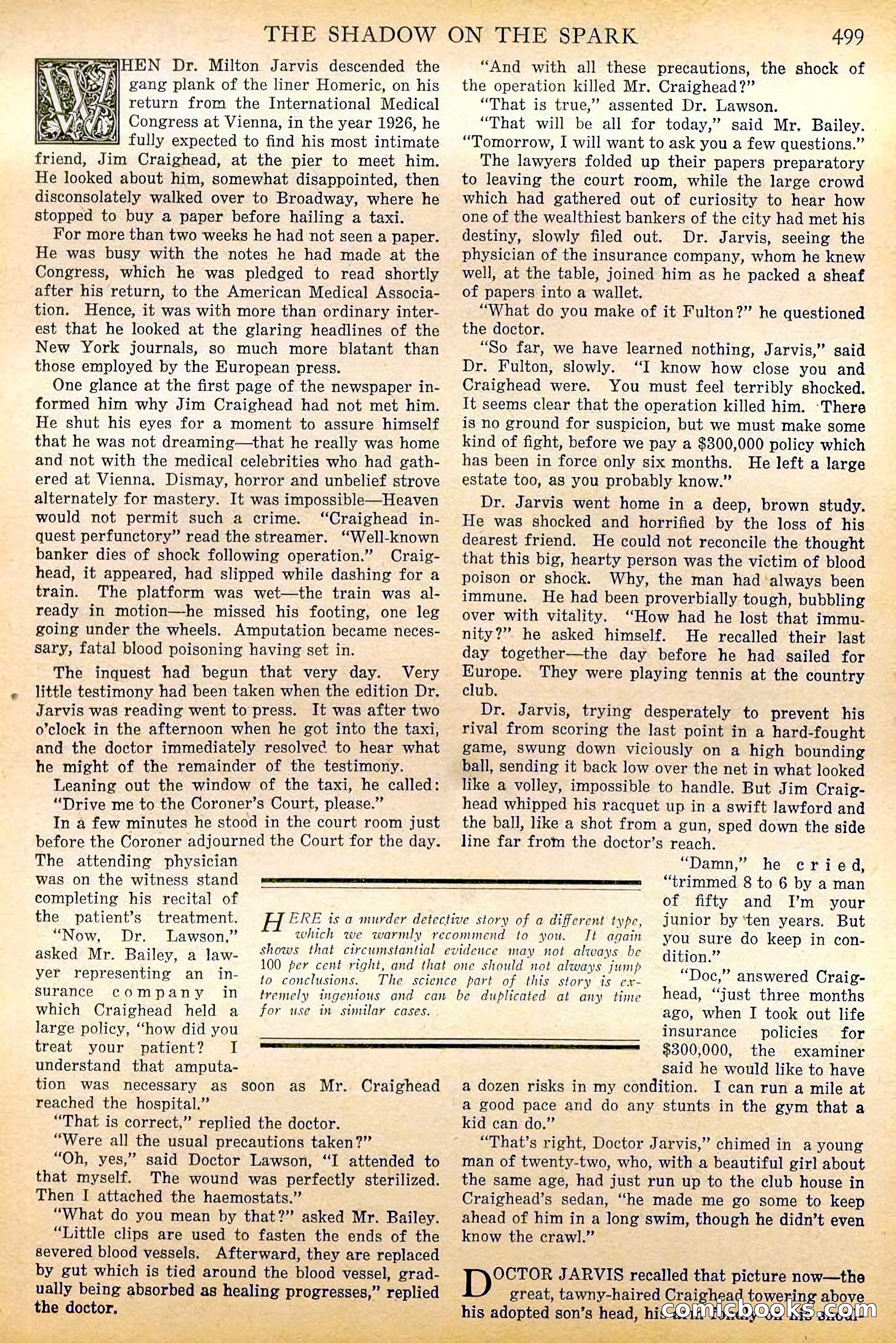
A restored page from Pulp Fiction, 1927. Page through the whole issue in the reader above.
📄 Transcribed text from this page (OCR, searchable)
Machine-transcribed from the original scan — historical spelling and the odd misread are preserved.
ee THE SHADOW ON THE SPARK “HEN Dr. Milton Jarvis descended the gang plank of the liner Homeric, on his 4) return from the International Medical Congress at Vienna, in the year 1926, he : fully expected to find his most intimate friend, Jim Craighead, at the pier to meet him. He looked about him, somewhat disappointed, then disconsolately walked over to Broadway, where he stopped to buy a paper before hailing a taxi. For more than two weeks he had not seen a paper. He was busy with the notes he had made at the Congress, which he was pledged to read shortly after his return, to the American Medical Associa- tion. Hence, it was with more than ordinary inter- est that he looked at the glaring headlines of the New York journals, so much more blatant than those employed by the European press. One glance at the first page of the newspaper in- formed him why Jim Craighead had not met him. He shut his eyes for a moment to assure himself that he was not dreaming—that he really was home and not with the medical celebrities who had gath- ered at Vienna. Dismay, horror and unbelief strove alternately for mastery. It was impossible—Heaven would not permit such a crime. ‘Craighead in- quest perfunctory” read the streamer. ‘Well-known banker dies of shock following operation.” Craig- head, it appeared, had slipped while dashing for a train. The platform was wet—the train was al- ready in motion—he missed his footing, one leg going under the wheels. Amputation became neces- sary, fatal blood poisoning having set in. The inquest had begun that very day. Very little testimony had been taken when the edition Dr, Jarvis was reading went to press. It was after two o’clock in the afternoon when he got into the taxi, and the doctor immediately resolved to hear what he might of the remainder of the testimony. Leaning out the window of the taxi, he called: “Drive me to the Coroner’s Court, please.” In a few minutes he stood in the court room just before the Coroner adjourned the Court for the day. The attending physician was on the witness stand LL LS PETES ES YE SEE EI 499 “And with all these precautions, the shock of the operation killed Mr. Craighead?” “That is true,” assented Dr. Lawson. “That will be all for today,” said Mr. Bailey. “Tomorrow, I will want to ask you a few questions.” The lawyers folded up their papers preparatory to leaving the court room, while the large crowd which had gathered out of curiosity to hear how one of the wealthiest bankers of the city had met his destiny, slowly filed out. Dr. Jarvis, seeing the physician of the insurance company, whom he knew well, at the table, joined him as he packed a sheaf of papers into a wallet. “What do you make of it Fulton?” he questioned the doctor. “So far, we have learned nothing, Jarvis,” said Dr. Fulton, slowly. “I know how close you and Craighead were. You must feel terribly shocked. It seems clear that the operation killed him. ‘There is no ground for suspicion, but we must make some kind of fight, before we pay a $300,000 policy which has been in force only six months. He left a large estate too, as you probably know.” Dr. Jarvis went home in a deep, brown study. He was shocked and horrified by the loss of his dearest friend. He could not reconcile the thought that this big, hearty person was the victim of blood poison or shock. Why, the man had ‘always been immune. He had been proverbially tough, bubbling over with vitality. “How had he lost that immu- nity?” he asked himself. He recalled their last day together—the day before he had sailed for Europe. They were playing tennis at the country club, Dr. Jarvis, trying desperately to prevent his rival from scoring the last point in a hard-fought game, swung down viciously on a high bounding ball, sending it back low over the net in what looked like a volley, impossible to handle. But Jim Craig- head whipped his racquet up in a swift lawford and the ball, like a shot from a gun, sped down the side line far from the doctor’s reach. “Damn,” he cried, “trimmed 8 to 6 by a man completing his recital of the patient’s treatment. “Now, Dr. Lawson,” asked Mr. Bailey, a law- yer representing an in- surance company in which Craighead held a large policy, ‘how did you treat your patient? I understand that amputa- tion was necessary as soon as Mr.. Craighead reached the hospital.” “That is correct,” replied the doctor. “Were all the usual precautions taken?” “Oh, yes,” said Doctor Lawson, “I attended to that myself. The wound was perfectly sterilized. Then I attached the haemostats.” “What do you mean by that?” asked Mr. Bailey. “Little clips are used to fasten the ends of the severed blood vessels. Afterward, they are replaced by gut which is tied around the blood vessel, grad- ually being absorbed as healing progresses,” replied the doctor. to conclusions. for use in similar cases. ERE is a murder detective story of a different type, which we warmly recommend to you. shows that circumstantial evidence may not always be 100 per cent right, and that one should not always jump The science part of this story is ex- tremely ingenious and can be duplicated at any time — EE eee ee a RT of fifty and I’m your junior by ‘ten years. But you sure do keep in con- dition.” “Doc,” answered Craig- head, “just three months ago, when I took out life insurance policies for $300,000, the examiner said he would like to have a dozen risks in my condition. I can run a mile at a good pace and do any stunts in the gym that a kid can do.” “That’s right, Doctor Jarvis,” chimed in a young man of twenty-two, who, with a beautiful girl about the same age, had just run up to the club house in Craighead’s sedan, “he made me go some to keep ahead of him in a long swim, though he didn’t even know the crawl.” It again De JARVIS recalled that picture now—the great, tawny-haired Crai d towering above his adopted son’s head, hi{42441 choo ~COln é te ipe e