
Pulp Fiction, 1927 · page 76 of 107
Amazing Stories, August 1927 — page 76: what you’re looking at
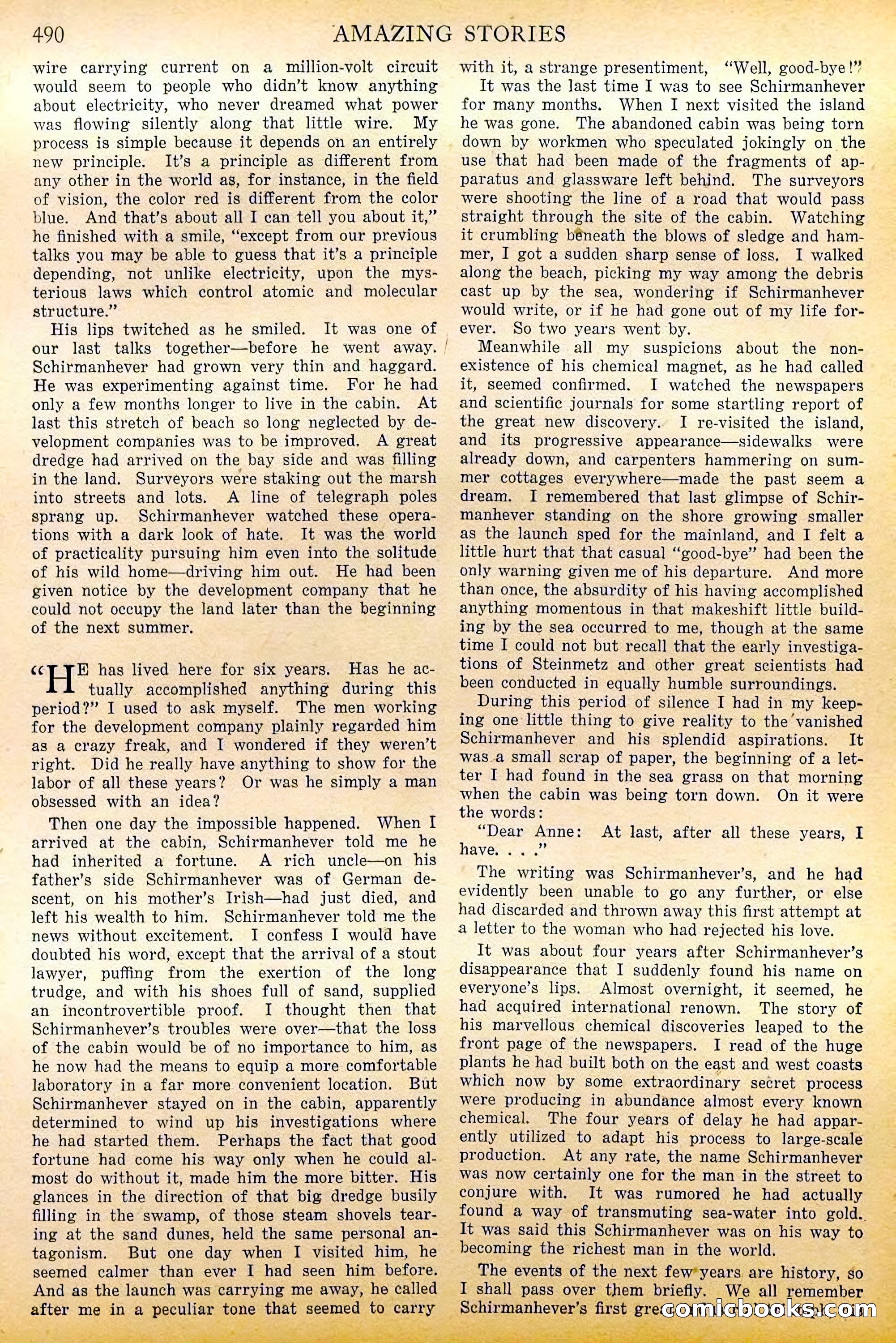
A restored page from Pulp Fiction, 1927. Page through the whole issue in the reader above.
📄 Transcribed text from this page (OCR, searchable)
Machine-transcribed from the original scan — historical spelling and the odd misread are preserved.
490 wire carrying current on a million-volt circuit would seem to people who didn’t know anything about electricity, who never dreamed what power was flowing silently along that little wire. My process is simple because it depends on an entirely new principle. It’s a principle as different from any other in the world as, for instance, in the field of vision, the color red is different from the color blue. And that’s about all I can tell you about it,” he finished with a smile, “except from our previous talks you may be able to guess that it’s a principle depending, not unlike electricity, upon the mys- terious laws which control atomic and molecular structure.” His lips twitched as he smiled. It was one of our last talks together—before he went away. Schirmanhever had grown very thin and haggard. He was experimenting against time. For he had only a few months longer to live in the cabin. At last this stretch of beach so long neglected by de- velopment companies was to be improved. A great dredge had arrived on the bay side and was filling in the land. Surveyors were staking out the marsh into streets and lots. A line of telegraph poles sprang up. Schirmanhever watched these opera- tions with a dark look of hate. It was the world of practicality pursuing him even into the solitude of his wild home—driving him out. He had been given notice by the development company that he could not occupy the land later than the beginning of the next summer. « FE has lived here for six years. Has he ac- tually accomplished anything during this period?” I used to ask myself. The men working for the development company plainly regarded him as a crazy freak, and I wondered if they weren’t right. Did he really have anything to show for the labor of all these years? Or was he simply a man obsessed with an idea? Then one day the impossible happened. When I arrived at the cabin, Schirmanhever told me he had inherited a fortune. A rich uncle—on his father’s side Schirmanhever was of German de- scent, on his mother’s Irish—had just died, and left his wealth to him. Schirmanhever told me the news without excitement. I confess I would have doubted his word, except that the arrival of a stout lawyer, puffing from the exertion of the long trudge, and with his shoes full of sand, supplied an incontrovertible proof. I thought then that Schirmanhever’s troubles were over—that the loss of the cabin would be of no importance to him, as he now had the means to equip a more comfortable laboratory in a far more convenient location. But Schirmanhever stayed on in the cabin, apparently determined to wind up his investigations where he had started them. Perhaps the fact that good fortune had come his way only when he could al- most do without it, made him the more bitter. His glances in the direction of that big dredge busily filling in the swamp, of those steam shovels tear- ing at the sand dunes, held the same personal an- tagonism. But one day when I visited him, he seemed calmer than ever I had seen him before. And as ane launch was carrying me awa) \ AMAZING STORIES with it, a strange presentiment, ‘Well, good-bye!’ It was the last time I was to see Schirmanhever for many months. When I next visited the island he was gone. The abandoned cabin was being torn down by workmen who speculated jokingly on the use that had been made of the fragments of ap- paratus and glassware left behind. The surveyors were shooting the line of a road that would pass straight through the site of the cabin. Watching it crumbling béneath the blows of sledge and ham- mer, I got a sudden sharp sense of loss, I walked along the beach, picking my way among the debris cast up by the sea, wondering if Schirmanhever would write, or if he had gone out of my life for- ever. So two years went by. Meanwhile all my suspicions about the non- existence of his chemical magnet, as he had called it, seemed confirmed. I watched the newspapers and scientific journals for some startling report of the great new discovery. I re-visited the island, and its progressive appearance—sidewalks were already down, and carpenters hammering on sum- mer cottages everywhere—made the past seem a dream. I remembered that last glimpse of Schir- manhever standing on the shore growing smaller as the launch sped for the mainland, and I felt a little hurt that that casual “good-bye” had been the only warning given me of his departure. And more than once, the absurdity of his having accomplished anything momentous in that makeshift little build- ing by the sea occurred to me, though at the same time I could not but recall that the early investiga- tions of Steinmetz and other great scientists had been conducted in equally humble surroundings. During this period of silence I had in my keep- ing one little thing to give reality to the vanished Schirmanhever and his splendid aspirations. It was.a small scrap of paper, the beginning of a let- ter I had found in the sea grass on that morning when the cabin was being torn down. On it were the words: “Dear Anne: At last, after all these years, I haves oc The writing was Schirmanhever’s, and he had evidently been unable to go any further, or else had discarded and thrown away this first attempt at a letter to the woman who had rejected his love. It was about four years after Schirmanhever’s disappearance that I suddenly found his name on everyone’s lips. Almost overnight, it seemed, he had acquired international renown. The story of his marvellous chemical discoveries leaped to the front page of the newspapers. I read of the huge plants he had built both on the east and west coasts which now by some extraordinary secret process were producing in abundance almost every known chemical. The four years of delay he had appar- ently utilized to adapt his process to large-scale production. At any rate, the name Schirmanhever was now certainly one for the man in the street to conjure with. It was rumored he had actually found a way of transmuting sea-water into gold. It was said this Schirmanhever was on his way to becoming the richest man in the world. The events of the next few*years are history, so “ANE: shall ‘pass over the briefly. We all (Sees