
Pulp Fiction, 1927 · page 64 of 107
Amazing Stories, August 1927 — page 64: what you’re looking at
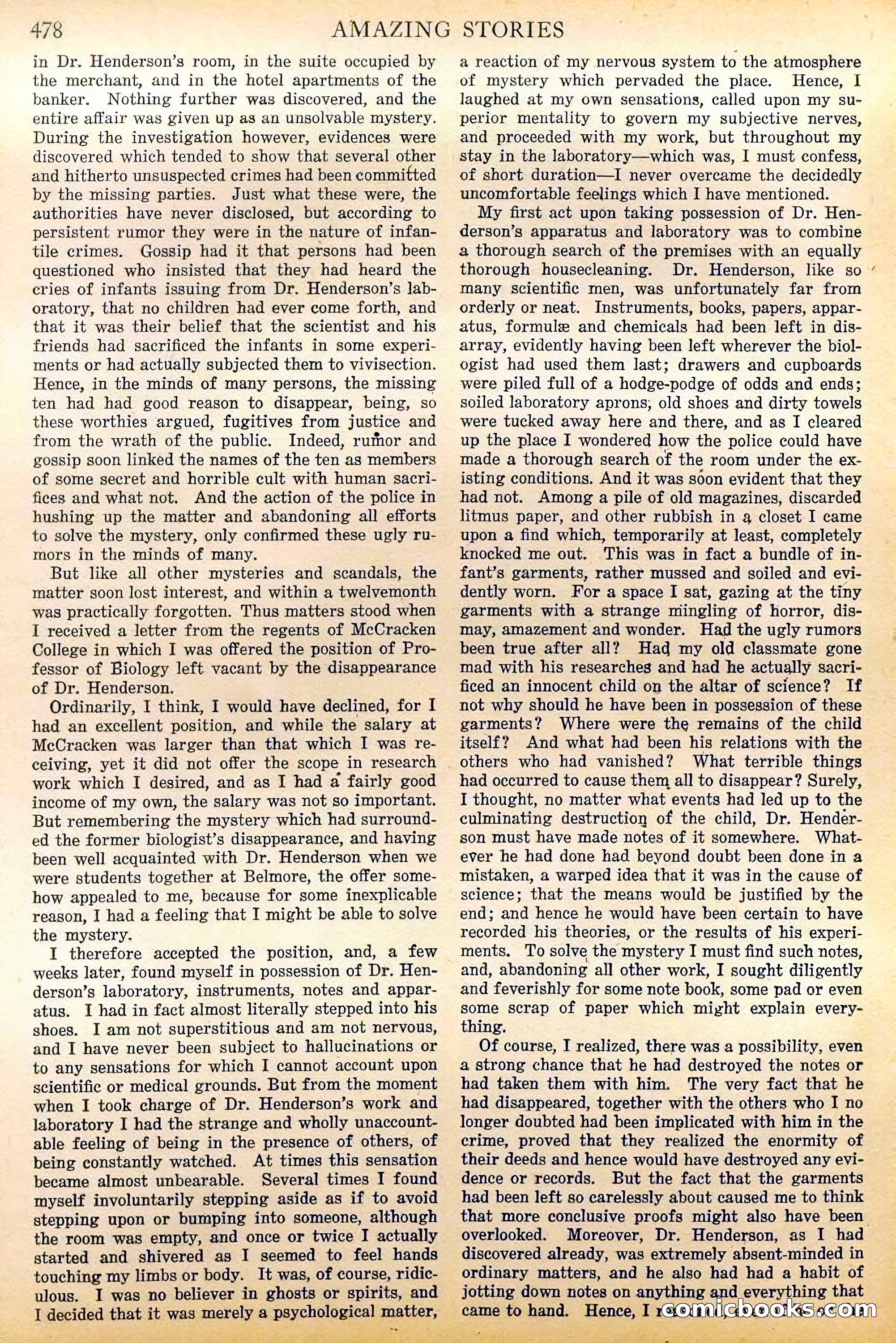
A restored page from Pulp Fiction, 1927. Page through the whole issue in the reader above.
📄 Transcribed text from this page (OCR, searchable)
Machine-transcribed from the original scan — historical spelling and the odd misread are preserved.
478 in Dr. Henderson’s room, in the suite occupied by the merchant, and in the hotel apartments of the banker. Nothing further was discovered, and the entire affair was given up as an unsolvable mystery. During the investigation however, evidences were discovered which tended to show that several other and hitherto unsuspected crimes had been committed by the missing parties. Just what these were, the authorities have never disclosed, but according to persistent rumor they were in the nature of infan- tile crimes. Gossip had it that persons had been questioned who insisted that they had heard the eries of infants issuing from Dr. Henderson’s lab- oratory, that no children had ever come forth, and that it was their belief that the scientist and his friends had sacrificed the infants in some experi- ments or had actually subjected them to vivisection. Hence, in the minds of many persons, the missing ten had had good reason to disappear, being, so these worthies argued, fugitives from justice and from the wrath of the public. Indeed, rumor and gossip soon linked the names of the ten as members of some secret and horrible cult with human sacri- fices and what not. And the action of the police in hushing up the matter and abandoning all efforts to solve the mystery, only confirmed these ugly ru- mors in the minds of many. But like all other mysteries and scandals, the matter soon lost interest, and within a twelvemonth was practically forgotten. Thus matters stood when I received a letter from the regents of McCracken College in which I was offered the position of Pro- fessor of Biology left vacant by the disappearance of Dr. Henderson. Ordinarily, I think, I would have declined, for I had an excellent position, and while the salary at McCracken was larger than that which I was re- ceiving, yet it did not offer the scope in research work which I desired, and as I had a fairly good income of my own, the salary was not so important, But remembering the mystery which had surround- ed the former biologist’s disappearance, and having been well acquainted with Dr. Henderson when we were students together at Belmore, the offer some- how appealed to me, because for some inexplicable reason, I had a feeling that I might be able to solve the mystery. I therefore accepted the position, and, a few weeks later, found myself in possession of Dr. Hen- derson’s laboratory, instruments, notes and appar- atus. I had in fact almost literally stepped into his shoes. I am not superstitious and am not nervous, and I have never been subject to hallucinations or to any sensations for which I cannot account upon scientific or medical grounds. But from the moment when I took charge of Dr. Henderson’s work and laboratory I had the strange and wholly unaccount- able feeling of being in the presence of others, of being constantly watched. At times this sensation became almost unbearable. Several times I found myself involuntarily stepping aside as if to avoid stepping upon or bumping into someone, although the room was empty, and once or twice I actually started and shivered as I seemed to feel hands touching my limbs or body. It was, of course, ridic- ulous. I was no believer in ghosts or spirits, and I decided that it was merely a psychological matter, AMAZING STORIES a reaction of my nervous system to the atmosphere of mystery which pervaded the place. Hence, I laughed at my own sensations, called upon my su- perior mentality to govern my subjective nerves, and proceeded with my work, but throughout my stay in the laboratory—which was, I must confess, of short duration—I never overcame the decidedly uncomfortable feelings which I have mentioned. My first act upon taking possession of Dr. Hen- derson’s apparatus and laboratory was to combine a thorough search of the premises with an equally thorough housecleaning, Dr. Henderson, like so many scientific men, was unfortunately far from orderly or neat. Instruments, books, papers, appar- atus, formule and chemicals had been left in dis- array, evidently having been left wherever the biol- ogist had used them last; drawers and cupboards were piled full of a hodge-podge of odds and ends; soiled laboratory aprons, old shoes and dirty towels were tucked away here and there, and as I cleared up the place I wondered how the police could have made a thorough search of the room under the ex- isting conditions. And it was soon evident that they had not. Among a pile of old magazines, discarded litmus paper, and other rubbish in a closet I came upon a find which, temporarily at least, completely knocked me out. This was in fact a bundle of in- fant’s garments, rather mussed and soiled and evi- dently worn. For a space I sat, gazing at the tiny garments with a strange mingling of horror, dis- may, amazement and wonder. Had the ugly rumors been true after all? Had my old classmate gone mad with his researches and had he actually sacri- ficed an innocent child on the altar of science? If not why should he have been in possession of these garments? Where were the remains of the child itself? And what had been his relations with the others who had vanished? What terrible things had occurred to cause them all to disappear? Surely, I thought, no matter what events had led up to the culminating destruction of the child, Dr. Hender- son must have made notes of it somewhere. What- ever he had done had beyond doubt been done in a mistaken, a warped idea that it was in the cause of science; that the means would be justified by the end; and hence he would have been certain to have recorded his theories, or the results of his experi- ments. To solve the mystery I must find such notes, and, abandoning all other work, I sought diligently and feverishly for some note book, some pad or even some scrap of paper which might explain every- thing. Of course, I realized, there was a possibility, even a strong chance that he had destroyed the notes or had taken them with him. The very fact that he had disappeared, together with the others who I no longer doubted had been implicated with him in the crime, proved that they realized the enormity of their deeds and hence would have destroyed any evi- dence or records. But the fact that the garments had been left so carelessly about caused me to think that more conclusive proofs might also have been overlooked. Moreover, Dr. Henderson, as I had discovered already, was extremely absent-minded in ordinary matters, and he also had had a habit of jotting down notes on anything and everything that came to hand. Henee, I xaisYiiasveolSscOun) — +