
Pulp Fiction, 1927 · page 45 of 107
Amazing Stories, August 1927 — page 45: what you’re looking at
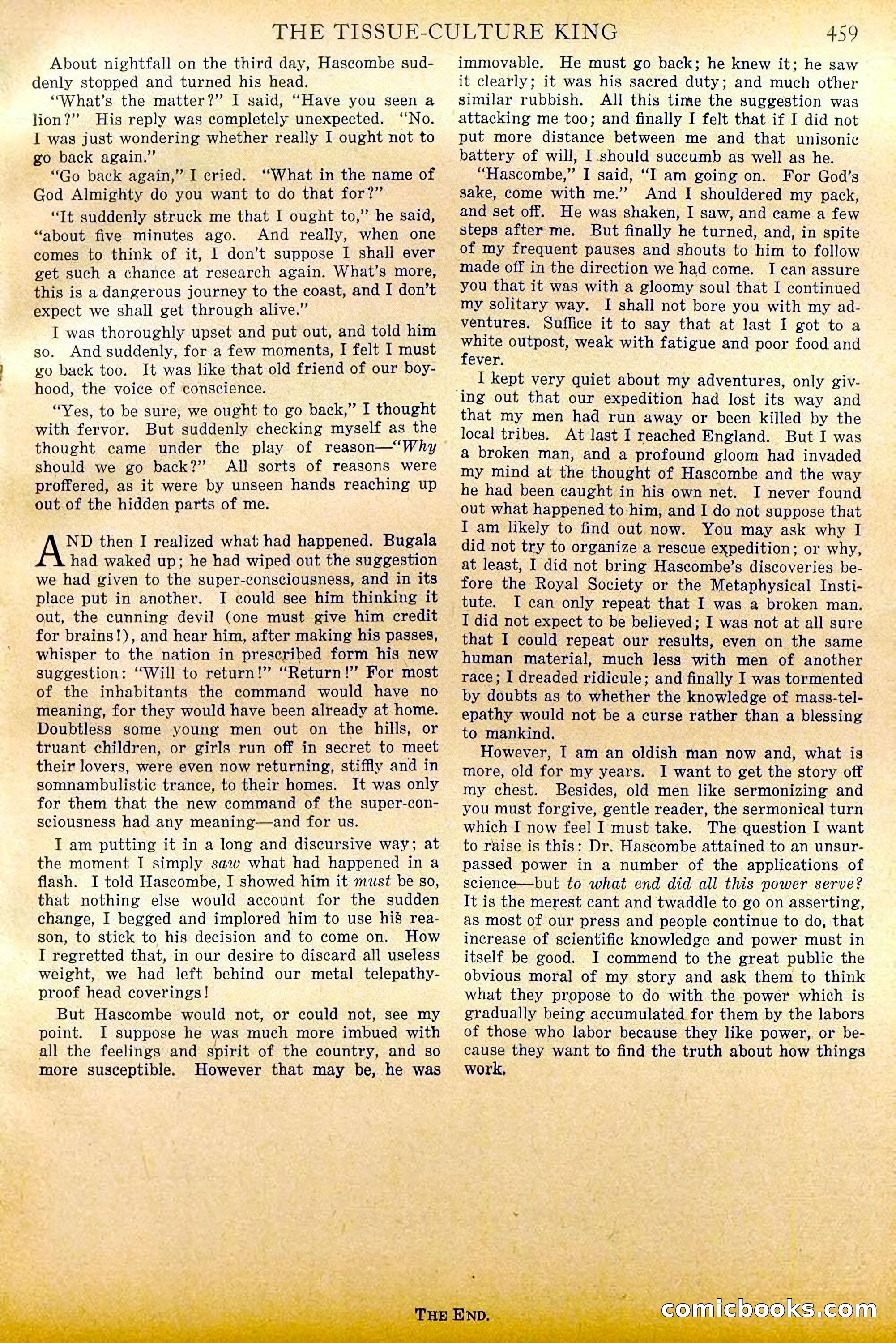
A restored page from Pulp Fiction, 1927. Page through the whole issue in the reader above.
📄 Transcribed text from this page (OCR, searchable)
Machine-transcribed from the original scan — historical spelling and the odd misread are preserved.
THE TISSUE-CULTURE KING About nightfall on the third day, Hascombe sud- denly stopped and turned his head. “What’s the matter?” I said, “Have you seen a lion?” His reply was completely unexpected. “No. I was just wondering whether really I ought not to go back again.” “Go back again,” I cried. “What in the name of God Almighty do you want to do that for?” “Tt suddenly struck me that I ought to,” he said, “about five minutes ago. And really, when one comes to think of it, I don’t suppose I shall ever get such a chance at research again. What’s more, this is a dangerous journey to the coast, and I don’t expect we shall get through alive.” I was thoroughly upset and put out, and told him so. And suddenly, for a few moments, I felt 1 must go back too. It was like that old friend of our boy- hood, the voice of conscience. “Yes, to be sure, we ought to go back,” I thought with fervor. But suddenly checking myself as the thought came under the play of reason—‘Why should we go back?” All sorts of reasons were proffered, as it were by unseen hands reaching up out of the hidden parts of me. ND then I realized what had happened. Bugala had waked up; he had wiped out the suggestion we had given to the super-consciousness, and in its place put in another. I could see him thinking it out, the cunning devil (one must give him credit for brains!), and hear him, after making his passes, whisper to the nation in preseribed form his new suggestion: “Will to return!” “Return!” For most of the inhabitants the command would have no meaning, for they would have been already at home. Doubtless some young men out on the hills, or truant children, or girls run off in secret to meet their lovers, were even now returning, stiffly and in somnambulistic trance, to their homes. It was only for them that the new command of the super-con- sciousness had any meaning—and for us. I am putting it in a long and discursive way; at the moment I simply saw what had happened in a flash. I told Hascombe, I showed him it must be so, that nothing else would account for the sudden change, I begged and implored him to use hi8 rea- son, to stick to his decision and to come on. How T regretted that, in our desire to discard all useless weight, we had left behind our metal telepathy- proof head coverings! But Hasecombe would not, or could not, see my point. I suppose he was much more imbued with all the feelings and gpirit of the country, and so However that may be, he was more susceptible. 459 immovable. He must go back; he knew it; he saw it clearly; it was his sacred duty; and much other similar rubbish. Al] this time the suggestion was attacking me too; and finally I felt that if I did not put more distance between me and that unisonic battery of will, I-should succumb as well as he. “Hascombe,” I said, “I am going on. For God’s sake, come with me.” And I shouldered my pack, and set off. He was shaken, I saw, and came a few steps after me. But finally he turned, and, in spite of my frequent pauses and shouts to him to follow made off in the direction we had come. I can assure you that it was with a gloomy soul that I continued my solitary way. I shall not bore you with my ad- ventures. Suffice it to say that at last I got to a white outpost, weak with fatigue and poor food and fever. I kept very quiet about my adventures, only giv- ing out that our expedition had Jost its way and that my men had run away or been killed by the local tribes. At last I reached England. But I was a broken man, and a profound gloom had invaded my mind at the thought of Hascombe and the way he had been caught in his own net. I never found out what happened to him, and I do not suppose that I am likely to find out now. You may ask why I did not try to organize a rescue expedition; or why, at least, I did not bring Hascombe’s discoveries be- fore the Royal Society or the Metaphysical Insti- tute. I can only repeat that I was a broken man. I did not expect to be believed; I was not at all sure that I could repeat our results, even on the same human material, much less with men of another race; I dreaded ridicule; and finally I was tormented by doubts as to whether the knowledge of mass-tel- epathy would not be a curse rather than a blessing to mankind. However, I am an oldish man now and, what is more, old for my years. I want to get the story off my chest. Besides, old men like sermonizing and you must forgive, gentle reader, the sermonical turn which I now feel I must take. The question I want to raise is this: Dr. Hascombe attained to an ungur- passed power in a number of the applications of science—but to what end did all this power serve? It is the merest cant and twaddle to go on asserting, as most of our press and people continue to do, that increase of scientific knowledge and power must in itself be good. I commend to the great public the obvious moral of my story and ask them to think what they propose to do with the power which is gradually being accumulated for them by the labors of those who labor because they like power,. or be- ee they want to find the truth about how things wor. +