
Pulp Fiction, 1927 · page 39 of 107
Amazing Stories, August 1927 — page 39: what you’re looking at
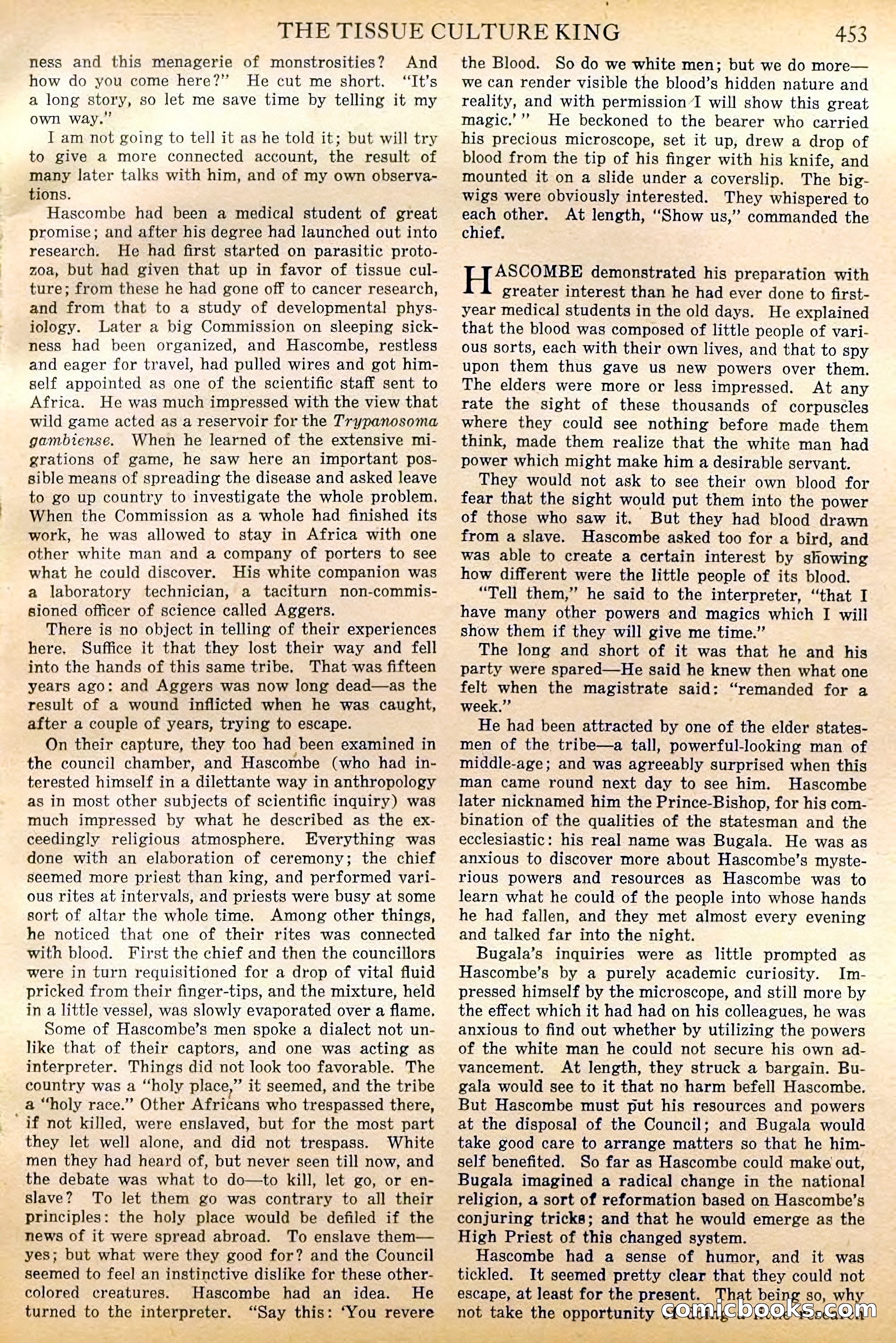
A restored page from Pulp Fiction, 1927. Page through the whole issue in the reader above.
📄 Transcribed text from this page (OCR, searchable)
Machine-transcribed from the original scan — historical spelling and the odd misread are preserved.
THE TISSUE CULTURE KING ness and this menagerie of monstrosities? And how do you come here?” He cut me short. ‘It’s a long story, so let me save time by telling it my own way.” I am not going to tell it as he told it; but will try to give a more connected account, the result of many later talks with him, and of my own observa- tions. Hascombe had been a medical student of great promise; and after his degree had launched out into research. He had first started on parasitic proto- zoa, but had given that up in favor of tissue cul- ture; from these he had gone off to cancer research, and from that to a study of developmental phys- iology. Later a big Commission on sleeping sick- ness had been organized, and Hascombe, restless and eager for travel, had pulled wires and got him- self appointed as one of the scientific staff sent to Africa. He was much impressed with the view that wild game acted as a reservoir for the Trypanosoma gambtense. When he learned of the extensive mi- grations of game, he saw here an important pos- sible means of spreading the disease and asked leave to go up country to investigate the whole problem. When the Commission as a whole had finished its work, he was allowed to stay in Africa with one other white man and a company of porters to see what he could discover. His white companion was a laboratory technician, a taciturn non-commis- sioned officer of science called Aggers. There is no object in telling of their experiences here, Suffice it that they lost their way and fell into the hands of this same tribe. That was fifteen years ago: and Aggers was now long dead—as the result of a wound inflicted when he was caught, after a couple of years, trying to escape. On their capture, they too had been examined in the council chamber, and Hascombe (who had in- terested himself in a dilettante way in anthropology as in most other subjects of scientific inquiry) was much impressed by what he described as the ex- ceedingly religious atmosphere. Everything was done with an elaboration of ceremony; the chief seemed more priest than king, and performed vari- ous rites at intervals, and priests were busy at some sort of altar the whole time. Among other things, he noticed that one of their rites was connected with blood. First the chief and then the councillors were in turn requisitioned for a drop of vital fluid pricked from their finger-tips, and the mixture, held in a little vessel, was slowly evaporated over a flame, Some of Hascombe’s men spoke a dialect not un- like that of their captors, and one was acting as interpreter. Things did not look too favorable. The country was a “holy place,” it seemed, and the tribe a “holy race.” Other Africans who trespassed there, ‘if not killed, were enslaved, but for the most part they let well alone, and did not trespass. White men they had heard of, but never seen till now, and the debate was what to do—to kill, let go, or en- slave? To let them go was contrary to all their principles: the holy place would be defiled if the news of it were spread abroad. To enslave them— yes; but what were they good for? and the Council seemed to feel an instinctive dislike for these other- colored creatures. Hascombe had an idea. He turned to the interpreter. “Say this: ‘You revere } ‘ 453 the Blood. So do we white men; but we do more— we can render visible the blood’s hidden nature and reality, and with permission‘ will show this great magic.’”’ He beckoned to the bearer who carried his precious microscope, set it up, drew a drop of blood from the tip of his finger with his knife, and mounted it on a slide under a coverslip. The big- wigs were obviously interested. They whispered to each other. At length, ‘Show us,” commanded the chief. Fes coe ee demonstrated his preparation with greater interest than he had ever done to first- year medical students in the old days. He explained that the blood was composed of little people of vari- ous sorts, each with their own lives, and that to spy upon them thus gave us new powers over them. The elders were more or less impressed. At any rate the sight of these thousands of corpuscles where they could see nothing before made them think, made them realize that the white man had power which might make him a desirable servant. They would not ask to see their own blood for fear that the sight would put them into the power of those who saw it. But they had blood drawn from a slave. Hascombe asked too for a bird, and was able to create a certain interest by showing how different were the little people of its blood. “Tell them,” he said to the interpreter, “that I have many other powers and magics which I will show them if they will give me time.” The long and short of it was that he and his party were spared—He said he knew then what one felt when the magistrate said: “remanded for a week.” He had been attracted by one of the elder states- men of the tribe—a tall, powerful-looking man of middle-age; and was agreeably surprised when this Man came round next day to see him. Hascombe later nicknamed him the Prince-Bishop, for his com- bination of the qualities of the statesman and the ecclesiastic: his real name was Bugala. He was as anxious to discover more about Hascombe’s myste- rious powers and resources as Hascombe was to learn what he could of the people into whose hands he had fallen, and they met almost every evening and talked far into the night. Bugala’s inquiries were as little prompted as Hascombe’s by a purely academic curiosity. Im- pressed himself by the microscope, and still more by the effect which it had had on his colleagues, he was anxious to find out whether by utilizing the powers of the white man he could not secure his own ad- vancement. At length, they struck a bargain. Bu- gala would see to it that no harm befell Hascombe. But Hascombe must put his resources and powers at the disposal of the Council; and Bugala would take good care to arrange matters so that he him- self benefited. So far as Hascombe could make out, Bugala imagined a radical change in the national religion, a sort of reformation based on Hascombe’s conjuring tricks; and that he would emerge as the High Priest of this changed system. Hascombe had a sense of humor, and it was tickled. It seemed pretty clear that they could not escape, at least for the ean re t being EW why not take the ppatenty SETA Lad scOMm