
Pulp Fiction, 1864 · page 8 of 52
The Secret Shot; Or, The Rivals Of Misty Mount — page 8: what you’re looking at
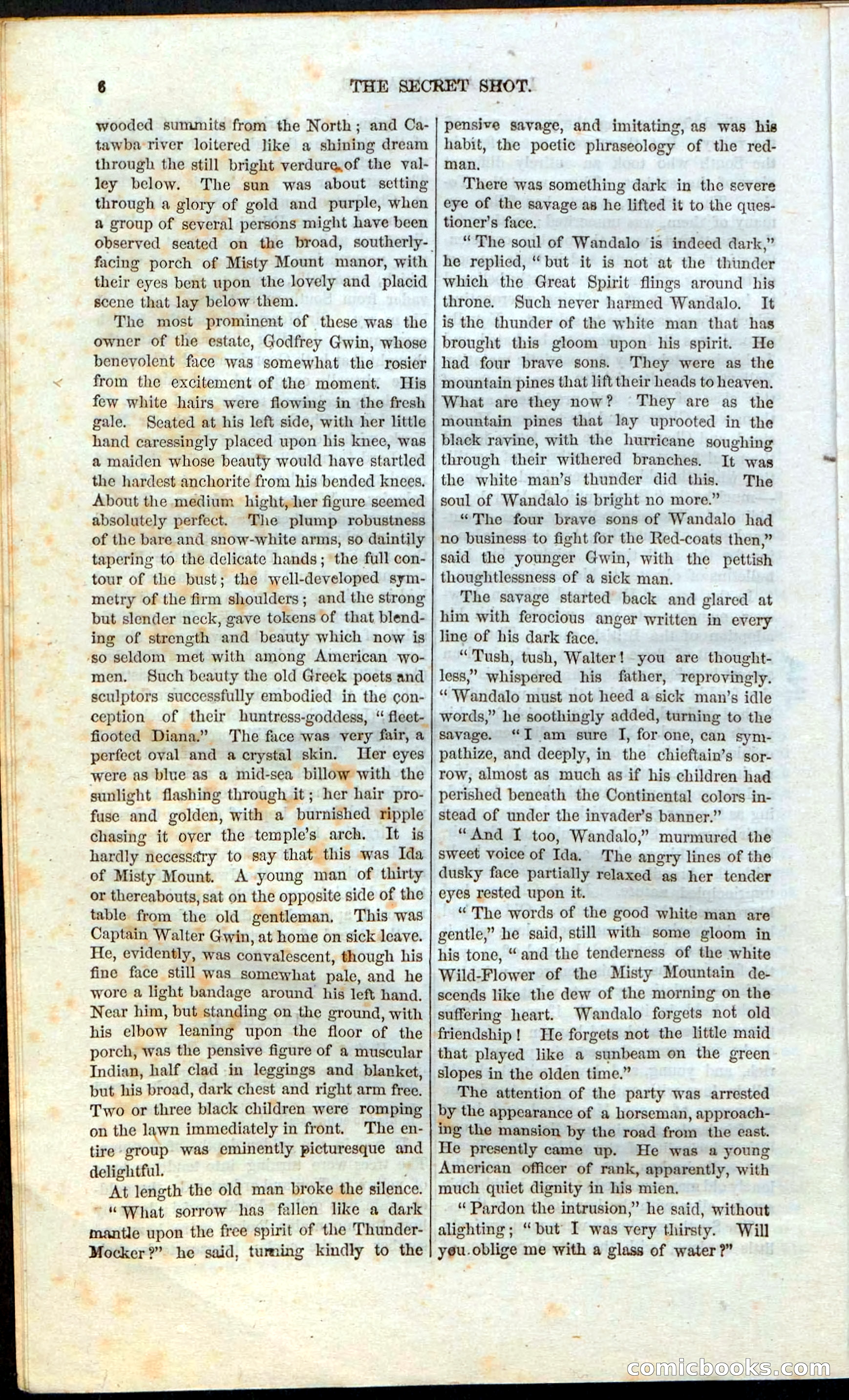
A restored page from Pulp Fiction, 1864. Page through the whole issue in the reader above.
📄 Transcribed text from this page (OCR, searchable)
Machine-transcribed from the original scan — historical spelling and the odd misread are preserved.
pe ——- i 6 THE SECRET SHOT. wooded summits from the North; and Ca- tawba river loitered like a shining dream through the still bright verdure,of the val- ley below. The sun was about setting through a glory of gold and purple, when a group of several persons might have been observed seated on the broad, southerly-| facing porch of Misty Mount manor, with their eyes bent upon the lovely and placid scene that lay below them. The most prominent of these was the owner of the estate, Godfrey Gwin, whose benevolent face was somewhat the rosier from the excitement of the moment. His few white hairs were flowing in the fresh gale. Seated at his left side, with her little hand caressingly placed wpon his knee, was a maiden whose beauty would have startled the hardest anchorite from his bended knees. About the medium hight,her figure seemed absolutely perfect. The plump robustness of the bare and snow-white arms, so daintily tapering to the delicate hands; the full con- tour of the bust; the well-developed sym- metry of the firm shoulders; and the strong but slender neck, gave tokens of that blend- ing of strength and beauty which now is ‘so seldom met with among American wo- men. Such beauty the old Greek poets and sculptors successfully embodied in the con- ception of their huntress-goddess, “ fleet- fiooted Diana.” The face was very fair, a perfect oval and a crystal skin. Her eyes were as blue as a mid-sea billow with the sunlight flashing through it ; her hair pro- fuse and golden, with a burnished ripple chasing it over the temple’s arch. It is hardly necessdry to say that this was Ida of Misty Mount. A young man of thirty or thereabouts, sat on the opposite side of the table from the old gentleman, This was Captain Walter Gwin, at home on sick leave. He, evidently, was convalescent, though his fine face still was somewhat pale, and he wore a light bandage around his left hand. Near him, but standing on the ground, with his elbow leaning upon the floor of the porch, was the pensive figure of a muscular Indian, half clad in leggings and blanket, but his broad, dark chest and right arm free. Two or three black children were romping on the lawn immediately in front. tire group was eminently picturesque and delightful. ' At length the old man broke the silence. ~ “What sorrow has fallen like a dark mantle upon the free spirit of the Thunder- Mocker?”’ he said, turning kindly to the friendship |! The en- | ing pensive savage, and imitating, as was his habit, the poetic phraseology of the red- man, There was something dark in the severe eye of the savage as he lifted it to the ques- tioner’s face. “The soul of Wandalo is indeed dark,” he replied, “but it is not at the thunder which the Great Spirit flings around his throne. Such never harmed Wandalo. It is the thunder of the white man that has brought this gloom upon his spirit. He had four brave sons. They were as the mountain pines that lift their heads to heaven. What are they now? They are as the mountain pines that lay uprooted in the black ravine, with the hurricane soughing through their withered branches. It was the white man’s thunder did this. The soul of Wandalo is bright no more.” “The four brave sons of Wandalo had no business to fight for the Red-coats then,” said the younger Gwin, with the pettish thoughtlessness of a sick man. The savage started back and glared at him with ferocious anger written in every line of his dark face, “Tush, tush, Walter! you are thought- less,” whispered his father, reprovingly. “Wandalo must not heed a sick man’s idle words,” he soothingly added, turning to the savage. “I am sure I, for one, can sym- pathize, and deeply, in the chieftain’s sor- row, almost as much as if his children had perished beneath the Continental colors in- stead of under the invader’s banner.” “And I too, Wandalo,” murmured the sweet voice of Ida. The angry lines of the dusky face partially relaxed as her tender eyes rested upon it. “The words of the good white man are gentle,” he said, still with some gloom in his tone, “and the tenderness of the white Wild-Flower of the Misty Mountain de- scends like the dew of the morning on the suffering heart. Wandalo forgets not old He forgets not the little maid that played like a sunbeam on the green slopes in the olden time.” The attention of the party was arrested by the appearance of a horseman, approach- the mansion by the road from the east. He presently came up. He was a young American officer of rank, apparently, with much quiet dignity in his mien. “ Pardon the intrusion,” he said, without alighting; “but I was very thirsty. Will you.oblige me with a glass of water?” chook