
Pulp Fiction, 1955 · page 23 of 36
American Science Fiction #41 — page 23: what you’re looking at
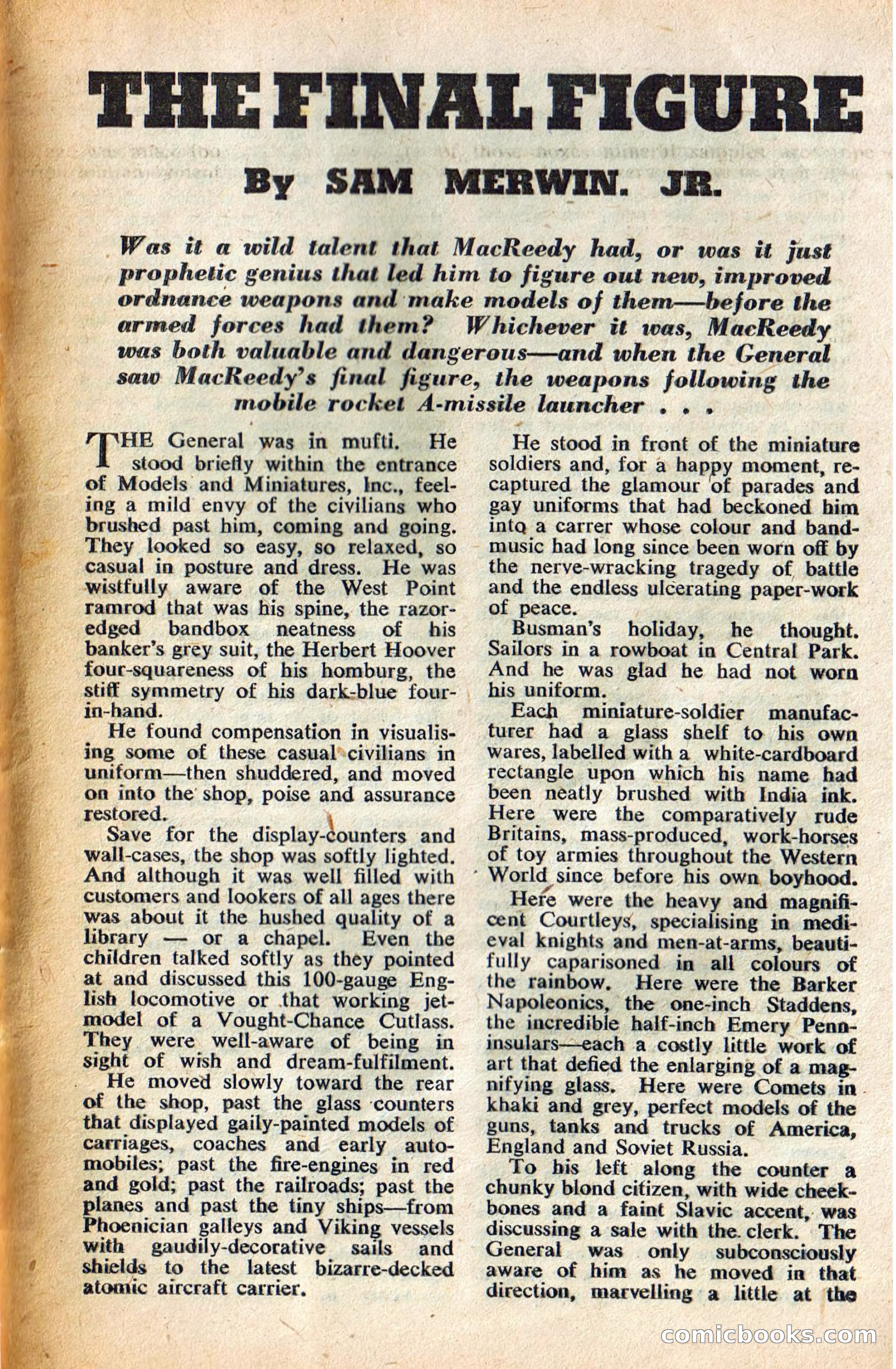
A restored page from Pulp Fiction, 1955. Page through the whole issue in the reader above.
📄 Transcribed text from this page (OCR, searchable)
Machine-transcribed from the original scan — historical spelling and the odd misread are preserved.
‘a 4 Y % Cher , - 7 a “4 ‘ AY i Pee * x ay patty Js ; OR | ] he, $ — 7 ioe cee U _Was it a wild talent that MacReedy had, or was it just prophetic genius that led him to figure out new, improved ordnance weapons and make models of them—before the ie armed forces had them? Whichever it was, MacReedy _ «was both valuable and dangerous—and when the General ae saw MacReedy’s final figure, the weapons following the mobile rocket A-missile launcher .. . : : i edged bandbox e with gaudily-decorative sails _ Shields to the latest bizarre-decked ‘J ‘HE General was in mufti. He EG stood briefly within the entrance - of Models’ and Miniatures, Inc., feel- ing a mild envy of the civilians who brushed past him, coming and going. They looked so easy, so relaxed, so casual in posture and dress. He was wistfully aware of the West Point ramrod that was his spine, the razor- neatness of his banker’s grey suit, the Herbert Hoover four-squareness of his homburg, the stiff symmetry of his dark-blue four- | in-hand. He found compensation in visualis- ing some of these casual’ civilians in uniform—then shuddered, and moved on into the’ shop, poise and assurance restored. Save for the display-dountexs and wall-cases, the shop was softly lighted. And although it was well filled with customers and lookers of all ages there was about it the hushed quality of a library — or a chapel. Even the children talked softly as they pointed as at and discussed this 100-gauge Eng- lish locomotive or that working jet- model of a Vought-Chance Cutlass. They were well-aware of being in sight of wish and dream-fulfilment. . He moved slowly toward the rear of the shop, past the glass ‘counters _ that displayed gaily-painted models of Carriages, coaches and early auto- Be mobiles; past the fire-engines in red - and gold; past the railroads; past the _ planes and past the tiny ships—from — Phoenician galleys and Viking Nessias an - atontic aircraft carrier. He stood in front of the miniature soldiers and, for a happy moment, re- captured the glamour of parades and gay uniforms that had beckoned him into a carrer whose colour and band- music had long since been worn off by the nerve-wracking tragedy of battle and the endless ulcerating paper-work of peace. Busman’s_ holiday, he thought. Sailors in a rowboat in Central Park. And he was glad he had not worn his uniform. : Each miniature-soldier manufac- furer had a glass shelf to his own wares, labelled with a white-cardboard rectangle upon which his name had been neatly brushed with India ink. Here were the comparatively rude Britains, mass-produced, work-horses of toy armies throughout the Western ‘ World since before his own boyhood. Here were the heavy and magnifi- cent Courtleys, specialising in medi- eval knights and men-at-arms, beauti- fully caparisoned in all colours of the rainbow, Here were the Barker Napoleonics, the one-inch Staddens, the incredible half-inch Emery Penn- insulars—each a costly little work of art that defied the enlarging of a mag- nifying glass. Here were Comets in. khaki and grey, perfect models of the guns, tanks and trucks of America, England and Soviet Russia. To his left along the counter a chunky blond citizen, with wide cheek- bones and a faint Slavic accent, was discussing a sale with the. clerk. The General was only — subconsciously aware of him as he moved in that direction, marvelling a little at the connicloooks.comn)