
Pulp Fiction, 1928 · page 82 of 100
Amazing Stories, Vol. 3, No. 2 — page 82: what you’re looking at
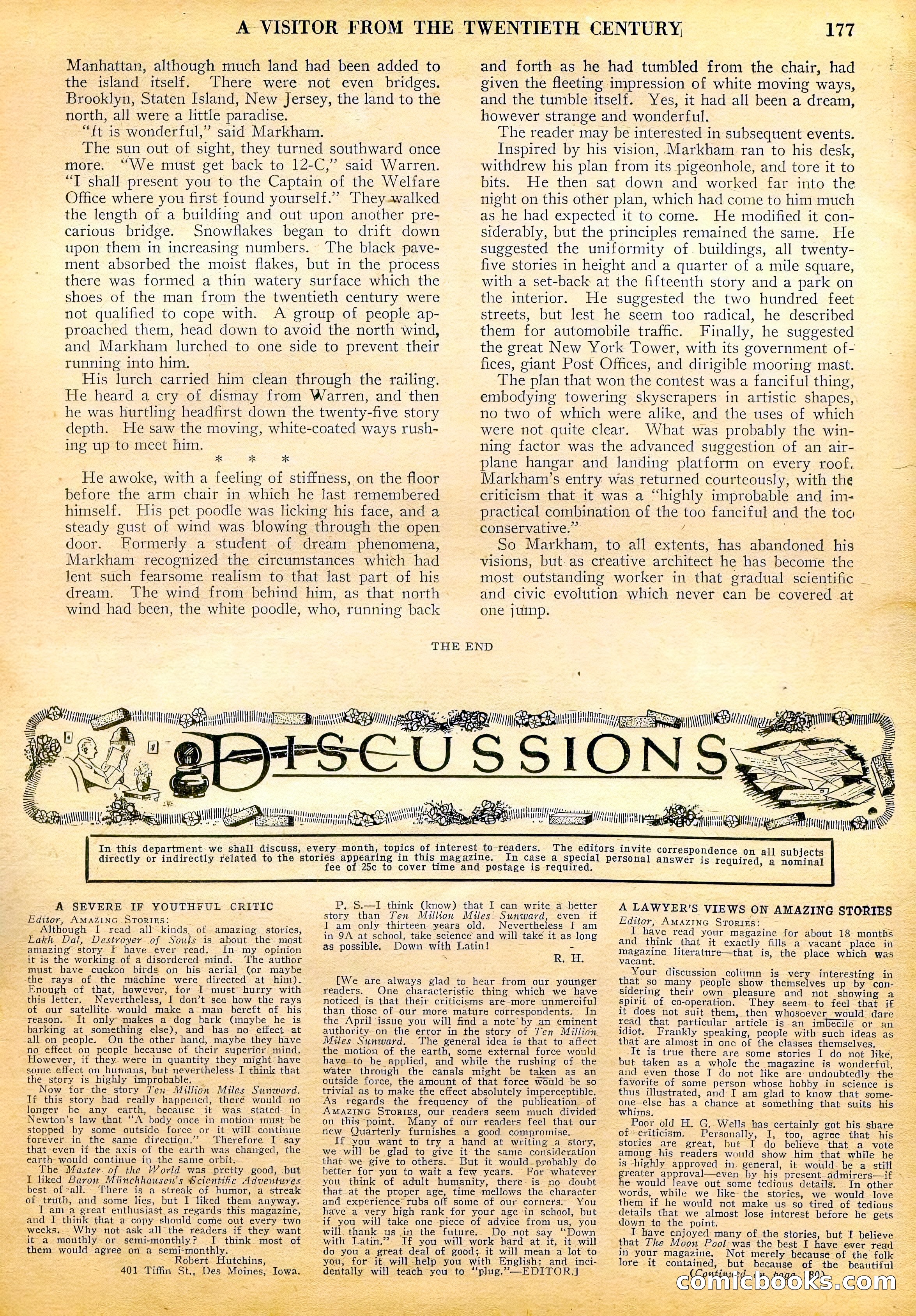
A restored page from Pulp Fiction, 1928. Page through the whole issue in the reader above.
📄 Transcribed text from this page (OCR, searchable)
Machine-transcribed from the original scan — historical spelling and the odd misread are preserved.
Manhattan, although much land had been added to the island itself. There were not even bridges. Brooklyn, Staten Island, New Jersey, the land to the north, all were a little paradise. “{t is wonderful,” said Markham. The sun out of sight, they turned southward once more. “We must get back to 12-C,’ said Warren. “T shall present you to the Captain of the Welfare Office where you first found yourself.” They-awalked the length of a building and out upon another pre- carious bridge. Snowflakes began to drift down upon them in increasing numbers. The black pave- ment absorbed the moist flakes, but in the process there was formed a thin watery surface which the shoes of the man from the twentieth century were not qualified to cope with. A group of people ap- proached them, head down to avoid the north wind, and Markham lurched to one side to prevent their running into him. His lurch carried him clean through the railing. He heard a cry of dismay from Warren, and then _ he was hurtling headfirst down the twenty-five story : Sings depth. He saw the moving, white-coated ways rush- ing up to meet him. Bee ke © ok He awoke, with a feeling of stiffness, on the floor before the arm chair in which he last remembered himself. His pet poodle was licking his face, and a steady gust of wind was blowing through the open door. Formerly a student of dream phenomena, Markham recognized the circumstances which had lent such fearsome realism to that last part of his dream. The wind from behind him, as that north wind had been, the white poodle, who, running back A VISITOR FROM THE TWENTIETH CENTURY, 177 and forth as he had tumbled from the chair, had given the fleeting impression of white moving ways, and the tumble itself. Yes, it had all been a dream, however strange and wonderful. The reader may be interested in subsequent events. Inspired by his vision, Markham ran to his desk, withdrew his plan from its pigeonhole, and tore it to bits. He then sat down and worked far into the night on this other plan, which had come to him much as he had expected it to come. He modified it con- siderably, but the principles remained the same. He suggested the uniformity of. buildings, all twenty- five stories in height and a quarter of a mile square, with a set-back at the fifteenth story and a park on the interior. He suggested the two hundred feet streets, but lest he seem too radical, he described them for automobile traffic. Finally, he suggested the great New York Tower, with its government of- fices, giant Post Offices, and dirigible mooring mast. The plan that won the contest was a fanciful thing, embodying towering skyscrapers in artistic shapes, no two of which were alike, and the uses of which were not quite clear. What was probably the win- ning factor was the advanced suggestion of an air- plane hangar and landing platform on every roof. Markham’s entry was returned courteously, with the criticism that it was a “highly improbable and im- practical combination of the too fanciful and the toc conservative.” / : So Markham, to all extents, has abandoned his visions, but. as creative architect he has become the most outstanding worker in that gradual scientific and civic evolution which never can be covered at one jump. THE END eS as COTO unit lt A ented Ns nut LU In this department we shall discuss, every month, topics of interest to readers. The editors ‘invite directly or indirectly related to the stories appearing in this magazine. rey FSCUSSIONS Bi NEEM SS BAA i Sa My Sy NE ye Pee i Ct tuntes fyrtiyees rn ; ‘ Rpg. : Td arene MEME coe correspondence on all subjects In case a special personal answer is Tequired, a nominal Wes, fee of 25c to cover me and postage is required. A SEVERE IF YOUTHFUL CRITIC Editor, AMAZING Storius: : Although I read all kinds, of amazing stories, Lakh Dal, Destroyer of Souls is about the most amazing story F have ever read. In my opinion it is the working of a disordered mind. The author must bave cuckoo birds on his aerial (or maybe the rays of the machine were directed at him). Enough of that, however, for I must hurry with this letter, Nevertheless, I don’t see how the rays of our satellite would make a man bereft of his reason. It only makes a dog bark (maybe he is barking at something else), and has no effect at all on people. On the other hand, maybe they have no effect on people because of their superior mind. However, if they were in quantity they might have some effect on humans, but nevertheless I think that the story is highly improbable. _ Now for the story Ten Million Miles Sunward. If this story had really happened, there would no longer be any earth, because it Newton's law that “A body once in motion must be stopped by some outside force or it will continue forever in the game direction.” ‘Therefore I say that even if the axis of the earth was changed, the — earth would continue in the same orbit. : The Sg, the World was pretty good, -but I liked Baron Miinchhausen’s Scientific Adventures best of ‘all. There is a streak of humor, a streak of truth, and some lies, but I liked them anyway. T am a great enthusiast as regards this magazine, and I think that a copy should come out every two weeks. Why not ask all the readers if they want ijt-a monthly or semi-monthly? I. think most of them would agree on a semi-monthly. - : ~ Robert Hutchins, ~ 401 Tiffin = was stated. in. St, Des Moines, Iowa. — P. S.—I think (know) that I can write a -better story than Ten Million Miles’ Sunward, even if I am only thirteen years old. Nevertheless I am in 9A at school, take science and will take it as long as possible. Down with Latin} B [We are always glad to hear from our younger readers. One characteristic thing which we have noticed is that their criticisms are more unmerciful than those of our more mature correspondents, In the April issue you will find a note by an eminent authority on the error in the story of Ten Million, Miles Sunwayd, The general idea is that to affect the motion of the earth, some external force would have to be applied, and while the rushing of the water through the canals might be taken as an outside force, the amount of that force would be so trivial as to make the effect absolutely imperceptible. As regards the frequency of the publication of Amazina Srorres, out readers seem much divided on this point. Many of our readers feel that our new Quarterly furnishes a good compromise. If -you want to try a hand at writing a story, we will be glad to give it the same consideration that we give to others. But it would_probably do better for you to wait a few years. For whatever you think of adult humanity, there is no doubt that at the proper age, time mellows the character and experience’ rubs off some of our cornets. You have a very high rank for yout age in school, but -if you will take one piece of advice from us, you will. thank us in the future. Do not say “Down with Latin.” If you will work hard at it, it will do you a great deal of good; it will mean a lot to -you, for it will help you with English; and inci- dentally will teach you to “‘plug."-—EDITOR,.J A LAWYER'S VIEWS ON AMAZING STORIES Editor, Amazinc Stoxtus: I have read your magazine for about 18 months and think that it exactly fills a vacant place in magazine literature—that is, the place which was vacant, , Your discussion column is very interesting in that so many people show themselves up by con- sidering their own pleasure and not showing a spirit of co-operation. They seem to feel that if it does not suit them, then whosoever would dare. tead that particular article is an imbecile ot an idiot, Frankly speaking, people with such ideas as that are almost in one of the classes themselves. -It is true there are some stories I do not like, but taken as a whole the magazine is wonderful, and even those I do not like are undoubtedly the favorite of some person whose hobby in science is thus illustrated, and I am glad to know that some- one else has a chance at something that suits his — whims. Poor old H, G. Wells has certainly got his share of criticism. Personally, I, too, agree that his stories are great, but I do believe that a vote — among his readers would show him that while he is highly approved in. general, it would. be a still ees approval—even by his present. admirers—if ~ e would leave out some tedious details, In other words, while we like the stories, we would love them if he would not make us so tired of tedious details that we almost lose interest before he gets down to the point, I have enjoyed many of the stories, but I believe that The Moon Pool was the best IT have ever read im your magazine. Not merely because of the folk lore it contained, but because of the beautiful — = comicbooks¢com