
Pulp Fiction, 1928 · page 66 of 100
Amazing Stories, Vol. 3, No. 2 — page 66: what you’re looking at
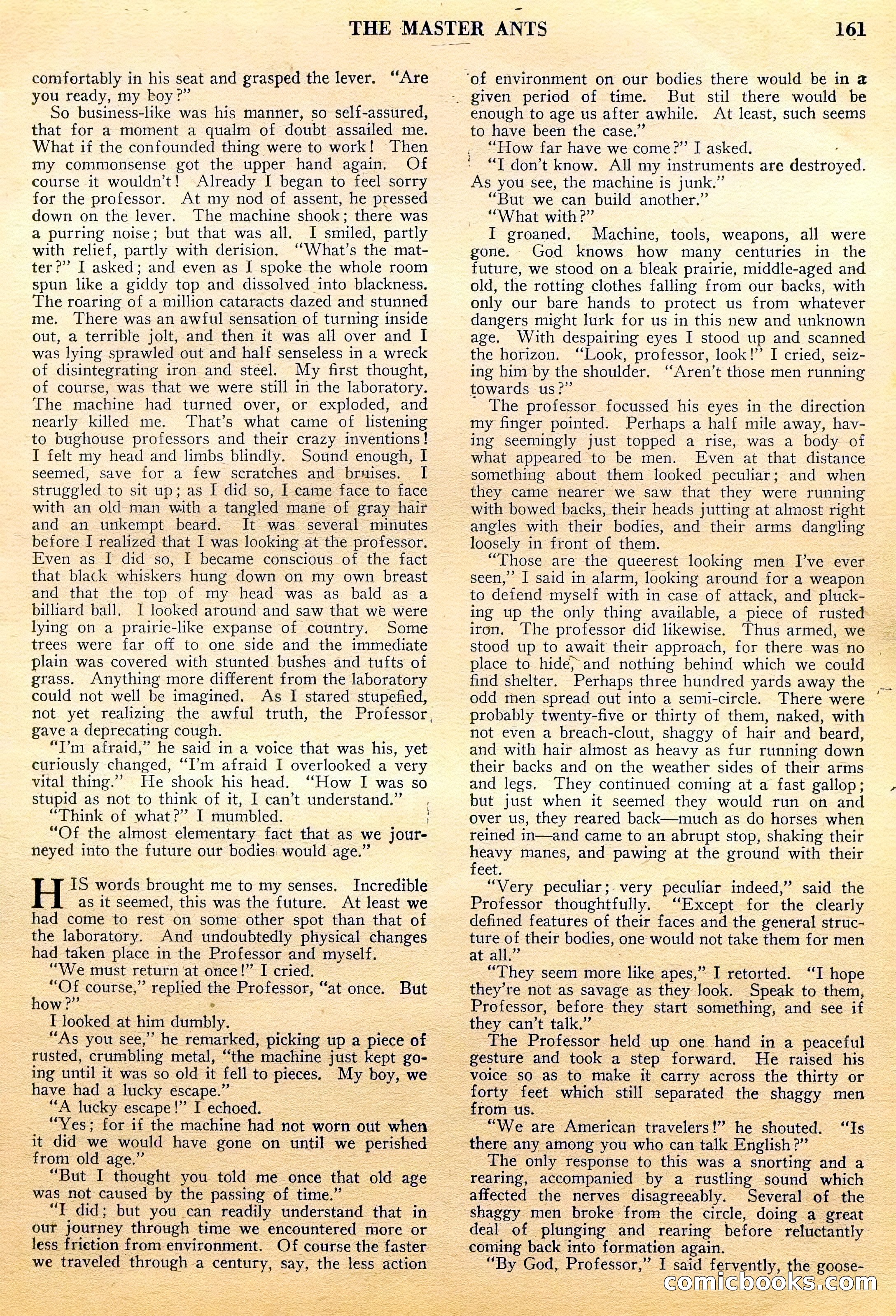
A restored page from Pulp Fiction, 1928. Page through the whole issue in the reader above.
📄 Transcribed text from this page (OCR, searchable)
Machine-transcribed from the original scan — historical spelling and the odd misread are preserved.
THE MASTER ANTS 161 comfortably in his seat and grasped the lever. “Are you ready, my boy?” So business-like was his manner, so self-assured, that for a moment a qualm of doubt assailed me. What if the confounded thing were to work! Then my commonsense got the upper hand again. Of course it wouldn't! Already I began to feel sorry for the professor. At my nod of assent, he pressed down on the lever. The machine shook; there was a purring noise; but that was all. I smiled, partly with relief, partly with derision, ‘“What’s the mat- ter?” I asked; and even as I spoke the whole room spun like a giddy top and dissolved into blackness. The roaring of a million cataracts dazed and stunned me. There was an awful sensation of turning inside out, a terrible jolt, and then it was all over and I was lying sprawled out and half senseless in a wreck of disintegrating iron and steel. My first thought, of course, was that we were still in the laboratory. The machine had turned over, or exploded, and neatly killed me. ‘That's what came of listening to bughouse professors and their crazy inventions! I felt my head and limbs blindly. Sound enough, I seemed, save for a few scratches and bruises. I struggled to sit up; as I did so, I eame face to face with an old man with a tangled mane of gray hair and an unkempt beard. It was several minutes before I realized that 1 was looking at the professor. Even as I did so, I became conscious of the fact that black whiskers hung down on my own breast and that the top of my head was as bald as a billiard ball. I looked around and saw that we were lying on a prairie-like expanse of country. Some trees were far off to one side and the immediate plain was covered with stunted bushes and tufts of grass. Anything more different from the laboratory could not well be imagined. As I stared stupefied, not yet realizing the awful truth, the Professor, gave a deprecating cough. “I’m afraid,” he said in a voice that was his, yet curiously changed, “I’m afraid I overlooked a very vital thing.’’ He shook his head. ‘How I was so stupid as not to think of it, I can’t understand.” “Think of what?’ I mumbled. “Of the almost elementary fact that as we jour- neyed into the future our bodies would age.” IS words brought me to my senses. Incredible as it seemed, this was the future. At least we had come to rest on some other spot than that of the laboratory. And undoubtedly physical changes had taken place in the Professor and myself. “We must return at once!” I cried. “Of course,” replied the Professor, “at once. But how?” ° T looked at him dumbly. “As you see,” he remarked, picking up a piece of rusted, crumbling metal, “the machine just kept go- ing until it was so old it fell to pieces. My boy, we have had a lucky escape.” : “A lucky escape!” I echoed. “Yes; for if the machine had not worn out when it did we would have gone on until we perished from old age,” “But I thought you told me once that old age was not caused by the passing of time.” “I did; but you can readily understand that in our journey through time we encountered more or less frietion from environment. Of course the faster _ we traveled through a century, say, the less action ‘of environment on our bodies there would be in @ -. given period of time. But stil there would be enough to age us after awhile. At least, stich seems to have been the case.” “How far have we come?” I asked. ; “T don’t know. All my instruments are destroyed. As you see, the machine is junk,” “But we can build another.” “What with?” I groaned. Machine, tools, weapons, all were gone. God knows how many centuries in the future, we stood on a bleak prairie, middle-aged and old, the rotting clothes falling from our backs, with only our bare hands to protect us from whatever dangers might lurk for us in this new and unknown age, With despairing eyes I stood up and scanned the horizon. ‘Look, professor, look!” I cried, seiz- ing him by the shoulder. ‘“Aren’t those men running towards us?” The professor focussed his eyes in the direction my finger pointed. Perhaps a half mile away, hav- ing seemingly just topped a rise, was a body of what appeared to be men. Even at that distance something about them looked peculiar; and when they came nearer we saw that they were running with bowed backs, their heads jutting at almost right angles with their bodies, and their arms dangling loosely in front of them. “Those are the queerest looking men I’ve ever seen,” I said in alarm, looking around for a weapon to defend myself with in case of attack, and pluck- ing up the only thing available, a piece of rusted iron. The professor did likewise. Thus armed, we stood up to await their approach, for there was no place to hide; and nothing behind which we could find shelter. Perhaps three hundred yards away the odd men spread out into a semi-circle. There were probably twenty-five or thirty of them, naked, with not even a breach-clout, shaggy of hair and beard, and with hair almost as heavy as fur running down their backs and on the weather sides of their arms and legs, They continued coming at a fast gallop; but just when it seemed they would run on and over us, they reared back—much as do horses when reined in—and came to an abrupt stop, shaking their peayy manes, and pawing at the ground with their eet. “Very peculiar; very peculiar indeed,” said the Professor thoughtfully. “Except for the clearly defined features of their faces and the general struc- ture of their bodies, one would not take them for men at all.” “They seem more like apes,” I retorted. “I hope they’re not as savage as they look. Speak to them, Professor, before they start something, and see if they can’t talk.” The Professor held up one hand in a peaceful gesture and took a step forward. He raised his voice so as to make it carry across the thirty or forty feet which still separated the shaggy men from us. _ “We are American travelers!” he shouted. ‘Is there any among you who can talk English ?” The only response to this was a snorting and a rearing, accompanied by a rustling sound which affected the nerves disagreeably. Several of the shaggy men broke from the circle, doing a great deal of plunging and rearing before reluctantly coming back into formation again. “By God, Professor,” I said fervently, the goose- COMICIOOXS.COM