
Pulp Fiction, 1928 · page 62 of 100
Amazing Stories, Vol. 3, No. 2 — page 62: what you’re looking at
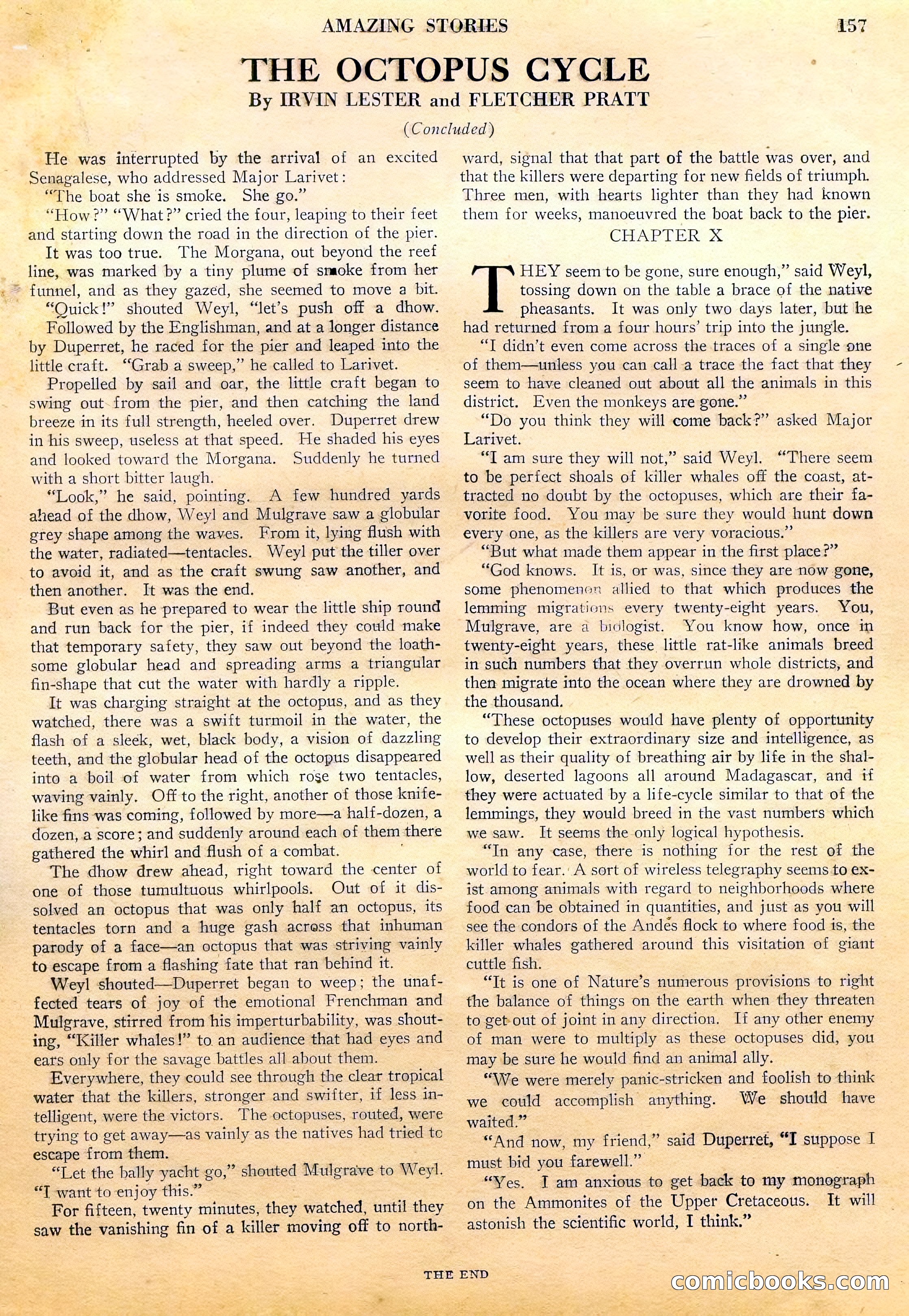
A restored page from Pulp Fiction, 1928. Page through the whole issue in the reader above.
📄 Transcribed text from this page (OCR, searchable)
Machine-transcribed from the original scan — historical spelling and the odd misread are preserved.
oo AMAZING STORIES 157 THE OCTOPUS CYCLE By IRVIN LESTER and FLETCHER PRATT (Concluded) t He was interrupted by the arrival of an excited Senagalese, who addressed Major Larivet: “The boat she is smoke. She go.” “How?” “What?” cried the four, leaping to their feet and starting down the road in the direction of the pier. It was too true. The Morgana, out beyond the reef line, was marked by a tiny plume of smaoke from her ~ funnel, and as they gazed, she seemed to move a bit. “Quick!” shouted Weyl, “let’s push off a dhow. Followed by the Englishman, and at a longer distance by Duperret, he raced for the pier and leaped into the little craft. ‘Grab a sweep,” he called to Larivet. Propelled by sail and oar, the little craft began to swing out.from the pier, and then catching the land breeze in its full strength, heeled over. Duperret drew in his sweep, useless at that speed. He shaded his eyes and looked toward the Morgana. Suddenly he turned with a short bitter laugh. “Look,” he said, pointing. A few hundred yards ahead of the dhow, Weyl and Mulgrave saw a globular grey shape among the waves. From it, lying flush with the water, radiated—tentacles. Weyl put the tiller over to avoid it, and as the craft swung saw another, and then another. It was the end. But even as he prepared to wear the little ship round and run back for the pier, if indeed they could make that temporary safety, they saw out beyond the loath- some globular head and spreading arms a triangular fin-shape that cut the water with hardly a ripple. It was charging straight at the octopus, and as they watched, there was a swift turmoil in the water, the flash of a sleek, wet, black body, a vision of dazzling teeth, and the globular head of the octopus disappeared into a boil of water from which rose two tentacles, waving vainly, Off to the right, another of those knife- like fins was coming, followed by more—a half-dozen, a dozen, a score; and suddenly around each of them there gathered the whirl and flush of a combat. The dhow drew ahead, right toward the center of one of those tumultuous whirlpools. Out of it dis- solved an octopus that was only half an octopus, its tentacles torn and a huge gash acress that inhuman parody of a face—an octopus that was striving vainly to escape from a flashing fate that ran behind it. Weyl shouted—Duperret began to weep; the unaf- fected tears of joy of the emotional Frenchman and Mulgrave, stirred from his imperturbability, was shout- ing, “Killer whales!” to an audience that had eyes and eat's only for the savage battles all about them. Everywhere, they could see through the clear tropical water that the killers, stronger and swifter, if less in- telligent, were the victors. The octopuses, routed, were trying to get away—as vainly as the natives had tried te escape from them. : “T et the hally yacht go,” shouted Mulgrave to Weyl. “T want to enjoy this.” For fifteen, twenty minutes, they watched, until they saw the vanishing fin of a killer moving off to north- THE END ward, signal that that part of the battle was over, and that the killers were departing for new fields of triumph, Three men, with hearts lighter than they had known them for weeks, manoeuvred the boat back to the pier. CHAPTER X T HEY seem to be gone, sure enough,” said Weyl, tossing down on the table a brace of the native pheasants. It was only two days later, but ‘he had returned from a four hours’ trip into the jungle. “JT didn’t even come across the traces of a single one of them—unless you can calla trace the fact that they seem to have cleaned out about all the animals in this district. Even the monkeys are gone.” “Do you think they will come back?” asked Major Larivet. “T am sure they will not,” said Weyl. “There seem to be perfect shoals of killer whales off the coast, at- tracted no doubt by the octopuses, which are their fa- vorite food. You may be sure they would hunt down every one, as the killers are very voracious.” “But what made them appear in the first place?” “God knows. It is, or was, since they are now gone, some phenomenen allied to that which produces the lemming migrations every twenty-eight years. You, Mulgrave, are a biologist. “You know how, once in twenty-eight years, these little rat-like animals breed in such numbers that they overrun whole districts, and then migrate into the ocean where they are drowned by the thousand. “These octopuses would have plenty of opportunity to develop their extraordinary size and intelligence, as well as their quality of breathing air by life in the shal- low, deserted lagoons all around Madagascar, and tf they were actuated by a life-cycle similar to that of the lemmings, they would breed in the vast numbers which we saw. It seems the only logical hypothesis. “Tn any case, there is nothing for the rest of the world to fear. A sort of wireless telegraphy seems to ex- ist among animals with regard to neighborhoods where food can be obtained in quantities, and just as you will see the condors of the Andes flock to where food is, the killer whales gathered around this visitation of giant cuttle fish. “Tt is one of Nature’s numerous provisions to right the balance of things on the earth when they threaten to get-out of joint in any direction, If any other enemy of man were to multiply as these octopuses did, you may be sure he would find an animal ally. “We were merely panic-stricken and foolish to think we could accomplish anything. We should have waited.” “And now, my friend,” said Duperret, “I suppose I must bid you farewell.” “Ves. T am anxious to get back to my monograph on the Ammonites of the Upper Cretaceous. It will astonish the scientific world, I think.” Copmiclooolks.Comnn -