
Pulp Fiction, 1928 · page 44 of 100
Amazing Stories, Vol. 3, No. 2 — page 44: what you’re looking at
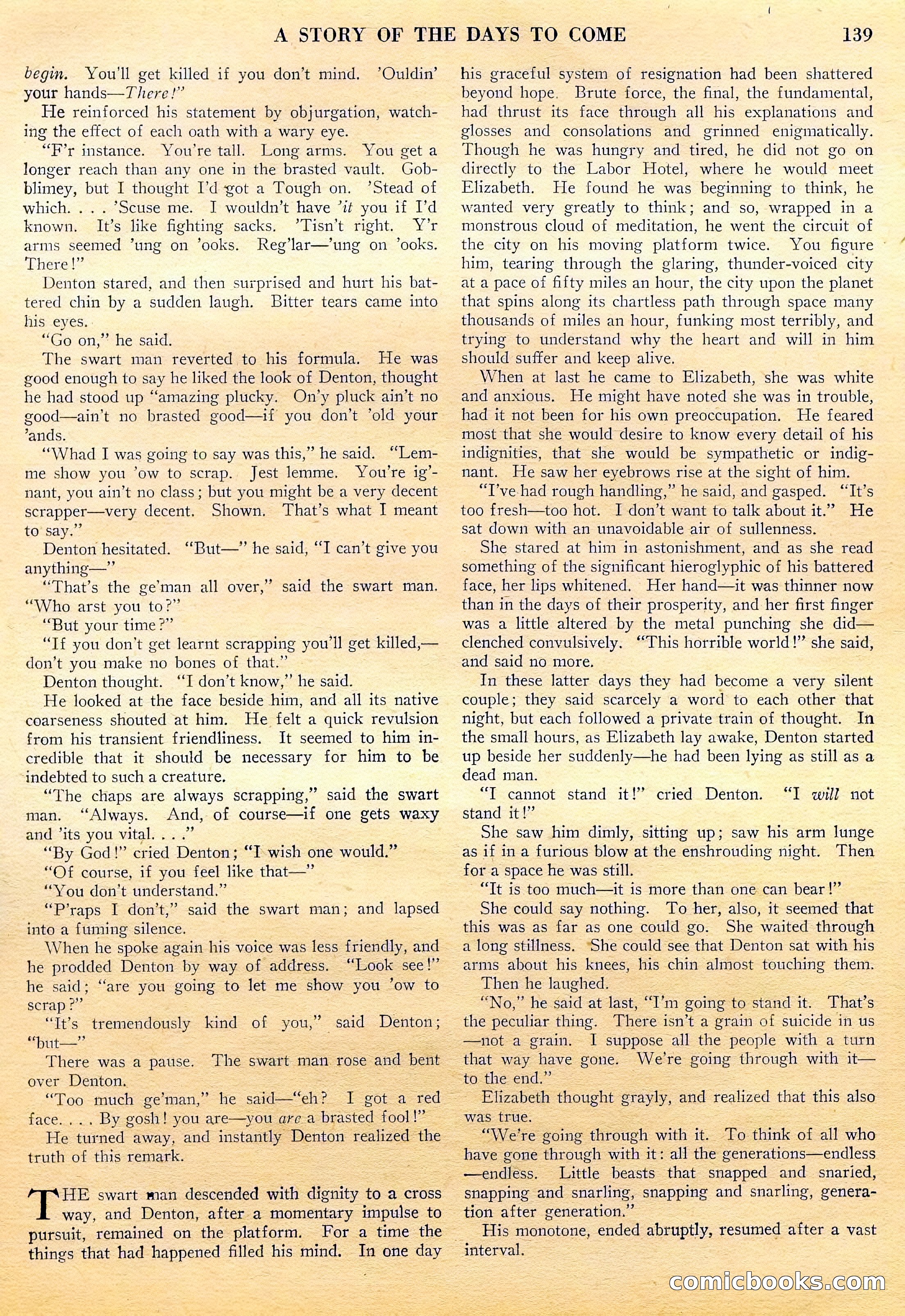
A restored page from Pulp Fiction, 1928. Page through the whole issue in the reader above.
📄 Transcribed text from this page (OCR, searchable)
Machine-transcribed from the original scan — historical spelling and the odd misread are preserved.
A STORY OF THE DAYS TO COME begim. You'll get killed if you don’t mind. ’Ouldin’ your hands—There!” He reinforced his statement by objurgation, watch- ing the effect of each oath with a wary eye. “F’r instance. You're tall. Long arms. You get a longer reach than any one in the brasted vault. Gob- blimey, but I thought 'd-got a Tough on. ‘Stead of which. ... *Scuse me. J wouldn’t have 7it you if I’d known. It’s like fighting sacks. ’Tisn’t right. Y’r arms seemed ’ung on ’ooks. Reg’lar—ung on ’ooks. There!” Denton stared, and then surprised and hurt his bat- tered chin by a sudden laugh. Bitter tears came into his eyes. “Go on,” he said. The swart man reverted to his formula. He was good enough to say he liked the look of Denton, thought he had stood up ‘‘amazing plucky. On’y pluck ain’t no good—ain't no brasted good—if you don’t “old your ’ands. “Whad I was going to say was this,” he said. “Lem- me show you ’ow to scrap. Jest lemme, You're ig’- nant, you ain’t no class; but you might be a very decent scrapper—very decent. Shown. That’s what I meant to say.” Denton hesitated. ‘“But—” he said, “I can’t give you anything—” “That’s the ge’man all over,” said the swart man, “Who arst you to?” “But your time?” “Tf you don’t get learnt scrapping you'll get killed,— don’t you make no bones of that.” Denton thought. “TI don’t know,” he said. He looked at the face beside him, and all its native coarseness shouted at him. He felt a quick revulsion from his transient friendliness. It seemed to him in- credible that it should be necessary for him to be indebted to such a creature, “The chaps are always scrapping,” said the swart man. “Always. And, of course—if one gets waxy and ‘its you vital... .” “By God!” cried Denton; “I wish one would.” “Of course, if you feel like that—” “You don't understand.” “P’raps I don’t,” said the swart man; and lapsed into a fuming silence. When he spoke again his voice was less friendly, and he prodded Denton by way of address. “Look see!” he said; “are you going to let me show you ’ow to scrap?” “It’s tremendously kind of you,” said Denton; “but—” = There was a pause. The swart man rose and bent over Denton. : : “Too much ge’man,” he said—“‘eh? I got a red face... By gosh! you are—you area brasted fool!” He turned away, and instantly Denton realized the truth of this remark. 2 HE swart man descended with dignity to a cross way, and Denton, after a momentary impulse to pursuit, remained on the platform. For a time the things that had happened filled his mind. In one day 139 his graceful system of resignation had been shattered beyond hope. Brute force, the final, the fundamental, had thrust its face through all his explanations and glosses and consolations and grinned enigmatically. Though he was hungry and tired, he did not go on directly to the Labor Hotel, where he would meet Elizabeth. He found he was beginning to think, he wanted very greatly to think; and so, wrapped in a monstrous cloud of meditation, he went the circuit of the city on his moving platform twice. You figure ~ him, tearing through the glaring, thunder-voiced city at a pace of fifty miles an hour, the city upon the planet that spins along its chartless path through space many thousands of miles an hour, funking most terribly, and trying to understand why the heart and will in him should suffer and keep alive. When at last he came to Elizabeth, she was white and anxious. He might have noted she was in trouble, had it not been for his own preoccupation. He feared most that she would desire to know every detail of his indignities, that she would be sympathetic or indig- nant. He saw her eyebrows rise at the sight of him. “T’ve-had rough handling,” he said, and gasped. “It’s too fresh—too hot. I don’t want to talk about it.” He sat down with an unavoidable air of sullenness. She stared at him in astonishment, and as she read something of the significant hieroglyphic of his battered face, her lips whitened. Her hand—it was thinner now than in the days of their prosperity, and her first finger was a little altered by the metal punching she did— clenched convulsively. “This horrible world!” she said, and said no more. In these latter days they had become a very silent couple; they said scarcely a word to each other that night, but each followed a private train of thought. In the small hours, as Elizabeth lay awake, Denton started up beside her suddenly—he had been lying as still as a dead man. “T cannot stand it!’ cried Denton. stand it!” She saw him dimly, sitting up; saw his arm lunge as if in a furious blow at the enshrouding night. Then for a space he was still. “Tt is too much—it is more than one can bear!” She could say nothing. To her, also, it seemed that this was as far as one could go. She waited through a long stillness. “She could see that Denton sat with his arms about his knees, his chin almost touching them. Then he laughed. “No,” he said at last, “I’m going to stand it. That’s the peculiar thing. There isn’t a grain of suicide in us —not a grain. I suppose all the people with a turn that way have gone. We're going through with it— to the end.” Elizabeth thought grayly, and realized that this also was true. “We're going through with it. To think of all who have gone through with it: all the generations—endless —endless. Little beasts that snapped and snaried, snapping and snarling, snapping and snarling, genera- tion after generation.” His monotone, ended abruptly, resumed after a vast “T will not -Gnterval. - Conmiclooolks.conn Te Ce na ne aie