
Pulp Fiction, 1928 · page 39 of 100
Amazing Stories, Vol. 3, No. 2 — page 39: what you’re looking at
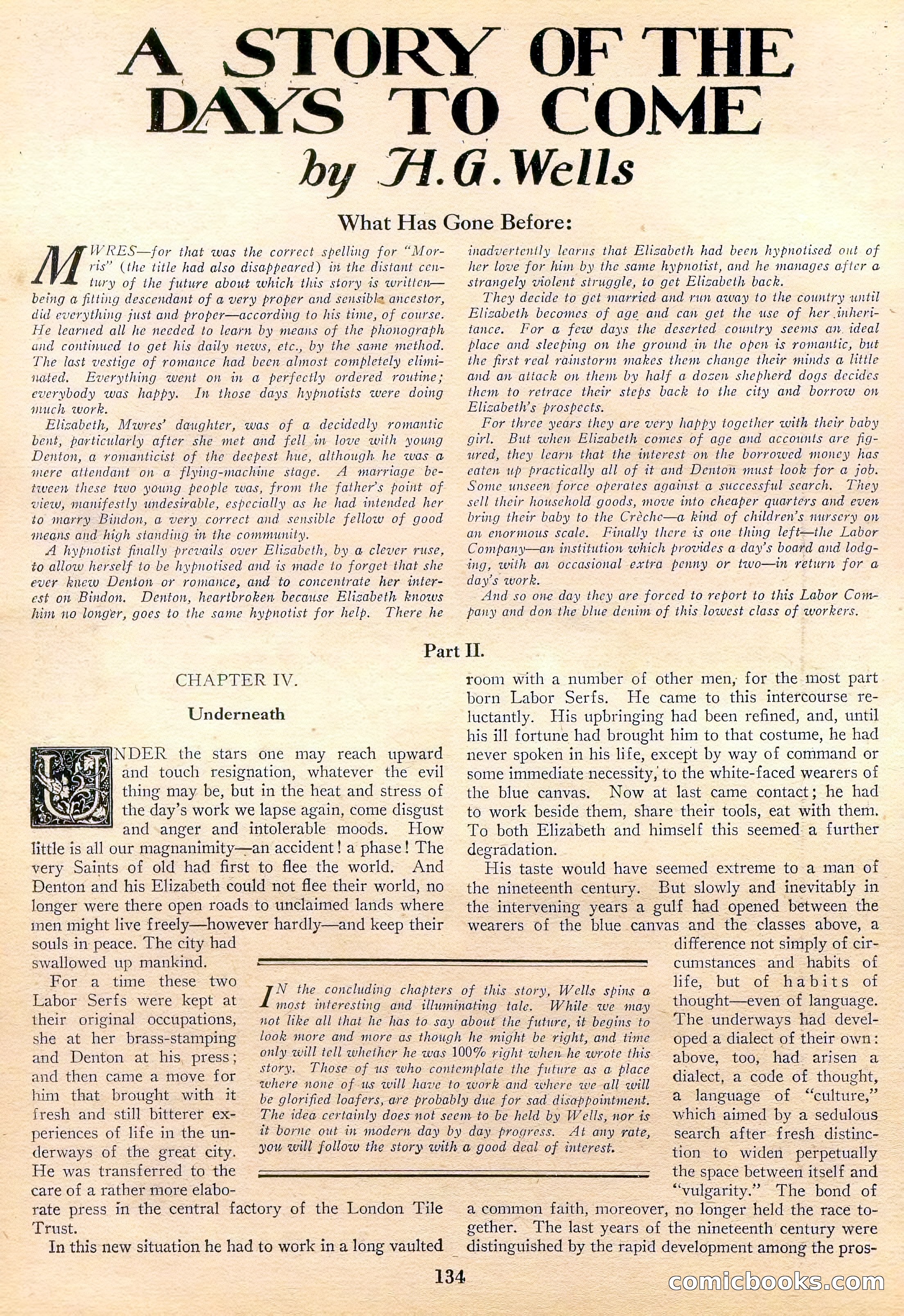
A restored page from Pulp Fiction, 1928. Page through the whole issue in the reader above.
📄 Transcribed text from this page (OCR, searchable)
Machine-transcribed from the original scan — historical spelling and the odd misread are preserved.
A STORY OF THE DAYS TO COME by F.G.Wells What Has Gone Before: WRES—for that was the correct spelling for “Mor- Mi: (the title had also disappeared) in the distant cen- tury of the future about which this story is written— being a filting descendant of a very proper and sensible ancestor, did everything just and proper—according to his time, of course. He learned all he needed to learn by means of the phonograph and continued to get his daily news, etc., by the same method. The last vestige of romance had been almost completely elimi- nated, Everything went on wm a perfectly ordered routine; everybody was happy. In those days hypnotists were doing much work. Elizabeth, Mwres’ daughter, was of a decidedly romantic bent, particularly after she met and fell in love with young Denton, a vomanticist of the deepest hue, although he was a mere attendant on a flying-machine stage. A marriage be- tween these two young people was, from the fathers point of view, manifestly undesirable, especially as he had intended her to marry Bindon, a very correct and sensible fellow of good means and high standing in the community, A hypnotist finally prevails over Elisabeth, by a@ clever ruse, to allow herself to be hypnotised and is made to forget that she every knew Denton or romance, and to concentrate her inter- est on Bindon. Denton, heartbroken because Elizabeth knows Jum no longer, goes to the same hypnotist for help. There he inadvertently learus that Elisabeth had been hypnotised out of her love for him by the same hypnotist, and he manages after a strangely violent struggle, to get Elisabeth back. They decide to get married and run away to the country wntil Elizabeth becomes of age and can get the use of her inheri- ~ tance. For a few days the deserted cowutry seems an. ideal place and sleeping on the ground in the open is romantic, but the first real rainstorm makes them change their minds a little and an attack on them by half a dosen shepherd dogs decides them to retrace their steps back to the city and borrow on Elisabeth’s prospects. For three years they are very happy together with their baby girl. But when Elisabeth comes of age and accounts are fig- ured, they learn that the interest on the borrowed money has eaten wp practically all of it and Denton must look for a job. Some unseen force operates against a successful search. They sell their household goods, move into cheaper quarters and even bring their baby to the Créche—a kind of children’s mursery on an enormous scale. Finally there is one thing left—the Labor Company—an institution which provides a day's board and lodg- ing, with an occasional extra penny or two—in return for a day’s work. And so one day they are forced to report to this Labor Com- pany and don the blue denim of this lowest class of workers. Part II. CHAPTER IV. Underneath NDER the stars one may reach upward and touch resignation, whatever the evil pq) thing may. be, but in the heat and stress of the day’s work we lapse again, come disgust and anger and intolerable moods. How little is all our magnanimity—an accident! a phase! The very Saints of old had first to flee the world. And Denton and his Elizabeth could not flee their world, no longer were there open roads to unclaimed lands where men might live freely—however hardly—and keep their souls in peace. The city had Kt! room with a number of other men, for the most part born Labor Serfs. He came to this intercourse re- luctantly. His upbringing had been refined, and, until his ill fortune had brought him to that costume, he had never spoken in his life, except by way of command or some immediate necessity, to the white-faced wearers of the blue canvas. Now at last came contact; he had to work beside them, share their tools, eat with them. To both Elizabeth and himself this seemed: a further degradation. His taste would have seemed extreme to a man of the nineteenth century. But slowly and inevitably in the intervening years a gulf had opened between the wearers of the blue canvas and the classes above, a difference not simply of cir- swallowed up mankind. For a time these two Labor Serfs were kept at their original occupations, she at her brass-stamping and Denton at his, press; and then came a move for him that brought with it fresh and still bitterer ex- periences of life in the un- derways of the great city. He was transferred to the care of a rather more elabo- rate press in the central factory of the London Tile Trust. be LT the concluding chapters of this story, Wells spins a most imteresting and illuminating tale. While we may not like all that he has to say about the future, it begins to look more and more as though he might be right, and time only will tell whether he was 100% right when he wrote this story, Those of us who contemplate the future as @ place where none of us will have to work and where we all will be glorified loafers, are probably due for sad disappointment. The idea certainly does not seem to be held by Wells, nor is it borne out in modern day by day progress. At any rate, you will follow the story with @ good deal of interest. - cumstances and habits of life, but of habits of thought—even of language. ~The underways had devel- oped a dialect of their own: above, too, had arisen a dialect, a code of thought, a language of “culture,” which aimed by a sedulous search after fresh distinc- tion to widen perpetually the space between itself and “vulgarity.” The bond of a common faith, moreover, no longer held the race to- gether. The last years of the nineteenth century were In this new situation he had to work ina long vaulted distinguished by the rapid development among the pros- 134 conmicloookks.conn