
Pulp Fiction, 1928 · page 35 of 100
Amazing Stories, Vol. 3, No. 2 — page 35: what you’re looking at
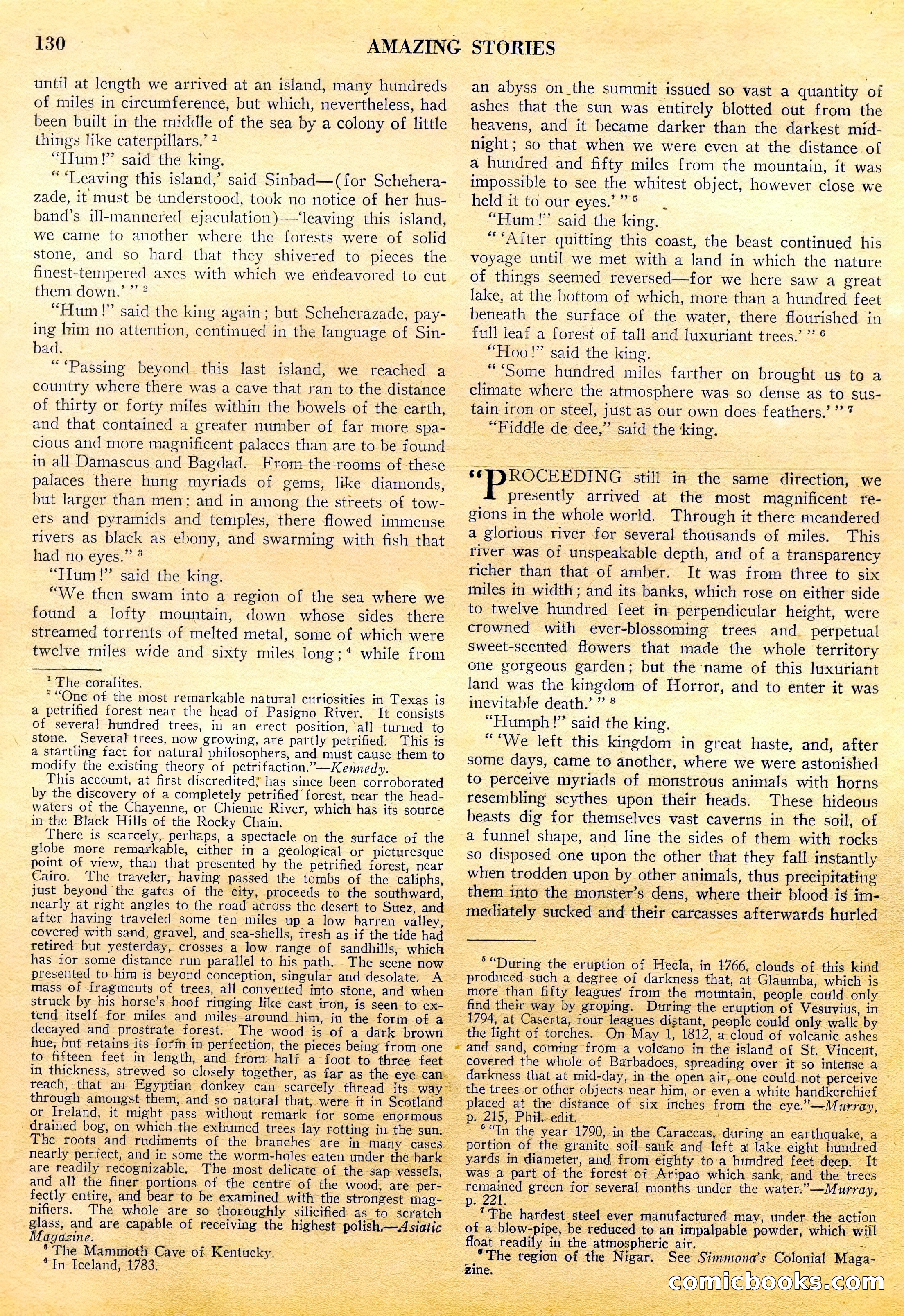
A restored page from Pulp Fiction, 1928. Page through the whole issue in the reader above.
📄 Transcribed text from this page (OCR, searchable)
Machine-transcribed from the original scan — historical spelling and the odd misread are preserved.
130 until at length we arrived at an island, many hundreds of miles in circumference, but which, nevertheless, had been built in the middle of the sea by a colony of little things like caterpillars.’ 2 “Hum!” said the king. ““Leaving this island,’ said Sinbad—(for Schehera- zade, it must be understood, took no notice of her hus- band’s ill-mannered ejaculation)—‘leaving this island, we came to another where the forests were of solid stone, and so hard that they shivered to pieces the finest-tempered axes with which we endeavored to cut them down.’ ” “Hum!” said the king again; but Scheherazade, pay- ing him no attention, continued in the language of Sin- bad. ““Passing beyond this last island, we reached a country where there was a cave that ran to the distance of thirty or forty miles within the bowels of the earth, and that contained a greater number of far more spa- cious and more magnificent palaces than are to be found 2 in all Damascus and Bagdad. From the rooms of these - palaces there hung myriads of gems, like diamonds, but larger than men; and in among the streets of tow- ers and pyramids and temples, there flowed immense rivers as black as ebony, and swarming with fish that had no eyes.” * ; “Hum!” said the king, “We then swam into a region of the sea where we found a lofty mountain, down whose sides there streamed torrents of melted metal, some of which were twelve miles wide and sixty miles long;* while from * The coralites. *“One of the most remarkable natural curiosities in Texas is a petrified forest near the head of Pasigno River. It consists of several hundred trees, in an erect position, ‘all turned to stone, Several trees, now growing, are partly petrified. This is a startling fact for natural philosophers, and must cause them to modify the existing theory of petrifaction.”—K ennedy. This account, at first discredited* has since been corroborated by the discovery of a completely petrified’ forest, near the head- waters of the Chayenne, or Chienne River, which has its source in the Black Hills of the Rocky Chain. There is scarcely, perhaps, a spectacle on the surface of the globe more remarkable, either in a geological or picturesque point of view, than that presented by the petrified forest, near Cairo. The traveler, having passed the tombs of the caliphs, just beyond the gates of the city, proceeds to the southward, nearly at right angles to the road across the desert to Suez, and after having traveled some ten miles up a low barren valley, covered with sand, gravel, and sea-shells, fresh as if the tide had retired but yesterday, crosses a low range of sandhills, which has for some distance run parallel to his path. The scene now presented to him is beyond conception, singular and desolate. A mass of fragments of trees, all converted into stone, and when struck by his horse’s hoof ringing like cast iron, is seen to ex- tend itself for miles and miles around him, in the form of a decayed and prostrate forest. The wood is of a dark brown hue, but retains its form in perfection, the pieces being from one to fifteen feet in length, and from half a foot to three feet in thickness, strewed so closely together, as far as the eye Cail. reach, that an Egyptian donkey can scarcely thread its wa through amongst them, and so natural that, were it in Scotland or Ireland, it might pass without remark for some enormous drained bog, on which the exhumed trees lay rotting in the sun, The roots and rudiments of the branches are in many cases nearly perfect, and in some the worm-holes eaten under the bark are readily recognizable, The most delicate of the sap vessels, and all the finer portions of the centre of the wood, are per- — fectly entire, and bear to be examined with the strongest mag- nifiers. The whole are so thoroughly silicified as to scratch glass, and are capable of receiving the highest polish—Asiatic Magazine. i * The Mammoth Cave of Kentucky. *In Iceland, 1783. - AMAZING STORIES an abyss on the summit issued so vast a quantity of ashes that the sun was entirely blotted out from the heavens, and it became darker than the darkest mid- night; so that when we were even at the distance of a hundred and fifty miles from the mountain, it was impossible to see the whitest object, however close we held it to our eyes.’ ”’® “Hum!” said the king, ““After quitting this coast, the beast continued his voyage until we met with a land in which the nature of things seemed reversed—for we here saw a great lake, at the bottom of which, more than a hundred feet beneath the surface of the water, there flourished in full leaf a forest of tall and luxuriant trees,’ ” ¢ “Hoo!” said the king. ““Some hundred miles farther on brought us to a climate where the atmosphere was so dense as to sts- tain iron or steel, just as our own does feathers.’ ” 7 “Fiddle de dee,” said the icing. “pres Ns still in the same direction, we presently arrived at the most magnificent re- gions in the whole world. Through it there meandered a glorious river for several thousands of miles. This river was of unspeakable depth, and of a transparency richer than that of amber. It was from three to six miles in width ; and its banks, which rose on either side to twelve hundred feet in perpendicular height, were crowned with ever-blossoming trees and_ perpetual Sweet-scented: flowers that made the whole territory one gotgeous garden; but the ‘name of this luxuriant land was the kingdom of Horror, and to enter it was inevitable death.’ ” § “Humph!” said the king. “We left this kingdom in great haste, and, after some days, came to another, where we were astonished to perceive myriads of monstrous animals with horns resembling scythes upon their heads. These hideous beasts dig for themselves vast caverns in the soil, of a funnel shape, and line the sides of them with rocks so disposed one upon the other that they fall instantly when trodden upon by other animals, thus precipitating them into the monster’s dens, where their blood ig im- mediately sucked and their carcasses afterwards hurled *“During the eruption of Hecla, in 1766, clouds of this kind produced such a degree of darkness that, at Glaumba, which is more than fifty leagues from the mountain, people could only = find their way by groping. During the eruption of Vesuvius, in — 1794, at Caserta, four leagues distant, people could only walk by the light of torches. On May 1, 1812, a cloud of volcanic ashes « and sand, coming from a volcano in the island of St. Vincent, covered the whole of Barbadoes, spreading over it so intense a - the trees or other objects near him, or even a white handkerchief placed at the distance of six inches from the eye."—Murray, _ — p. 215, Phil, edit, Se ee - °“Tn the year 1790, in the Caraccas, during an earthquake, a portion of the granite soil sank and left ai lake eight hundred darkness that at mid-day, in the open air, one could not perceive — _ yards in diameter, and from eighty to'a hundred feet deep. It was a part of the forest of Aripao which sank, and the trees remained green for several months under the water.”—Murray, 221 ; : “The hardest steel ever manufactured may, under the action of a blow-pipe, be reduced to an impalpable float readily in the atmospheric air, _." The tegion of the Nigar. See Simmona's Zine. powder, which wiil ona’s Colonial Maga- = COnMIC IOOKS.COM