
Pulp Fiction, 1928 · page 30 of 100
Amazing Stories, Vol. 3, No. 2 — page 30: what you’re looking at
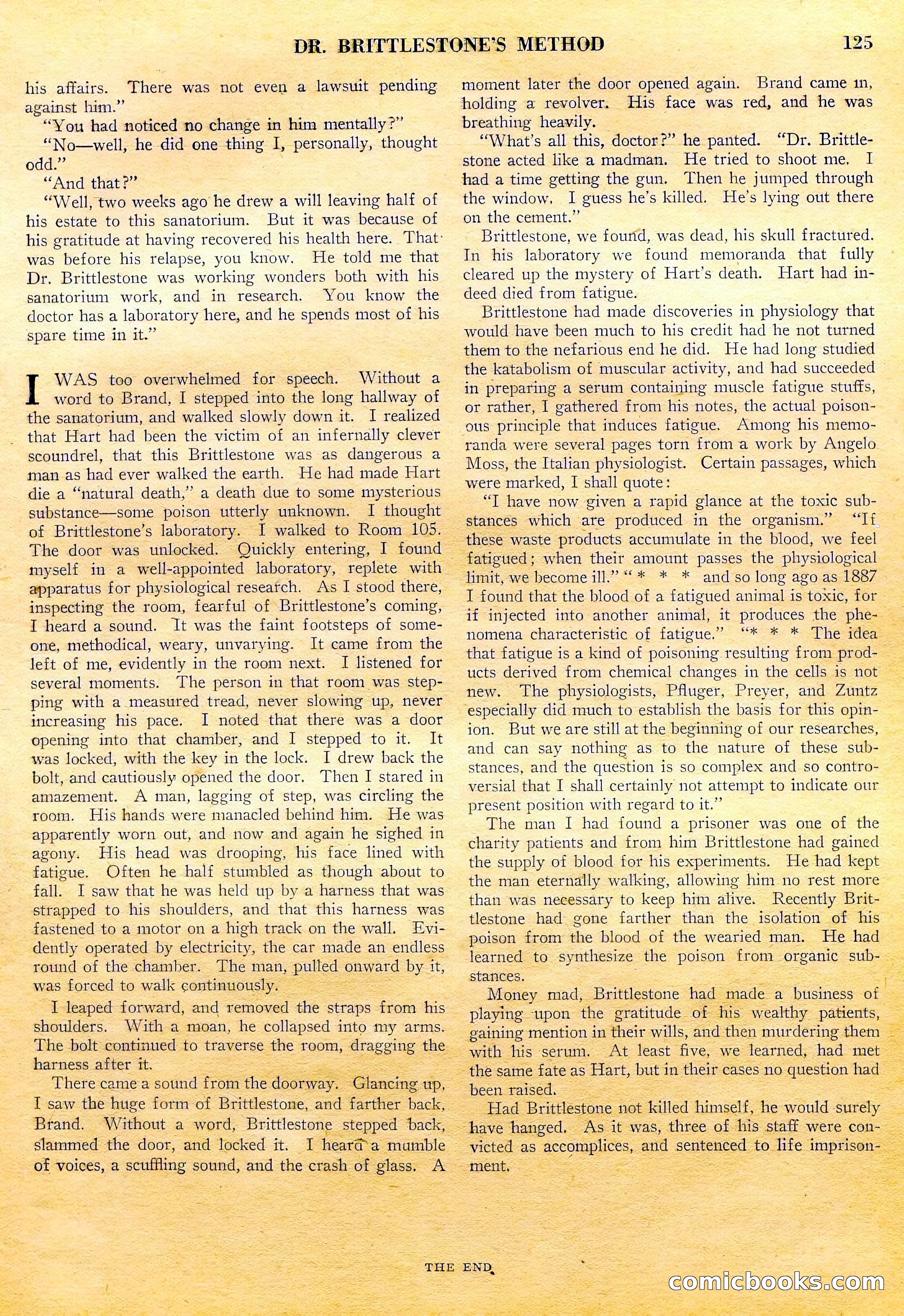
A restored page from Pulp Fiction, 1928. Page through the whole issue in the reader above.
📄 Transcribed text from this page (OCR, searchable)
Machine-transcribed from the original scan — historical spelling and the odd misread are preserved.
DR. BRITTLESTONE’S METHOD his affairs. There was not even a lawsuit pending against him.” “You had noticed no change in him mentally?” “No—well, he did one thing I, personally, thought odd.” “And that?” “Well, two weeks ago he drew a will leaving half of his estate to this sanatorium. But it was because of his gratitude at having recovered his health here. That: was before his relapse, you know. He told me that Dr. Brittlestone was working wonders both with his sanatorium work, and in research. You know the doctor has a laboratory here, and he spends most of his spare time in it.” I WAS too overwhelmed for speech. Without a word to Brand, I stepped into the long hallway of the sanatorium, and walked slowly down it. I realized that Hart had been the victim of an infernally clever scoundrel, that this Brittlestone was as dangerous a man as had ever walked the earth. He had made Hart die a “natural death,’ a death due to some mysterious substance—some poison utterly unknown. I thought of Brittlestone’s laboratory. I walked to Room 105. The door was unlocked. Quickly entering, I found myself in a well-appointed laboratory, replete with apparatus for physiological reseatch. As I stood there, inspecting the room, fearful of Brittlestone’s coming I heard a sound. It was the faint footsteps of some- one, methodical, weary, unvarying. It came from the left of me, evidently in the room next. I listened for several moments. The person in that room was step- ping with a measured tread, never slowing up, never increasing his pace. I noted that there was a door opening into that chamber, and I stepped to it. It was locked, with the key in the lock. I drew back the bolt, and cautiously opened the door. Then I stared in amazement. A man, lagging of step, was circling the room. His hands were manacled behind him. He was apparently worn out, and now and again he sighed in agony. His head was drooping, his face lined with fatigue. Often he half stumbled as though about to fall. I saw that he was held up by a harness that was strapped to his shoulders, and that this harness was fastened to a motor on a high track on the wall. Evi- dently operated by electricity, the car made an endless round of the chamber. The man, gullet onward by it, was forced to walk continuously, “a leaped forward, and removed “the straps from his shoulders. With a moan, he collapsed into my arms. The bolt continued to traverse athe room, - harness after it. There came a sound from he Meee I saw the huge form of Brittlestone, and farther back, : Brand. Without a word, Brittlestone : stepped back, = slammed the door, and locked it, I. shear@-a of voices, a scuffing sound, and the crash dragging the _ with his serum. the same fate as ate but in their cases no question had = been raised. : victed 2 as ASOOTEPNICES. and senten ed to. aie Pees 125 moment later the door opened again. Brand came 1n, holding a revolver. His face was red, and he was breathing heavily. “What's all this, doctor?” he panted. “Dr. Brittle- stone acted like a madman. He tried to shoot me, I had a time getting the gun. Then he jumped through the window, I guess he’s killed. He’s lying out there on the cement.” Brittlestone, we fourid, was dead, his skull fractured. In his laboratory we found memoranda that fully cleared up the mystery of Hart’s death. Hart had in- deed died from fatigue. Brittlestone had made discoveries in physiology that would have been much to his credit had he not turned them to the nefarious end he did. He had long studied the katabolism of muscular activity, and had succeeded in preparing a serum containing muscle fatigue stuffs, or rather, I gathered from his notes, the actual poison- ous principle that induces fatigue. Among his memo- ‘randa were several pages torn cota a work by Angelo Moss, the Italian physiologist. Certain passages, which were marked, I shall quote: “T have now given a rapid glance at the toxic sub- stances which are produced in the organism.” “If _ these waste products accumulate in the blood, we feel - fatigtied; when their amount passes the physiological limit, we become ill.” “*‘* * * andso long ago as 1887 I found that the blood of a fatigued animal is toxic, for if injected into another animal, it produces the phe- nomena characteristic of fatigue.” “* * * The idea that fatigue is a kind of poisoning resulting from prod- ucts derived from chemical changes in the cells is not — new. The physiologists, Pfluger, Preyer, and Zuntz especially did much to establish the basis for this opin- ion. But weare still at the beginning of our researches, and can say nothing as to the nature of these sub- stances, and the question is so complex and so contro- versial that I shall certainly not attempt to indicate our present position with regard to it.” The man I had found a prisoner was one of the charity patients and from him Brittlestone had gained the supply of blood for his experiments. He had kept the man eternally walking, allowing him no rest more than was necessaty to keep him alive. Recently Brit- tlestone had gone farther than the isolation of his poison from the blood of the wearied man. He had learned to synthesize the poison from organic Sune stances. Money mad, Brittlestone had eae a business lot playing ‘upon the gratitude of his wealthy patients, gaining mention in their wills, and then murdering them At least five, we learned, had met Had Brittlestone ‘not killed himself, he would. surely “have thanged. As it was, three of his staff were con- _ comichooks.com