
Pulp Fiction, 1928 · page 24 of 100
Amazing Stories, Vol. 3, No. 2 — page 24: what you’re looking at
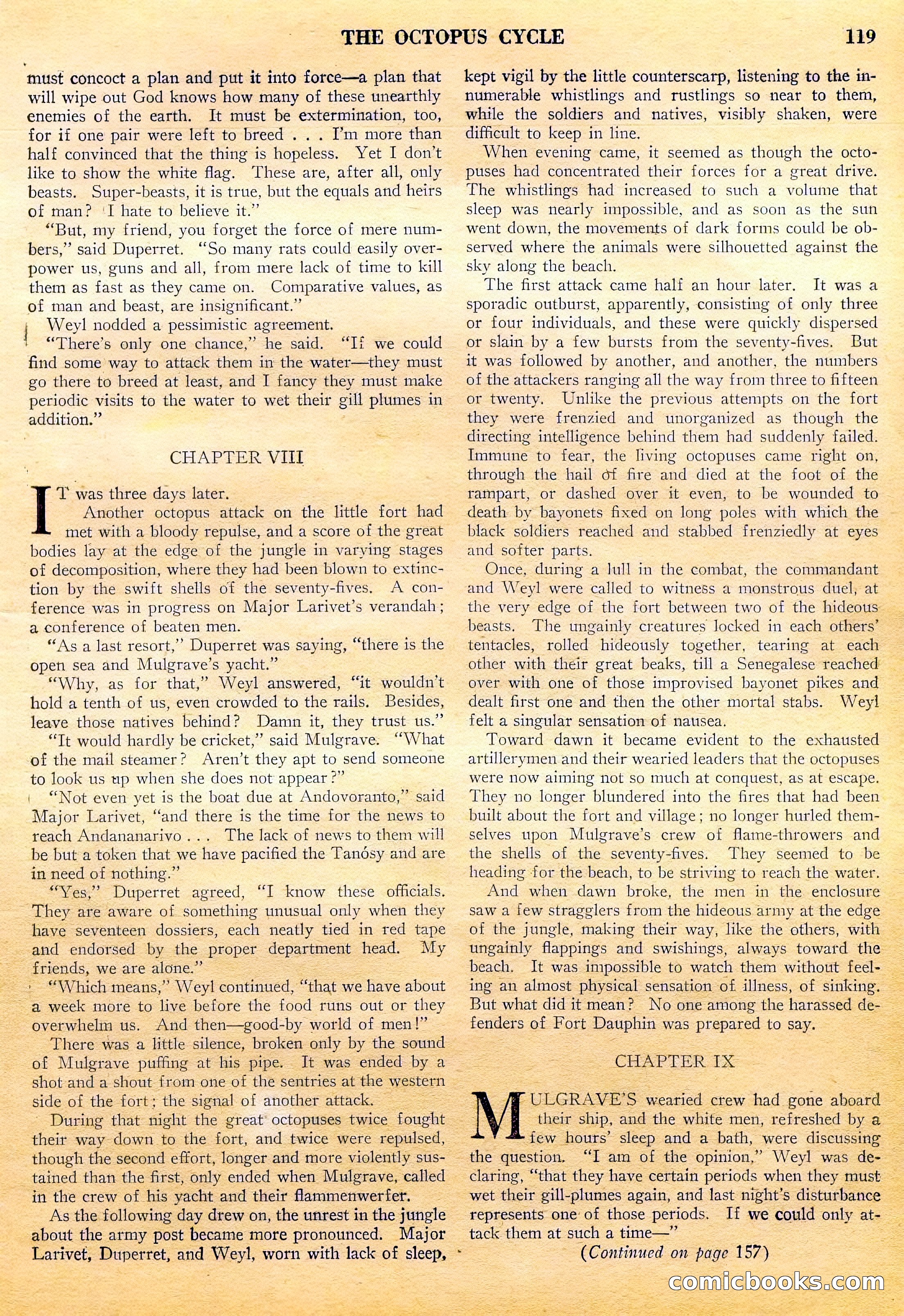
A restored page from Pulp Fiction, 1928. Page through the whole issue in the reader above.
📄 Transcribed text from this page (OCR, searchable)
Machine-transcribed from the original scan — historical spelling and the odd misread are preserved.
THE OCTOPUS CYCLE ¥ must concoct a plan and put it into force—a plan that will wipe out God knows how many of these unearthly enemies of the earth. It must be extermination, too, for if one pair were left to breed . . . I’m more than half convinced that the thing is hopeless. Yet I don’t like to show the white flag. These are, after all, only beasts. Super-beasts, it is true, but the equals and heirs of man? ‘I hate to believe it.” “But, my friend, you forget the force of mere num- bers,” said Duperret. “So many rats could easily over- power us, guns and all, from mere lack of time to kill them as fast as they came on. Comparative values, as of man and beast, are insignificant.” i Weyl nodded a pessimistic agreement. ' “There’s only one chance,” he said. “Ii we could find some way to attack them in the water—they must go there to breed at least, and I fancy they must make periodic visits to the water to wet their gill plumes in addition.” CHAPTER VIII “WU T was three days later. I Another octopus attack on the little fort had met with a bloody repulse, and a score of the great bodies lay at the edge of the jungle in varying stages of decomposition, where they had been blown to extinc- tion by the swift shells of the seventy-fives, A con- ference was in progress on Major Larivet’s verandah ; a conference of beaten men. “As a last resort,” Duperret was saying, open sea and Mulgrave’s yacht.” “Why, as for that,’ Weyl answered, “it wouldn't hold a tenth of us, even crowded to the rails. Besides, leave those natives behind? Damn it, they trust us.” “Tt would hardly be cricket,” said Mulgrave. “What of the mail steamer? Aren't they apt to send someone to look us up when she does not appear?” i “Not even yet is the boat due at Andovoranto,” said Major Larivet, ‘and there is the time for the news to reach Andananarivo... The lack of news to them will be but a token that we have pacified the Tandsy and are in need of nothing.” “Yes,” Duperret agreed, “I know these officials. _ They are aware of something unusual only when they have seventeen dossiers, each neatly tied in red tape and endorsed by the proper department head. My friends, we are alone.” » “Which means,” Weyl continued, “that we have about ~ a week more to live before the food runs out or they overwhelm us. And then—good-by world of men!” There was a little silence, broken only by the sound ‘there is the of Mulgrave puffing at his pipe. It was ended by a — shot and a shout from one of the sentries at the ee side of the fort; the signal of another attack. During that night the great’ octopuses twice fought their way down to the fort, and twice were repulsed, - though the second effort, longer and more violently sus- tained than the first, only ended when Mulgrave, called in the crew of his yacht and their flammenwerfer. As the following day drew on, the unrest in the jungle about the army post became more pronounced. Major Larivet, Duperret, and Weyl, worn with lack of sleep, the question, 119 kept vigil by the little counterscarp, listening to the in- numetable whistlings and rustlings so near to them, while the soldiers and natives, visibly shaken, were difficult to keep in line, When evening came, it seemed as though the octo- puses had concentrated their forces for a great drive. The whistlings had increased to such a voluine that sleep was tiearly impossible, and as soon as the sun went down, the movements of dark forms could be ob- served where the animals were silhouetted against the sky along the beach. The first attack came half an hour later. It was a sporadic outburst, apparently, consisting of only three or four individuals, and these were quickly dispersed or slain by a few bursts from the seventy-fives. But it was followed by another, and another, the numbers of the attackers ranging all the way from three to fifteen or twenty. Unlike the previous attempts on the fort they were frenzied and unorganized as though the directing intelligence behind them had suddenly failed. Immune to fear, the living octopuses came right on, through the hail of fire and died at the foot of the rampart, or dashed over it even, to be wounded to death by bayonets fixed on long poles with which the black soldiers reached and stabbed frenziedly at eyes and softer parts. Once, during a lull in the combat, the commandant and Weyl were called to witness a monstrous duel, at the very edge of the fort between two of the hideous beasts. The ungainly creatures locked in each others’ tentacles, rolled hideously together, tearing at each other with their great beaks, till a Senegalese reached over with one of those improvised bayonet pikes and dealt first one and then the other mortal stabs. Weyl felt a singular sensation of nausea. Toward dawn it became evident to the exhausted artillerymen and their wearied leaders that the octopuses were now aiming not so much at conquest, as at escape. They no longer blundered into the fires that had been built about the fort and village; no longer hurled them- selves upon Mulgrave’s crew of flame-throwers and the shells of the seventy-fves. They seemed to be heading for the beach, to be striving to reach the water, And when dawn broke, the men in the enclosure saw a few stragglers from the hideous army at the edge of the jungle, making their way, like the others, with — ungainly flappings and swishings, always toward the beach. It was inipossible to watch them without feel- ing an almost physical sensation of illness, of sinking. — But what did it mean? No one among the harassed de- fenders of Fort Dauphin was prepared to say. CHAPTER IX JW ULGRAVE’S wearied crew had gone aboard | # their ship, and the white men, refreshed by a -few hours’ sleep and a bath, were discussing — “Tam of the opinion,” Weyl was de- claring, “that they have certain periods when they must wet their gill-plumes again, and last night's disturbance represents one of those periods. Ii we could only at-— tack them at ‘stich a time— ee (Continued on page 157) GOMICLOOKEE ‘com