
Pulp Fiction, 1928 · page 20 of 100
Amazing Stories, Vol. 3, No. 2 — page 20: what you’re looking at
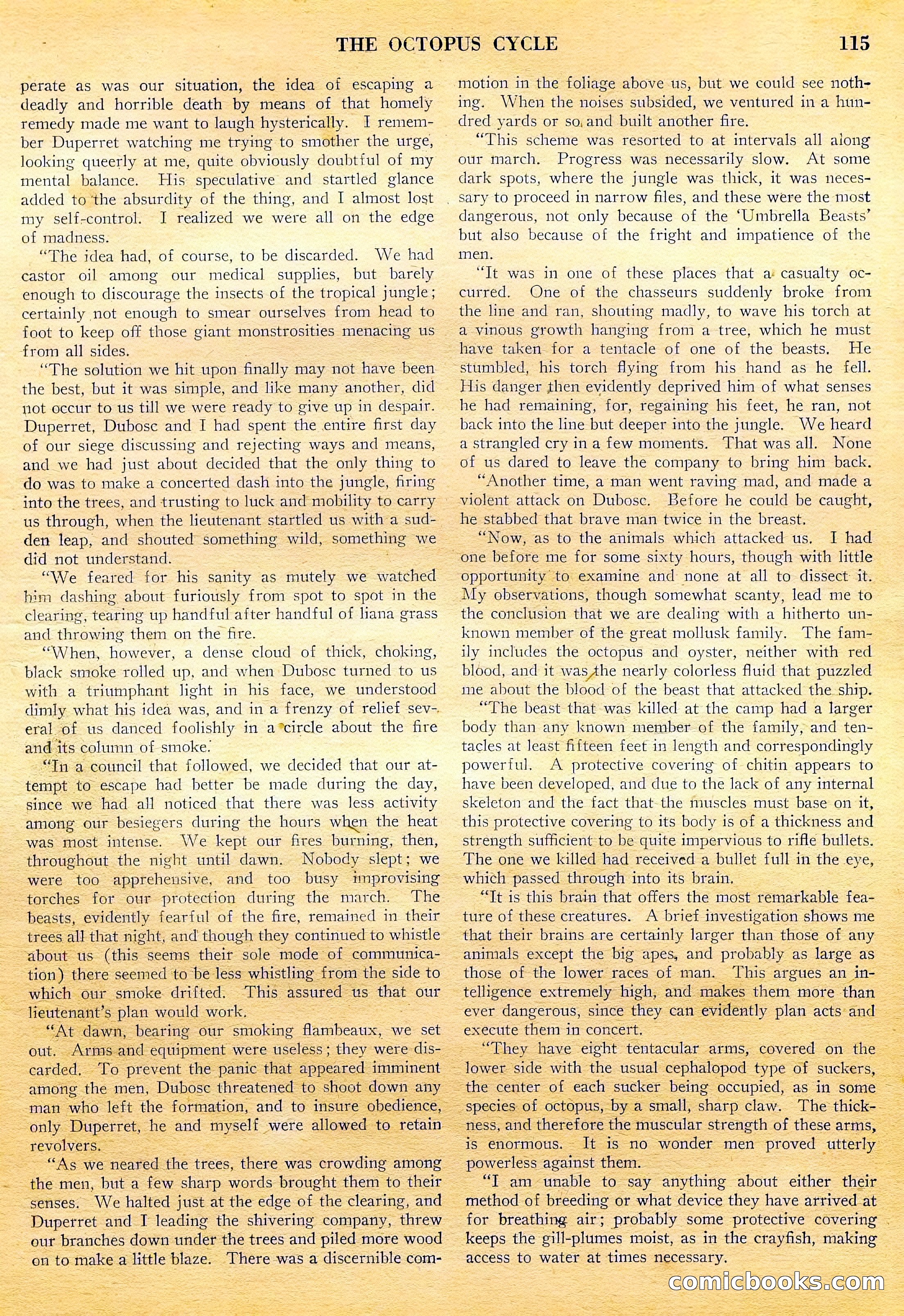
A restored page from Pulp Fiction, 1928. Page through the whole issue in the reader above.
📄 Transcribed text from this page (OCR, searchable)
Machine-transcribed from the original scan — historical spelling and the odd misread are preserved.
| THE OCTOPUS CYCLE perate as was our situation, the idea of escaping a deadly and horrible death by means of that homely remedy made me want to laugh hysterically. I remem- ber Duperret watching me trying to smother the urge, looking queerly at me, quite obviously doubtful of my mental balance. His speculative and startled glance added to the absurdity of the thing, and I almost lost my self-control. I realized we were all on the edge of madness. “The idea had, of course, to be discarded. We had castor oil among our medical supplies, but barely enough to discourage the insects of the tropical jungle ; certainly not enough to smear ourselves from head to foot to keep off those giant monstrosities menacing us from all sides. “The solution we hit upon finally may not have been the best, but it was simple, and like many another, did vot occur to us till we were ready to give up in despair. Duperret, Dubosc and I had spent the entire first day of our siege discussing and rejecting ways and means, and we had just about decided that the only thing to do was to make a concerted dash into the jungle, firing into the trees, and trusting to luck and mobility to carry us through, when the lieutenant startled us with a sud- den leap, and shouted something wild, something “we did not understand. “We feared for his sanity as mutely we watched him dashing about furiously from spot to spot in the clearing, tearing up handful after handful of lana grass and throwing them on the fire. ‘When, however, a dense cloud of thick, choking, black smoke rolled up, and when Dubosc turned to us with a triumphant light in his face, we understood dimly what his idea was, and in a frenzy of relief sev-. eral of us danced foolishly in a*circle about the fire and its column of smoke: “Tn a council that followed, we decided that our at- tempt to escape had better be made during the day, since we had all noticed that there was less activity among our besiegers during the hours when the heat was most intense. We kept our fires burning, then, throughout the night until dawn. Nobody slept; we were too apprehensive, and too busy tmprovising - torches for our protection during the march. The beasts, evidently fearful of the fire, remained in their trees all that night, and though they continued to whistle ‘about us” (this < seems theit sole mode of communica- tion) | tere seemed to be less whistling from the side to b smoke drifted. oS assured “us that our 2 ee ‘senses. We halted just at the edge of the clearing, and Duperret and I leading the shivering company, threw out branches down under: the trees and piled more wood on to make a little blaze. There was a discernible com- = the center of each sucker being occupied, as in some = is semen See we neared. the oS there was Seach among --- the men, but a few sharp words brought them to their 115 motion in the foliage above us, but we could see noth- ing. When the noises subsided, we ventured in a hun- dred yards or so.and built another fire. “This scheme was resorted to at intervals all along our march. Progress was necessarily slow. At some dark spots, where the jungle was thick, it was neces- _ sary to proceed in narrow files, and these were the most dangerous, not only because of the ‘Umbrella Beasts’ but also because of the fright and impatience of the men. “Tt was in one of these places that a casualty oc- curred, One of the chasseurs suddenly broke from the line and ran, shouting madly, to wave his torch at a vinous growth hanging from a tree, which he must have taken for a tentacle of one of the beasts. He stumbled, his torch flying from his hand as he fell. His danger then evidently deprived him of what senses he had remaining, for, regaining his feet, he ran, not back into the line but deeper into the jungle. We heard a strangled cry ina few moments. That was all. None of us dared to leave the company to bring him back. “Another time, a man went raving mad, and made a violent attack on Dubose. Before he could be caught, he stabbed that brave man twice in the breast. “Now, as to the animals which attacked us. I had ~one before me for some sixty hours, though with little opportunity to examine and none at all to dissect it. My observations, though somewhat scanty, lead me to the conclusion that we are dealing with a hitherto un- known member of the great mollusk family. The fam- ily includes the octopus and oyster, neither with red blood, and it was Ahe nearly colorless fluid that puzzled me about the blood of the beast that attacked the ship. “The beast that was killed at the camp had a larger body than any known member-of the family, and ten- tacles at least fifteen feet in length and correspondingly powerful. A protective covering of chitin appears to have been developed, and due to the lack of any internal skeleton and the fact that-the muscles must base on it, this protective covering to its body is of a thickness and strength sufficient to be quite impervious to rifle bullets. The one we killed had received a bullet full in the eye, which passed through into its brain, “Tt is this brain that offers the most remarkable fea- ture of these creatures. A brief investigation shows me that their brains are certainly larger than those of any animals except the big apes, and: probably as large, as those of the lower races of man. This argues an in- telligence extremely” high, and. makes ern more than = ever dangerous, since they can evi ey plan acts’ and eos execute them in concert, — “They have eight tentacular arms, Sravered on the - lower side with the usual cephalopod type of suckers, te is no ‘wonder men proved utter powerless against them. : OE am unable to say hie about either their “method of breeding or what device they have arrived ; at for breathing air; probably some protective covering keeps the gill-plumes moist, as in the crayfish, making access to mance at times ey: - CONMIGEOOKS: com 2