
Pulp Fiction, 1928 · page 17 of 100
Amazing Stories, Vol. 3, No. 2 — page 17: what you’re looking at
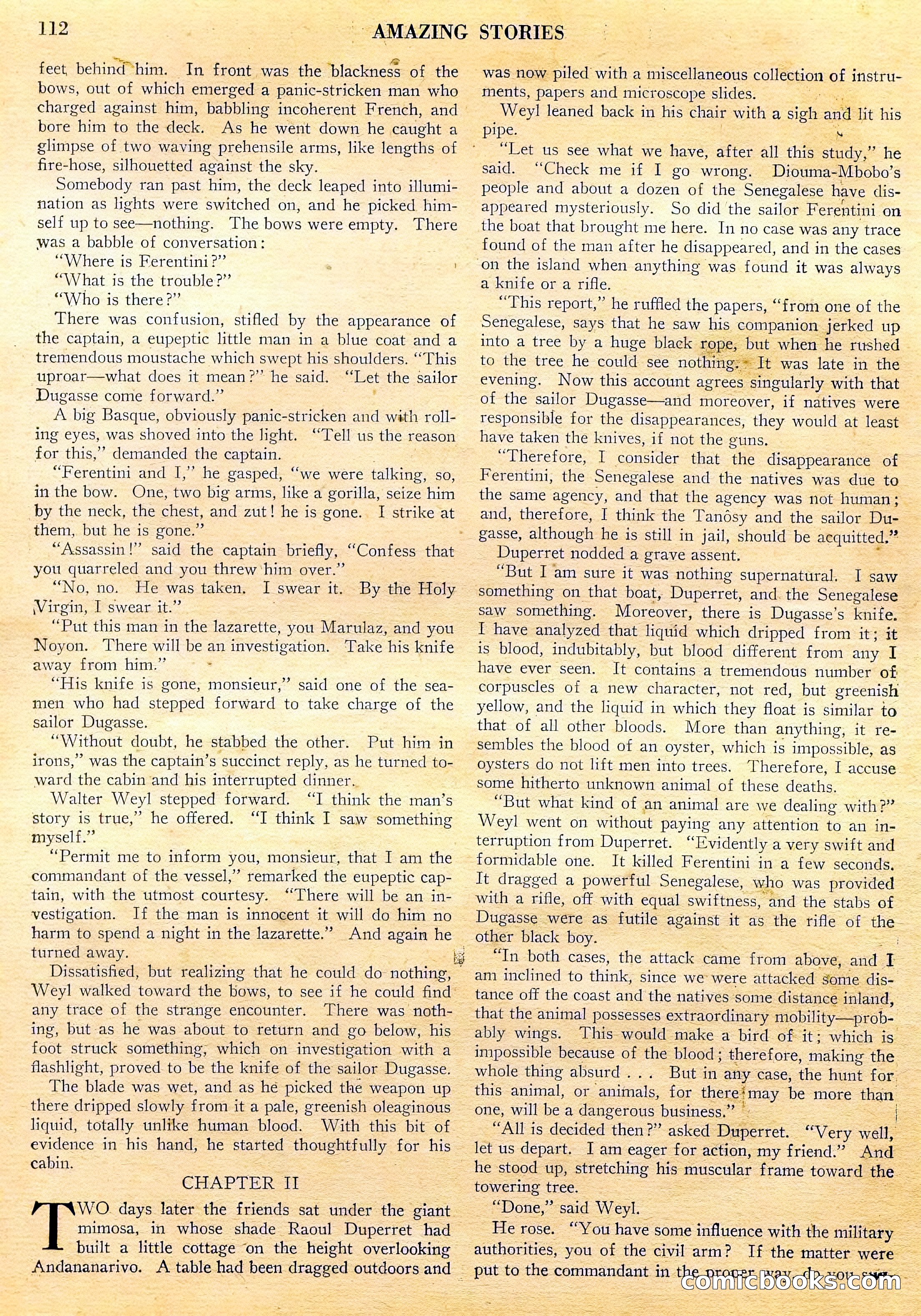
A restored page from Pulp Fiction, 1928. Page through the whole issue in the reader above.
📄 Transcribed text from this page (OCR, searchable)
Machine-transcribed from the original scan — historical spelling and the odd misread are preserved.
2 - AMAZING “, ae feet, behind him. In front was the blackness of the bows, out of which emerged a panic-stricken man who charged against him, babbling incoherent French, and — bore him to the deck. As he went down he caught a glimpse of two waving prehensile arms, like lengths of fire-hose, silhouetted against the sky. Somebody ran past him, the deck leaped into illumi- nation as lights were switched on, and he picked him- self up to see—nothing. The bows were empty. There was a babble of conversation: “Where is Ferentini?” . “What is the trouble?” “Who is there?” There was confusion, stifled by the appearance of the captain, a eupeptic little man in a blue coat and a tremendous moustache which swept his shoulders. “This uproar—what does it mean?” he said. “Let the sailor Dugasse come forward.” : A big Basque, obviously ing eyes, was shoved into the light. for this,” demanded the captain. “Ferentini and I,” he gasped, “we were talking, SO, in the bow. One, two big arms, like a gorilla, seize ier by the neck, the chest, are auth he is gone. I strike at them, but he is gone.” . “Assassin!” said the captain briefly, “Confess that you quarreled and you threw ‘him over.” “No, no. He was taken. I swear it. Virgin, I swear it.” “Put this man in the lazarette, you Marulaz, and you Noyon. There will be an investigation. Take his knife away from him.” “His knife is gone, monsieur,” said one of the sea- men who had stepped forward to take charge of the sailor Dugasse. “Without doubt, he stabbed the other. Put him in irons,” was the captain’s succinct reply, as he turned to- ward the cabin and his interrupted dinner. Walter Weyl stepped forward. “I think the man’s story is true,” he offered. “T think I saw something myself.” “Permit me to inform you, monsieur, that I am the commandant of the vessel,’ remarked the eupeptic cap- tain, with the utmost courtesy. “There will be an in- vestigation. If the man is innocent it will do him no harm to spend a night in the lazarette.”” And again he turned away. panic-stricken and with roll- “Tell us the reason By the Holy > ig Dissatisfied, but realizing that he could do nothing, Weyl walked toward the hows, to see if he could find any trace of the strange encounter. There was noth- ing, but as he was about to return and go below, his foot struck something, which on investigation with a flashlight, proved to be the knife of the sailor Dugasse. The blade was wet, and as hé picked the weapon up there dripped slowly from it a pale, greenish oleaginous liquid, totally unlike human blood. With this bit of evidence in his hand, he started thoughtfully for his cabin. CHAPTER II WO. days later the friends sat under the giant mimosa, in whose shade Raoul Duperret had built a little cottage on the height overlooking Andananarivo. A table had been dragged outdoors and STORIES. was now. piled with a miscellaneous collection of instru- ments, papers and microscope slides. Weyl leaned back in his chair with a sige and lit his pipe. ‘ “Let us see what we have, after all this study,” he said. “Check me if I go wrong. Diouma- Mbobo’s people and about a dozen of the Senegalese have dis- appeared mysteriously. So did the sailor Ferentini on the boat that brought me here. In no case was any trace found of the man Sie he disappeared, and in the cases ‘on the island when anything was found it was always a knife or a rifle. “This report,” he ruffled the papers, “from one of the Senegalese, says that he saw his companion jerked up into a tree by a huge black rope, but when he rushed to the tree he could see nothing It was late in the evening. Now this account agrees singularly with that of the lion Dugasse—and moreover, if natives were responsible for the disappearances, they would at least have taken the knives, if not the gtins. “Therefore, I consider that the disappearance of Ferentini, the Senegalese and the natives was due to the same agency, and that the agency was not human; and, therefore, I think the Tandsy and the sailor Du- gasse, although he is still in jail, should be aequitted,” Duperret modded a gtave assent. “But I am sure it was nothing supernatural. I saw something on that boat, Duperret, and. the Senegalese saw someting: Moreover there is Dugasse’s knife. I have analyzed that liquid which dripped from it; it is blood, indubitably, but blood different from any I have ever seen. It contains a tremendous number of corpuscles of a new character, not red, but greenish yellow, and the liquid in which they Heart is similar to that of all other bloods. More than anything , it Te- sembles the blood of an oyster, which is impossible, as oysters do not lift men into trees. Therefore, I accuse some hitherto unknown animal of these deaths. “But what kind of an animal are we dealing with?” Weyl went on without paying any attention to an in- terruption from Duperret. “Evidently a very swift and formidable one. It killed Ferentini in a few seconds, It dragged a powerful Senegalese, who was provided with a rifle, off with equal swiftness, and the stabs of Dugasse were as futile against it as the rifle of the- _ other black boy. “In both cases, the attack came from above, and. ae am inclined to think since we were attacked some dis- tance off the coast and the natives some distance inland, that the animal possesses extraordinary mobility—prob- ably wings. This would make a bird of it; which is impossible because of the blood; therefore, making the whole thing absurd . But in any case, the hunt for. this animal, or “Anitnals: for there‘ may be more than one, will be a dangerous business.” “Allis decided then?” asked Duperret. “Very nee let us depart. I am eager for action, my friend.’ And ~ he stood up, stretching his: smuscular frame toward the. : towering tree. “Done,” said Weyl. = He rose. “You have some influence with the miieay, = authorities, you of the civil arm? If the matter were — put to the commandant in. eECOMEHSOKS COW