
Pulp Fiction, 1927 · page 97 of 105
Amazing Stories, Vol. 2, No. 2 — page 97: what you’re looking at
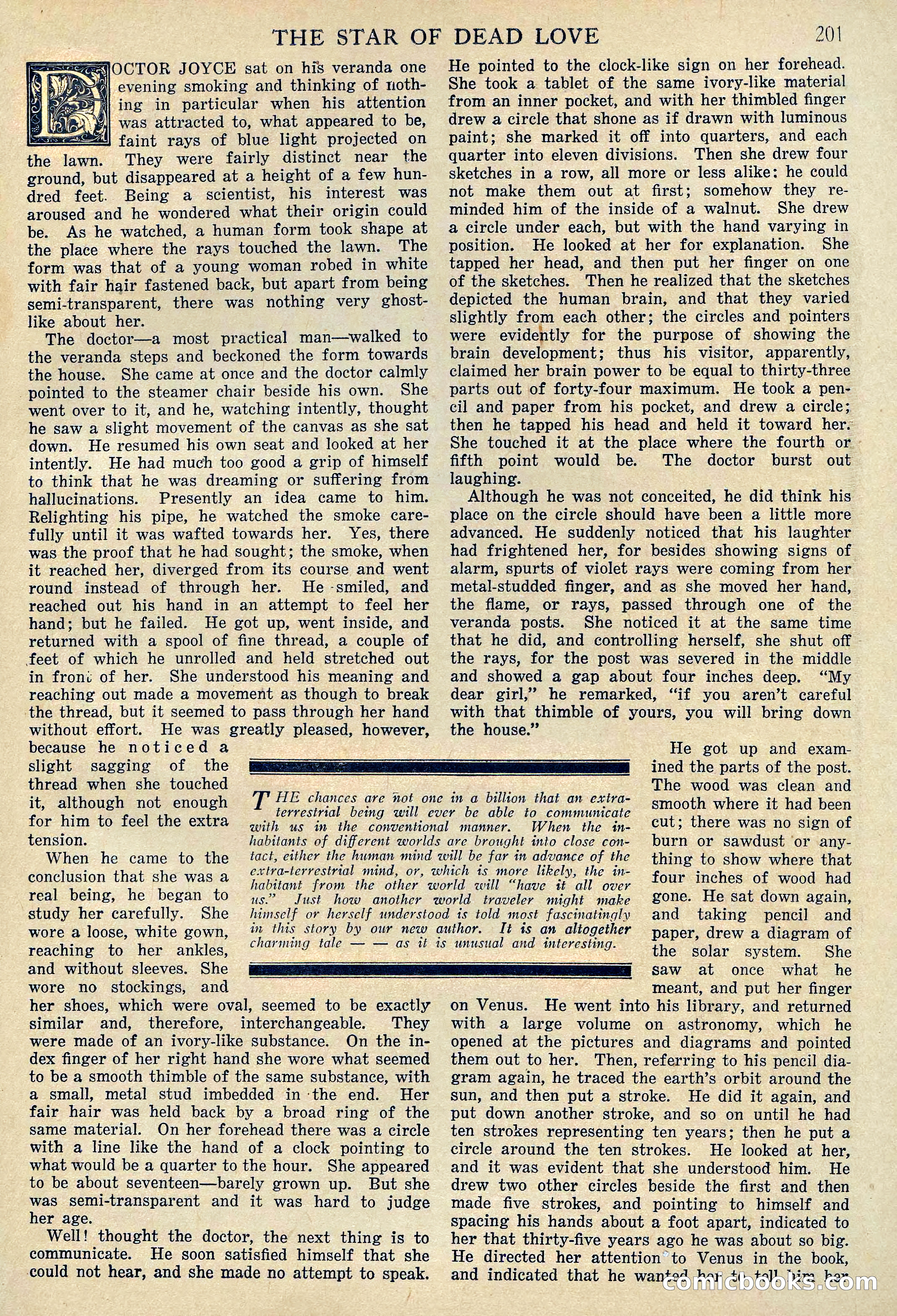
A restored page from Pulp Fiction, 1927. Page through the whole issue in the reader above.
📄 Transcribed text from this page (OCR, searchable)
Machine-transcribed from the original scan — historical spelling and the odd misread are preserved.
THE STAR OF DEAD LOVE ae OCTOR JOYCE sat on his veranda one a) evening smoking and thinking of tioth- PP fj ing in particular when his attention g|| was attracted to, what appeared to be, - faint rays of blue light projected on the lawn. They were fairly distinct near the ground, but disappeared at a height of a few hun- dred feet. Being a scientist, his interest was aroused and he wondered what their origin could be. As he watched, a human form took shape at the place where the rays touched the lawn. The form was that of a young woman robed in white with fair hair fastened back, but apart from being semi-transparent, there was nothing very ghost- like about her. The doctor—a most practical man—walked to the veranda steps and beckoned the form towards the house. She came at once and the doctor calmly pointed to the steamer chair beside his own. She went over to it, and he, watching intently, thought he saw a slight movement of the canvas as she sat down. He resumed his own seat and looked at her intently. He had much too good a grip of himself to think that he was dreaming or suffering from hallucinations. Presently an idea came to him. Relighting his pipe, he watched the smoke care- fully until it was wafted towards her. Yes, there was the proof that he had sought; the smoke, when it reached her, diverged from its course and went round instead of through her. He-smiled, and reached out his hand in an attempt to feel her hand; but he failed. He got up, went inside, and returned with a spool of fine thread, a couple of feet of which he unrolled and held stretched out in front of her. She understood his meaning and reaching out made a movement as though to break the thread, but it seemed to pass through her hand without effort. He was greatly pleased, however, because he noticed a slight sagging of the thread when she touched it, although not enough for him to feel the extra tension. When he came to the conclusion that she was a real being, he began to study her carefully. She wore a loose, white gown, reaching to her ankles, and without sleeves. She wore no stockings, and her shoes, which were oval, seemed to be exactly similar and, therefore, interchangeable. They were made of an ivory-like substance. On the in- dex finger of her right hand she wore what seemed to be a smooth thimble of the same substance, with a small, metal stud imbedded in ‘the end. Her fair hair was held back by a broad ring of the same material. On her forehead there was a circle with a line like the hand of a clock pointing to what would be a quarter to the hour. She appeared to be about seventeen—barely grown up. But she was semi-transparent and it was hard to judge her age. Well! thought the doctor, the next thing is to communicate. He soon satisfied himself that she could not hear, and she made no attempt to speak. T us.” MAN et ee a I Se eae | HE chances are not one in a billion that an extra- terrestrial being will ever be able to communicate with us im the conventional manner. habitants of different worlds are brought into close con- tact, either the human mind will be far in advance of the extrva-terrestrial mind, or, which ts more likely, the in- habttant from the other world will “have + all over Just how another world traveler might make himself or herself understood is told most fascinatingly m this story by our new author. charming tale — — as it is unusual and interesting. eee a ees re] SS SSE ee ee Nee eee ee nna ONE Nee eS 201 He pointed to the clock-like sign on her forehead. She took a tablet of the same ivory-like material from an inner pocket, and with her thimbled finger drew a circle that shone as if drawn with luminous paint; she marked it off into quarters, and each quarter into eleven divisions. Then she drew four sketches in a row, all more or less alike: he could not make them out at first; somehow they re- minded him of the inside of a walnut. She drew a circle under each, but with the hand varying in position. He looked at her for explanation. She tapped her head, and then put her finger on one of the sketches. Then he realized that the sketches depicted the human brain, and that they varied slightly from each other; the circles and pointers were evidently for the purpose of showing the brain development; thus his visitor, apparently, claimed her brain power to be equal to thirty-three parts out of forty-four maximum. He took a pen- cil and paper from his pocket, and drew a circle; then he tapped his head and held it toward her. She touched it at the place where the fourth or fifth point would be. laughing. The doctor burst out Although he was not conceited, he did think his place on the circle should have been a little more advanced. He suddenly noticed that his laughter had frightened her, for besides showing signs of alarm, spurts of violet rays were coming from her metal-studded finger, and as she moved her hand, the flame, or rays, passed through one of the veranda posts. She noticed it at the same time that he did, and controlling herself, she shut off - the rays, for the post was severed in the middle and showed a gap about four inches deep. “My dear girl,’ he remarked, “if you aren’t careful with that thimble of yours, you will bring down the house.” He got up and exam- ined the parts of the post. The wood was clean and smooth where it had been cut; there was no sign of burn or sawdust ‘or any- thing to show where that four inches of wood had gone. He sat down again, and taking pencil and paper, drew a diagram of the solar system. Saw at once what he meant, and put her finger on Venus. He went into his library, and returned with a large volume on astronomy, which he opened at the pictures and diagrams and pointed them out to her. Then, referring to his pencil dia- gram again, he traced the earth’s orbit around the sun, and then put a stroke. He did it again, and put down another stroke, and so on until he had ten strokes representing ten years; then he put a circle around the ten strokes. He looked at her, and it was evident that she understood him. He drew two other circles beside the first and then made five strokes, and pointing to himself and spacing his hands about a foot apart, indicated to her that thirty-five years ago he was about so big. He directed her attention to Venus in the book, and indicated that he wanted bar 4 toy im bes) When the in- Tt is an altogether She |