
Pulp Fiction, 1927 · page 85 of 105
Amazing Stories, Vol. 2, No. 2 — page 85: what you’re looking at
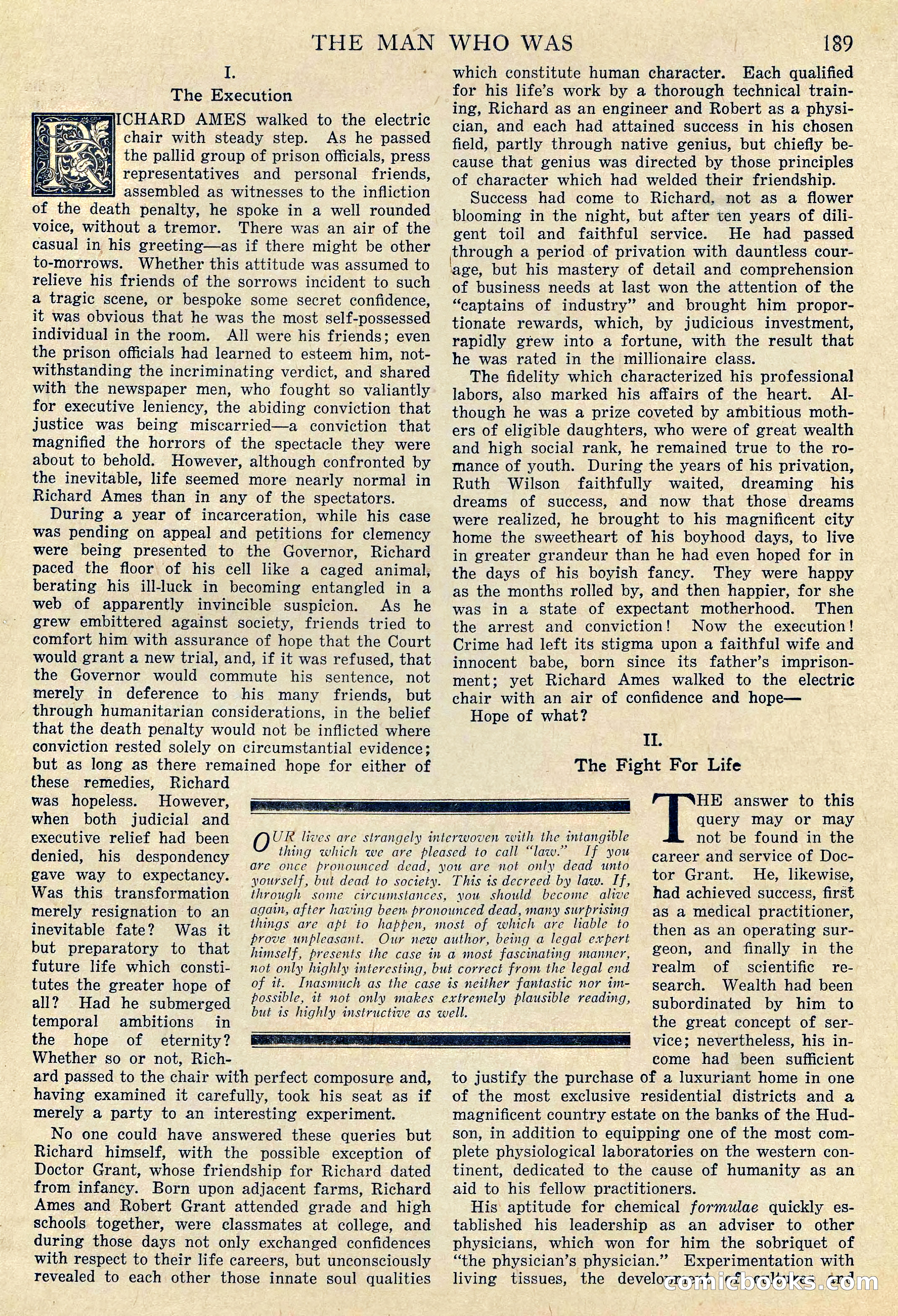
A restored page from Pulp Fiction, 1927. Page through the whole issue in the reader above.
📄 Transcribed text from this page (OCR, searchable)
Machine-transcribed from the original scan — historical spelling and the odd misread are preserved.
THE MAN E ‘ The Execution CHARD AMES walked to the electric i chair with steady step. As he passed the pallid group of prison officials, press ‘Ql4| representatives and personal friends, assembled as witnesses to the infliction of the death penalty, he spoke in a well rounded voice, without a tremor. There was an air of the casual in his greeting—as if there might be other to-morrows. Whether this attitude was assumed to relieve his friends of the sorrows incident to such a tragic scene, or bespoke some secret confidence, it was obvious that he was the most self-possessed individual in the room. All were his friends; even the prison officials had learned to esteem him, not- withstanding the incriminating verdict, and shared with the newspaper men, who fought so valiantly for executive leniency, the abiding conviction that justice was being miscarried—a conviction that magnified the horrors of the spectacle they were about to behold. However, although confronted by the inevitable, life seemed more nearly normal in Richard Ames than in any of the spectators. During a year of incarceration, while his case was pending on appeal and petitions for clemency were being presented to the Governor, Richard paced the floor of his cell like a caged animal, berating his ill-luck in becoming entangled in a web of apparently invincible suspicion. As he grew embittered against society, friends tried to comfort him with assurance of hope that the Court would grant a new trial, and, if it was refused, that the Governor would commute his sentence, not merely in deference to his many friends, but - through humanitarian considerations, in the belief that the death penalty would not be inflicted where conviction rested solely on circumstantial evidence; but as long as there remained hope for either of these remedies, Richard was hopeless. However, when both judicial and executive relief had been denied, his despondency gave way to expectancy. Was this transformation merely resignation to an inevitable fate? Was it but preparatory to that future life which consti- tutes the greater hope of all? Had he submerged temporal ambitions in the hope of eternity? Whether so or not, Rich- ard passed to the chair with perfect composure and, having examined it carefully, took his seat as if merely a party to an interesting experiment. No one could have answered these queries but Richard himself, with the possible exception of Doctor Grant, whose friendship for Richard dated from infancy. Born upon adjacent farms, Richard Ames and Robert Grant attended grade and high schools together, were classmates at college, and during those days not only exchanged confidences with respect to their life careers, but unconsciously revealed to each other those innate soul qualities prove unpleasant. of it. UR lives are strangely interwoven with the intangible thing which we are pleased to call “law.” are once pronounced dead, you are not only dead unto yourself, but dead to society. This is decreed by law. If, through some circumstances, you should become alive again, after having beem pronounced dead, many surprising things ave apt to happen, most of which are lable to Our new author, being a legal expert himself, presents the case in a most fascinating manner, not only highly interesting, but correct from the legal end Inasmuch as the case is neither fantastic nor um- possible, it not only makes extremely plausible reading, but is highly imstructive as well. WHO WAS 189 which constitute human character. Each qualified for his life’s work by a thorough technical train- ing, Richard as an engineer and Robert as a physi- clan, and each had attained success in his chosen field, partly through native genius, but chiefly be- cause that genius was directed by those principles of character which had welded their friendship. Success had come to Richard, not as a flower blooming in the night, but after ten years of dili- gent toil and faithful service. He had passed through a period of privation with dauntless cour- age, but his mastery of detail and comprehension of business needs at last won the attention of the “captains of industry” and brought him propor- tionate rewards, which, by judicious investment, rapidly grew into a fortune, with the result that he was rated in the millionaire class. The fidelity which characterized his professional labors, also marked his affairs of the heart. AIl- though he was a prize coveted by ambitious moth- ers of eligible daughters, who were of great wealth and high social rank, he remained true to the ro- mance of youth. During the years of his privation, Ruth Wilson faithfully waited, dreaming his dreams of success, and now that those dreams were realized, he brought to his magnificent city home the sweetheart of his boyhood days, to live in greater grandeur than he had even hoped for in the days of his boyish fancy. They were happy as the months rolled by, and then happier, for she was in a state of expectant motherhood. Then the arrest and conviction! Now the execution! Crime had left its stigma upon a faithful wife and innocent babe, born since its father’s imprison- ment; yet Richard Ames walked to the electric chair with an air of confidence and hope— Hope of what? II. | The Fight For Life Te: answer to this query may or may not be found in the eareer and service of Doc- tor Grant. He, likewise, had achieved success, first as a medical practitioner, then as an operating sur- geon, and finally in the realm of scientific re- search. Wealth had been subordinated by him to the great concept of ser- vice; nevertheless, his in- come had been sufficient to justify the purchase of a luxuriant home in one of the most exclusive residential districts and a magnificent country estate on the banks of the Hud- son, in addition to equipping one of the most com- plete physiological laboratories on the western con- tinent, dedicated to the cause of humanity as an aid to his fellow practitioners. His aptitude for chemical formulae quickly es- tablished his leadership as an adviser to other physicians, which won for him the sobriquet of “the physician’s physician.” Experimentation with living tissues, the develovaray;s) (a oreleles_rs| If you