
Pulp Fiction, 1927 · page 74 of 105
Amazing Stories, Vol. 2, No. 2 — page 74: what you’re looking at
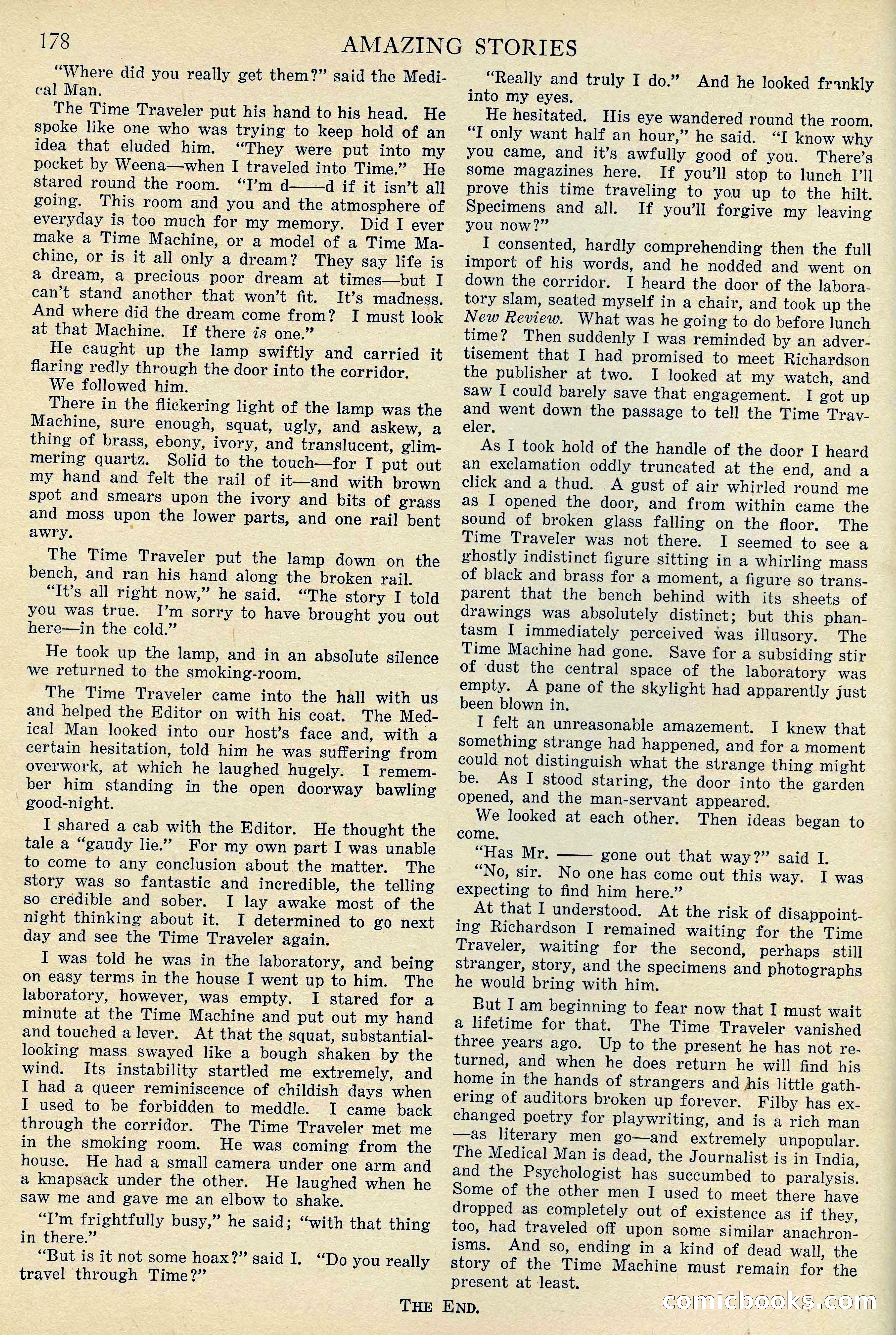
A restored page from Pulp Fiction, 1927. Page through the whole issue in the reader above.
📄 Transcribed text from this page (OCR, searchable)
Machine-transcribed from the original scan — historical spelling and the odd misread are preserved.
217 “Where did you really get them?” said the Medi- cal Man. The Time Traveler put his hand to his head. He spoke like one who was trying to keep hold of an idea that eluded him. “They were put into my pocket by Weena—when I traveled into Time.” He stared round the room. “I’m d d if it isn’t all going. This room and you and the atmosphere of everyday is too much for my memory. Did I ever make a Time Machine, or a model of a Time Ma- chine, or is it all only a dream? They say life is a dream, a precious poor dream at times—but I can’t stand another that won’t fit. It’s madness. And where did the dream come from? I must look at that Machine. If there gs one.” He caught up the lamp swiftly and carried it flaring redly through the door into the corridor. We followed him. There in the flickering light of the lamp was the Machine, sure enough, squat, ugly, and askew, a thing of brass, ebony, ivory, and translucent, glim- mering quartz. Solid to the touch—for I put out my hand and felt the rail of it—and with brown spot and smears upon the Ivory and bits of grass and moss upon the lower parts, and one rail bent awry. : The Time Traveler put the lamp down on the bench, and ran his hand along the broken rail. “It’s all right now,” he said. “The story I told you was true. I’m sorry to have brought you out here—in the cold.” He took up the lamp, and in an absolute silence we returned to the smoking-room. The Time Traveler came into the hall with us and helped the Editor on with his coat. The Med- ical Man looked into our host’s face and, with a certain hesitation, told him he was suffering from overwork, at which he laughed hugely. I remem- ber him standing in the open doorway bawling - good-night. I shared a cab with the Editor. He thought the tale a “gaudy lie.” For my own part I was unable to come to any conclusion about the matter. The story was so fantastic and incredible, the telling So credible and sober. I lay awake most of the night thinking about it. I determined to go next day and see the Time Traveler again. I was told he was in the laboratory, and being on easy terms in the house I went up to him. The laboratory, however, was empty. I stared for a minute at the Time Machine and put out my hand and touched a lever. At that the squat, substantial- looking mass swayed like a bough shaken by the wind. Its instability startled me extremely, and I had a queer reminiscence of childish days when I used to be forbidden to meddle. I came back through the corridor. The Time Traveler met me in the smoking room. He was coming from the house. He had a small camera under one arm and a knapsack under the other. He laughed when he saw me and gave me an elbow to shake. “I’m frightfully busy,” he said; “with that thing’ in there.” “But is it not some hoax?” said I. “Do you really travel through Time?” THE AMAZING STORIES “Really and truly I do.’ And he looked frankly into my eyes. He hesitated. His eye wandered round the room. “I only want half an hour,” he said. “TI know why you came, and it’s awfully good of you. There’s Some magazines here. If you’ll stop to lunch I'll prove this time traveling to you up to the hilt. Specimens and all. If you'll forgive my leaving you now?” I consented, hardly comprehending then the full import of his words, and he nodded and went on down the corridor. I heard the door of the labora- tory slam, seated myself in a chair, and took up the New Review. What was he going to do before lunch time? Then suddenly I was reminded by an adver- tisement that I had promised to meet Richardson the publisher at two. I looked at my watch, and saw I could barely save that engagement. I got up and went down the passage to tell the Time Trav- eler. As I took hold of the handle of the door I heard an exclamation oddly truncated at the end, and a click and a thud. A gust of air whirled round me as I opened the door, and from within came the sound of broken glass falling on the floor. The Time Traveler was not there. I seemed to see a ghostly indistinct figure sitting in a whirling mass of black and brass for a moment, a figure so trans- parent that the bench behind with its sheets of drawings was absolutely distinct ; but this phan- tasm I immediately perceived was illusory. The Time Machine had gone. Save for a Subsiding stir of dust the central space of the laboratory was empty. A pane of the skylight had apparently just been blown in. I felt an unreasonable amazement. I knew that Something strange had happened, and for a moment could not distinguish what the Strange thing might be. As I stood staring, the door into the garden opened, and the man-servant appeared. We looked at each other. Then ideas began to come. “Has Mr, gone out that way?” said I. “No, sir. No one has come out this way. I was expecting to find him here.” 3 At that I understood. At the risk of disappoint- ing Richardson I remained waiting for the Time Traveler, waiting for the Second, perhaps still stranger, story, and the specimens and photographs he would bring with him. But I am beginning to fear now that I must wait a lifetime for that. The Time Traveler vanished three years ago. Up to the present he has not re- turned, and when he does return he will find his home in the hands of strangers and his little gath- ering of auditors broken up forever. Filby has ex- changed poetry for playwriting, and is a rich man —as literary men go—and extremely unpopular. The Medical Man ig dead, the Journalist is in India, and the Psychologist has succumbed to paralysis. Some of the other men I used to meet there have dropped as completely out of existence as if they, too, had traveled off upon some similar anachron- isms. And so, ending in a kind of dead wall, the story of the Time Machine must remain for the present at least. CONMICOOOKS (COLA END.