
Pulp Fiction, 1927 · page 72 of 105
Amazing Stories, Vol. 2, No. 2 — page 72: what you’re looking at
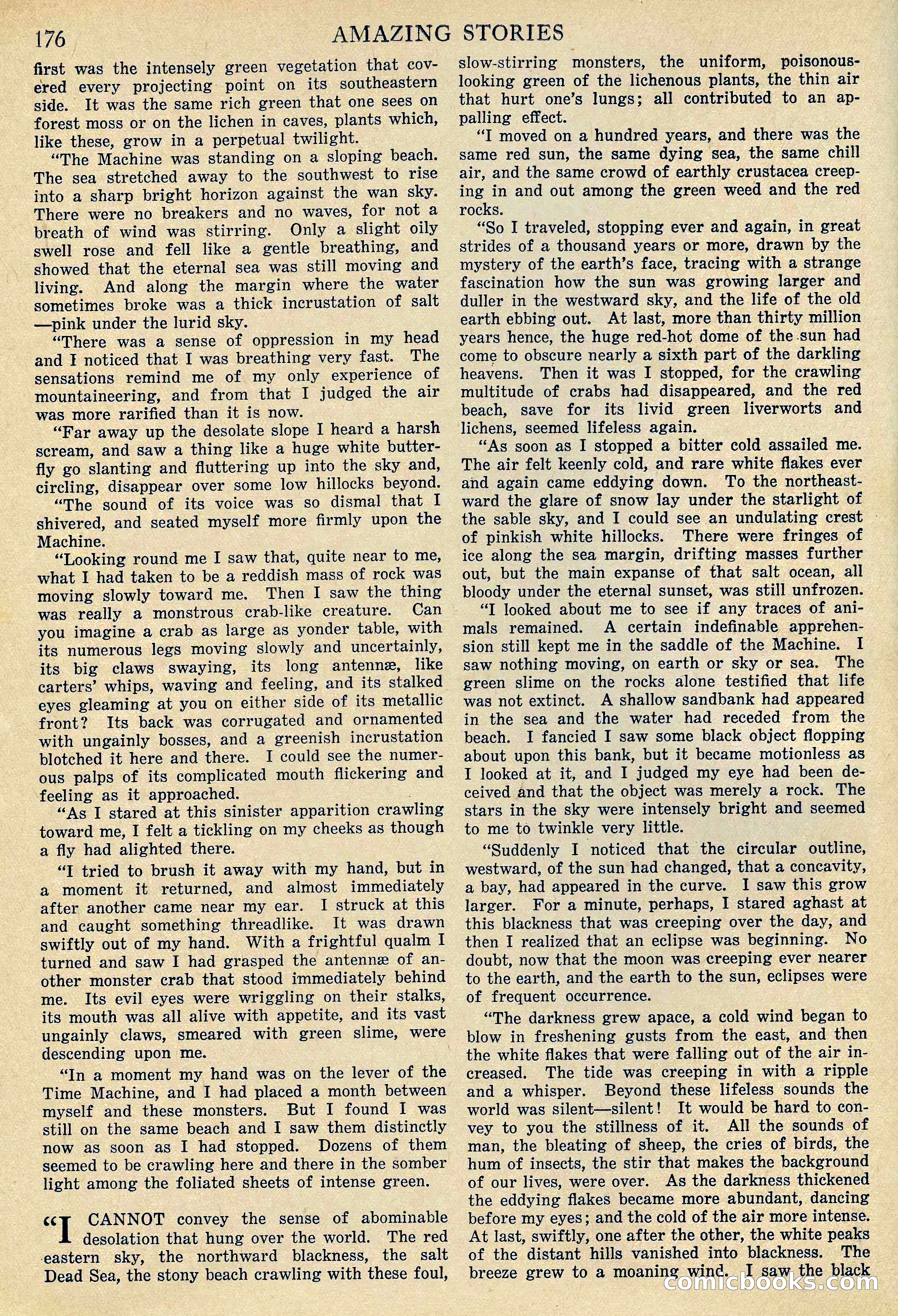
A restored page from Pulp Fiction, 1927. Page through the whole issue in the reader above.
📄 Transcribed text from this page (OCR, searchable)
Machine-transcribed from the original scan — historical spelling and the odd misread are preserved.
176 first was the intensely green vegetation that cov- ered every projecting point on its southeastern side. It was the same rich green that one sees on forest moss or on the lichen in caves, plants which, like these, grow in a perpetual twilight. “The Machine was standing on a sloping beach. The sea stretched away to the southwest to rise into a sharp bright horizon against the wan sky. There were no breakers and no waves, for not a breath of wind was stirring. Only a slight oily swell rose and fell like a gentle breathing, and showed that the eternal sea was still moving and living. And along the margin where the water sometimes broke was a thick incrustation of salt —pink under the lurid sky. “There was a sense of oppression in my head and I noticed that I was breathing very fast. The sensations remind me of my only experience of mountaineering, and from that I judged the air was more rarified than it is now. “Far away up the desolate slope I heard a harsh scream, and saw a thing like a huge white butter- fly go slanting and fluttering up into the sky and, circling, disappear over some low hillocks beyond. “The sound of its voice was so dismal that I shivered, and seated myself more firmly upon the Machine. “Looking round me I saw that, quite near to me, what I had taken to be a reddish mass of rock was moving slowly toward me. Then I saw the thing was really a monstrous crab-like creature. Can you imagine a crab as large as yonder table, with its numerous legs moving slowly and uncertainly, its big claws swaying, its long antenne, like carters’ whips, waving and feeling, and its stalked eyes gleaming at you on either side of its metallic front? Its back was corrugated and ornamented with ungainly bosses, and a greenish incrustation blotched it here and there. I could see the numer- ous palps of its complicated mouth flickering and feeling as it approached. “As IT stared at this sinister apparition crawling toward me, I felt a tickling on my cheeks as though a fly had alighted there. “T tried to brush it away with my hand, but in a moment it returned, and almost immediately after another came near my ear. I struck at this and caught something threadlike. It was drawn swiftly out of my hand. With a frightful qualm I turned and saw I had grasped the antennz of an- other monster crab that stood immediately behind me. Its evil eyes were wriggling on their stalks, its mouth was all alive with appetite, and its vast ungainly claws, smeared with green slime, were descending upon me. “In a moment my hand was on the lever of the Time Machine, and I had placed a month between myself and these monsters. But I found I was still on the same beach and I saw them distinctly now as soon as I had stopped. Dozens of them seemed to be crawling here and there in the somber light among the foliated sheets of intense green. “T CANNOT convey the sense of abominable desolation that hung over the world. The red eastern sky, the northward blackness, the salt Dead Sea, the stony beach crawling with these foul, AMAZING STORIES slow-stirring monsters, the uniform, poisonous- looking green of the lichenous plants, the thin air that hurt one’s lungs; all contributed to an ap- palling effect. “T moved on a hundred years, and there was the same red sun, the same dying sea, the same chill air, and the same crowd of earthly crustacea creep- ing in and out among the green weed and the red rocks. “So I traveled, stopping ever and again, in great strides of a thousand years or more, drawn by the mystery of the earth’s face, tracing with a strange fascination how the sun was growing larger and duller in the westward sky, and the life of the old earth ebbing out. At last, more than thirty million years hence, the huge red-hot dome of the-sun had come to obscure nearly a sixth part of the darkling heavens. Then it was I stopped, for the crawling multitude of crabs had disappeared, and the red beach, save for its livid green liverworts and lichens, seemed lifeless again. : “As soon as I stopped a bitter cold assailed me. The air felt keenly cold, and rare white flakes ever and again came eddying down. To the northeast- ward the glare of snow lay under the starlight of the sable sky, and I could see an undulating crest — of pinkish white hillocks. There were fringes of ice along the sea margin, drifting masses further out, but the main expanse of that salt ocean, all bloody under the eternal sunset, was still unfrozen. “T looked about me to see if any traces of ani- mals remained. A certain indefinable apprehen- sion still kept me in the saddle of the Machine. I saw nothing moving, on earth or sky or sea. The green slime on the rocks alone testified that life was not extinct. A shallow sandbank had appeared in the sea and the water had receded from the beach. I fancied I saw some black object flopping about upon this bank, but it became motionless as I looked at it, and I judged my eye had been de- ceived and that the object was merely a rock. The stars in the sky were intensely bright and seemed to me to twinkle very little. “Suddenly I noticed that the circular outline, westward, of the sun had changed, that a concavity, a bay, had appeared in the curve. I saw this grow larger. For a minute, perhaps, I stared aghast at this blackness that was creeping over the day, and then I realized that an eclipse was beginning. No doubt, now that the moon was creeping ever nearer to the earth, and the earth to the sun, eclipses were of frequent occurrence. “The darkness grew apace, a cold wind began to blow in freshening gusts from the east, and then the white flakes that were falling out of the air in- creased. The tide was creeping in with a ripple and a whisper. Beyond these lifeless sounds the world was silent—silent! It would be hard to con- vey to you the stillness of it. All the sounds of man, the bleating of sheep, the cries of birds, the hum of insects, the stir that makes the background of our lives, were over. As the darkness thickened the eddying flakes became more abundant, dancing before my eyes; and the cold of the air more intense. At last, swiftly, one after the other, the white peaks of the distant hills vanished into blackness. The breeze grew to a Toaning wane, — b oC ine Diack