
Pulp Fiction, 1927 · page 70 of 105
Amazing Stories, Vol. 2, No. 2 — page 70: what you’re looking at
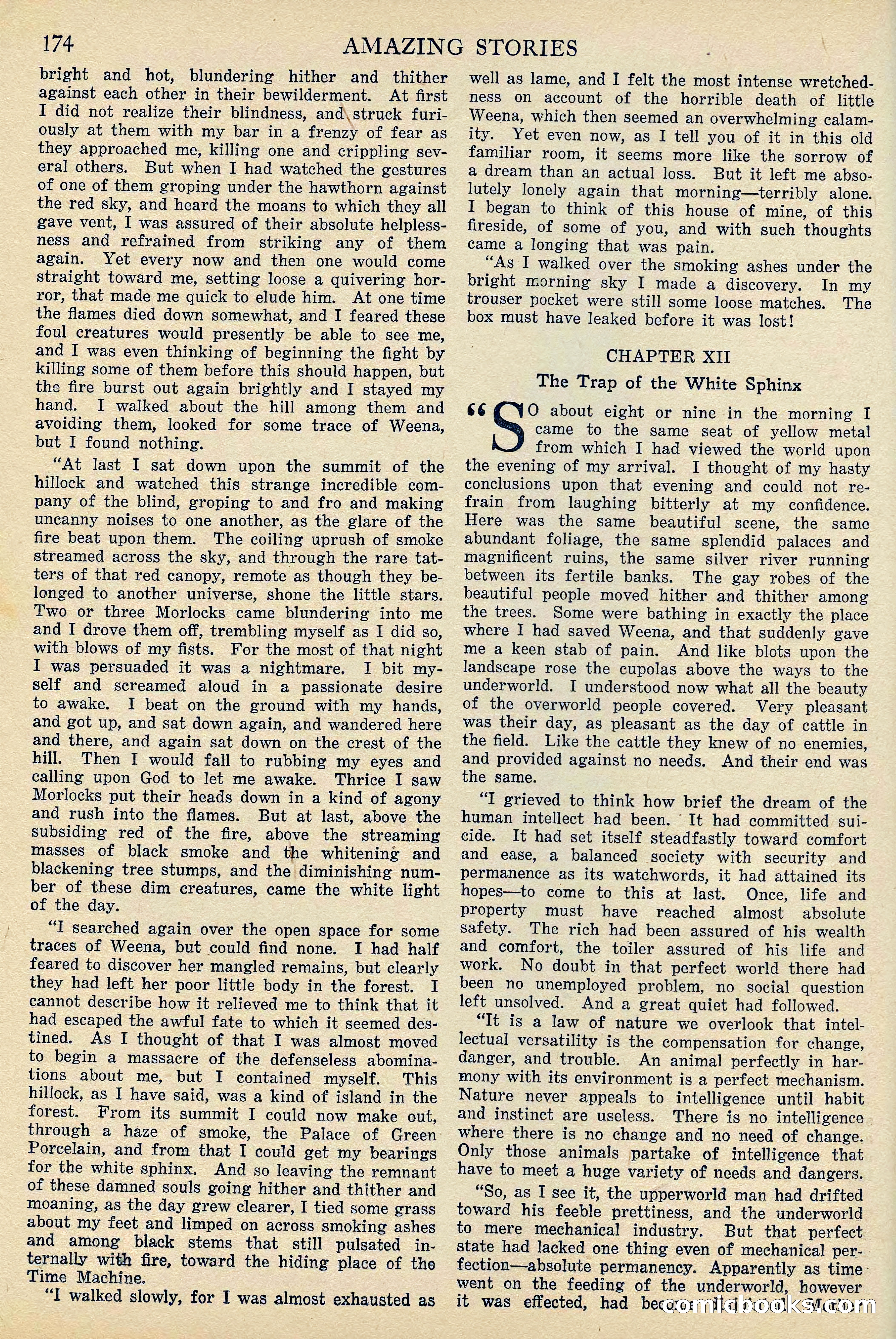
A restored page from Pulp Fiction, 1927. Page through the whole issue in the reader above.
📄 Transcribed text from this page (OCR, searchable)
Machine-transcribed from the original scan — historical spelling and the odd misread are preserved.
174 bright and hot, blundering hither and thither against each other in their bewilderment. At first I did not realize their blindness, and\ struck furi- ously at them with my bar in a frenzy of fear as they approached me, killing one and crippling sev- eral others. But when I had watched the gestures of one of them groping under the hawthorn against the red sky, and heard the moans to which they all gave vent, I was assured of their absolute helpless- ness and refrained from striking any of them again. Yet every now and then one would come straight toward me, setting loose a quivering hor- ror, that made me quick to elude him. At one time the flames died down somewhat, and I feared these foul creatures would presently be able to see me, and I was even thinking of beginning the fight by killing some of them before this should happen, but the fire burst out again brightly and I stayed my hand. I walked about the hill among them and avoiding them, looked for some trace of Weena, but I found nothing. “At last I sat down upon the summit of the hillock and watched this strange incredible com- pany of the blind, groping to and fro and making uncanny noises to one another, as the glare of the fire beat upon them. The coiling uprush of smoke streamed across the sky, and through the rare tat- ters of that red canopy, remote as though they be- longed to another universe, shone the little stars. Two or three Morlocks came blundering into me and I drove them off, trembling myself as I did so, with blows of my fists. For the most of that night I was persuaded it was a nightmare. I bit my- self and screamed aloud in a passionate desire to awake. I beat on the ground with my hands, and got up, and sat down again, and wandered here and there, and again sat down on the crest of the hill. Then I would fall to rubbing my eyes and calling. upon God to-let me awake. Thrice I saw Morlocks put their heads down in a kind of agony and rush into the flames. But at last, above the Subsiding red of the fire, above the streaming masses of black smoke and the whitening and blackening tree stumps, and the diminishing num- ber of these dim creatures, came the white light of the day. “I searched again over the open space for some traces of Weena, but could find none. I had half feared to discover her mangled remains, but clearly they had left her poor little body in the forest. I cannot describe how it relieved me to think that it had escaped the awful fate to which it seemed des- tined. As I thought of that I was almost moved to begin a massacre of the defenseless abomina- tions about me, but I contained myself. This hillock, as I have said, was a kind of island in the forest. From its summit I could now make out, through a haze of smoke, the Palace of Creen Porcelain, and from that I could get my bearings for the white sphinx. And go leaving the remnant of these damned souls going hither and thither and moaning, as the day grew clearer, I tied some grass about my feet and limped on across smoking ashes and among black stems that still pulsated in- ternally with fire, toward the hiding place of the Time Machine. “I walked slowly, for I was almost exhausted as AMAZING STORIES well as lame, and I felt the most intense wretched- ness on account of the horrible death of little Weena, which then seemed an overwhelming calam- ity. Yet even now, as I tell you of it in this old familiar room, it seems more like the sorrow of a dream than an actual loss. But it left me abso- lutely lonely again that morning—terribly alone. I began to think of this house of mine, of this fireside, of some of you, and with such thoughts came a longing that was pain. “As I walked over the smoking ashes under the bright morning sky I made a discovery. In my trouser pocket were still some loose matches. The box must have leaked before it was lost! CHAPTER XII The Trap of the White Sphinx 66 O about eight or nine in the morning I G came to the same seat of yellow metal from which I had viewed the world upon the evening of my arrival. I thought of my hasty conclusions upon that evening and could not re- frain from laughing bitterly at my confidence. Here was the same beautiful scene, the same abundant foliage, the same splendid palaces and magnificent ruins, the same silver river running between its fertile banks. The gay robes of the beautiful people moved hither and thither among the trees. Some were bathing in exactly the place where I had saved Weena, and that suddenly gave me a keen stab of pain. And like blots upon the landscape rose the cupolas above the ways to the underworld. I understood now what all the beauty of the overworld people covered. Very pleasant was their day, as pleasant as the day of cattle in the field. Like the cattle they knew of no enemies, and provided against no needs. And their end was the same. “I grieved to think how brief the dream of the human intellect had been. It had committed sui- cide. It had set itself steadfastly toward comfort and ease, a balanced society with security and permanence as its watchwords, it had attained its hopes—to come to this at last. Once, life and property must have reached almost absolute safety. The rich had been assured of his wealth and comfort, the toiler assured of his life and work. No doubt in that perfect world there had been no unemployed problem, no social question left unsolved. And a great quiet had followed. “It is a law of nature we overlook that intel- lectual versatility is the compensation for change, danger, and trouble. An animal perfectly in har- mony with its environment is a perfect mechanism. Nature never appeals to intelligence until habit and instinct are useless. There is no intelligence © where there is no change and no need of change. Only those animals partake of intelligence that have to meet a huge variety of needs and dangers. “So, as I see it, the upperworld man had drifted toward his feeble prettiness, and the underworld to mere mechanical industry. But that perfect state had lacked one thing even of mechanical per- - fection—ahbsolute permanency. Apparently as time: went on the feeding of the underworld, however It was effected, had becorot) fic sree} <Micatoy