
Pulp Fiction, 1927 · page 63 of 105
Amazing Stories, Vol. 2, No. 2 — page 63: what you’re looking at
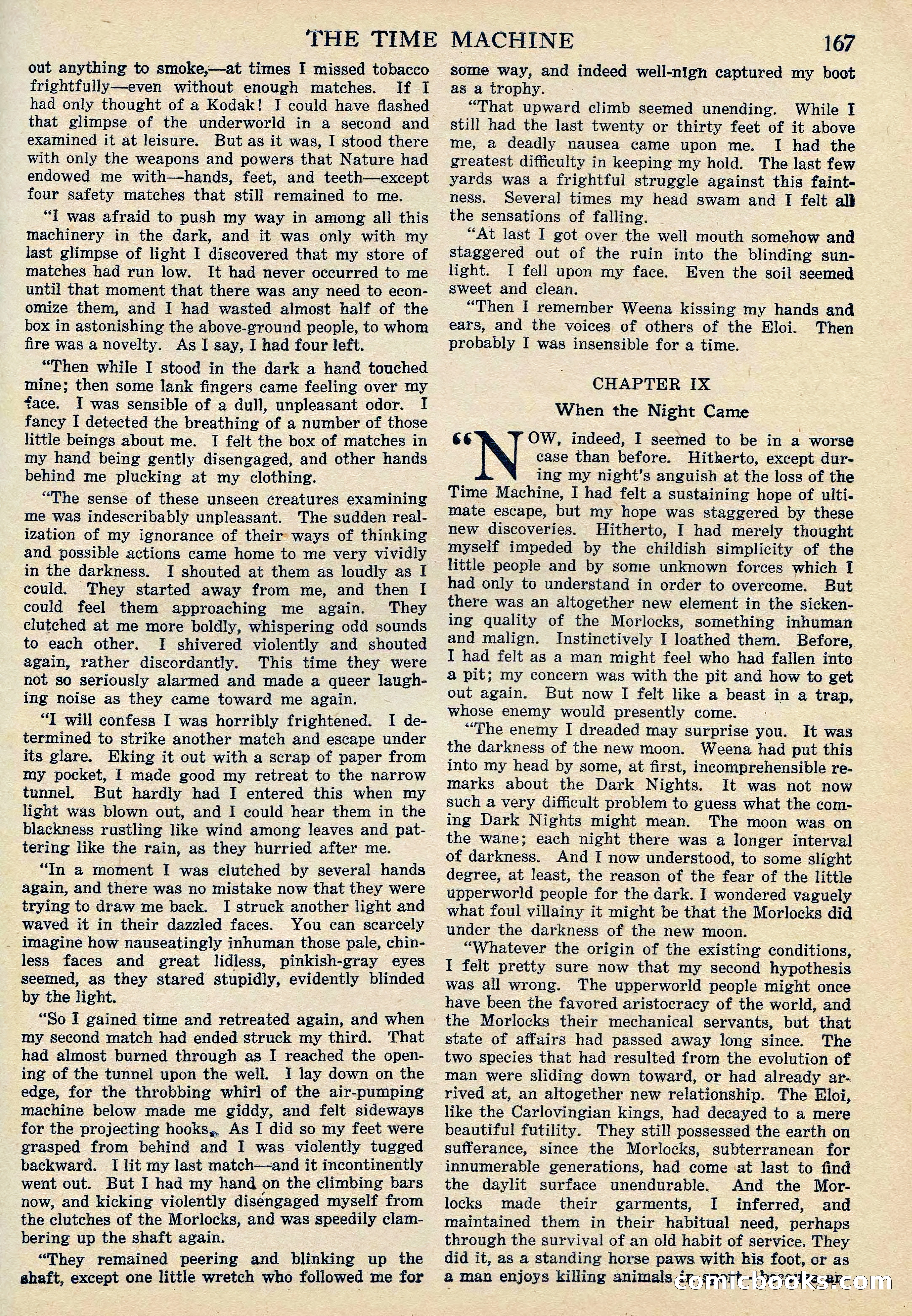
A restored page from Pulp Fiction, 1927. Page through the whole issue in the reader above.
📄 Transcribed text from this page (OCR, searchable)
Machine-transcribed from the original scan — historical spelling and the odd misread are preserved.
THE TIME MACHINE out anything to smoke,—at times I missed tobacco frightfully—even without enough matches. If I had only thought of a Kodak! I could have flashed that glimpse of the underworld in a second and examined it at leisure. But as it was, I stood there with only the weapons and powers that Nature had endowed me with—hands, feet, and teeth—except four safety matches that still remained to me. “J was afraid to push my way in among all this machinery in the dark, and it was only with my last glimpse of light I discovered that my store of matches had run low. It had never occurred to me until that moment that there was any need to econ- omize them, and I had wasted almost half of the box in astonishing the above-ground people, to whom fire was a novelty. As I say, I had four left. “Then while I stood in the dark a hand touched mine; then some lank fingers came feeling over my face. I was sensible of a dull, unpleasant odor. I fancy I detected the breathing of a number of those little beings about me. I felt the box of matches in my hand being gently disengaged, and other hands | behind me plucking at my clothing. “The sense of these unseen creatures examining me was indescribably unpleasant. The sudden real- ization of my ignorance of their ways of thinking and possible actions came home to me very vividly in the darkness. I shouted at them as loudly as I could. They started away from me, and then I could feel them approaching me again. They clutched at me more boldly, whispering odd sounds to each other. I shivered violently and shouted again, rather discordantly. This time they were not so seriously alarmed and made a queer laugh- ing noise as they came toward me again. “I will confess I was horribly frightened. I de- termined to strike another match and escape under its glare. Eking it out with a scrap of paper from my pocket, I made good my retreat to the narrow tunnel. But hardly had I entered this when my light was blown out, and I could hear them in the blackness rustling like wind among leaves and pat- tering like the rain, as they hurried after me. “In a moment I was clutched by several hands again, and there was no mistake now that they were trying to draw me back. I struck another light and waved it in their dazzled faces. You can scarcely _ imagine how nauseatingly inhuman those pale, chin- less faces and great lidless, pinkish-gray eyes seemed, as they stared stupidly, evidently blinded by the light. “So I gained time and retreated again, and when my second match had ended struck my third. That had almost burned through as I reached the open- ing of the tunnel upon the well. I lay down on the edge, for the throbbing whirl of the air-pumping machine below made me giddy, and felt sideways for the projecting hooks, As I did so my feet were grasped from behind and I was violently tugged backward. I lit my last match—and it incontinently went out. But I had my hand on the climbing bars now, and kicking violently disengaged myself from the clutches of the Morlocks, and was speedily clam- bering up the shaft again. “They remained peering and blinking up the shaft, except one little wretch who followed me for 167 some way, and indeed well-nign captured my boot as a trophy. “That upward climb seemed unending. While I still had the last twenty or thirty feet of it above me, a deadly nausea came upon me. I had the greatest difficulty in keeping my hold. The last few yards was a frightful struggle against this faint- ness. Several times my head swam and I felt al} the sensations of falling. “At last I got over the well mouth somehow and staggered out of the ruin into the blinding sun- light. I fell upon my face. Even the soil seemed Sweet and clean. “Then I remember Weena kissing my hands and ears, and the voices of others of the Eloi. Then probably I was insensible for a time. CHAPTER IX When the Night Came 66 OW, indeed, I seemed to be in a worse N case than before. Hitherto, except dur- ing my night’s anguish at the loss of the Time Machine, I had felt a sustaining hope of ulti- mate escape, but my hope was staggered by these new discoveries. Hitherto, I had merely thought myself impeded by the shildish simplicity of the little people and by some unknown forces which I had only to understand in order to overcome. But there was an altogether new element in the sicken- ing quality of the Morlocks, something inhuman and malign. I had felt as a man might feel who had fallen into a pit; my concern was with the pit and how to get out again. But now I felt like a beast in a trap, whose enemy would presently come. “The enemy I dreaded may surprise you. It was the darkness of the new moon. Weena had put this into my head by some, at first, incomprehensible re- marks about the Dark Nights. It was not now such a very difficult problem to guess what the com- ing Dark Nights might mean. The moon was on the wane; each night there was a longer interval of darkness. And I now understood, to some slight degree, at least, the reason of the fear of the little upperworld people for the dark. I wondered vaguely what foul villainy it might be that the Morlocks did under the darkness of the new moon. “Whatever the origin of the existing conditions, I felt pretty sure now that my second hypothesis was all wrong. The upperworld people might once have been the favored aristocracy of the world, and the Morlocks their mechanical servants, but that state of affairs had passed away long since. The two species that had resulted from the evolution of man were sliding down toward, or had already ar- rived at, an altogether new relationship. The Eloi, like the Carlovingian kings, had decayed to a mere beautiful futility. They still possessed the earth on sufferance, since the Morlocks, subterranean for ‘innumerable generations, had come at last to find the daylit surface unendurable. And the Mor- locks made their garments, I inferred, and maintained them in their habitual need, perhaps through the survival of an old habit of service. They did it, as a standing horse paws with his foot, or as Instinctively I loathed them. Before, im a man enjoys killing animals sro sy.tt- JOOKS: GO