
Pulp Fiction, 1927 · page 61 of 105
Amazing Stories, Vol. 2, No. 2 — page 61: what you’re looking at
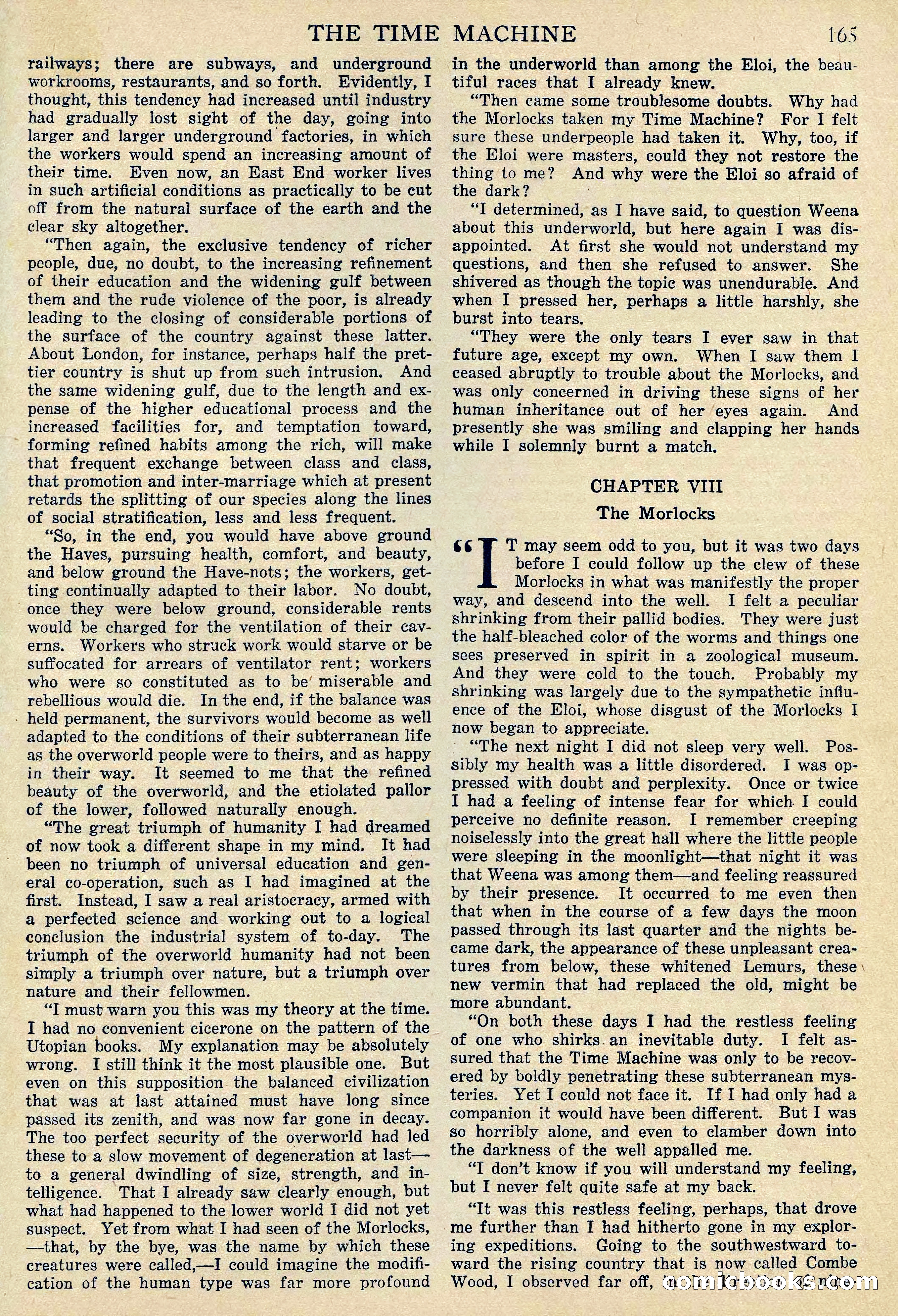
A restored page from Pulp Fiction, 1927. Page through the whole issue in the reader above.
📄 Transcribed text from this page (OCR, searchable)
Machine-transcribed from the original scan — historical spelling and the odd misread are preserved.
THE TIME railways; there are subways, and underground workrooms, restaurants, and so forth. Evidently, I thought, this tendency had increased until industry had gradually lost sight of the day, going into larger and larger underground factories, in which the workers would spend an increasing amount of their time. Even now, an East End worker lives in such artificial conditions as practically to be cut off from the natural surface of the earth and the clear sky altogether. “Then again, the exclusive tendency of richer people, due, no doubt, to the increasing refinement of their education and the widening gulf between them and the rude violence of the poor, is already leading to the closing of considerable portions of the surface of the country against these latter. About London, for instance, perhaps half the pret- tier country is shut up from such intrusion. And the same widening gulf, due to the length and ex- pense of the higher educational process and the increased facilities for, and temptation toward, - forming refined habits among the rich, will make that frequent exchange between class and class, that promotion and inter-marriage which at present retards the splitting of our species along the lines of social stratification, less and less frequent. “So, in the end, you would have above ground the Haves, pursuing health, comfort, and beauty, and below ground the Have-nots; the workers, get- ting continually adapted to their labor. No doubt, once they were below ground, considerable rents would be charged for the ventilation of their cav- erns. Workers who struck work would starve or be suffocated for arrears of ventilator rent; workers who were so constituted as to be’ miserable and rebellious would die. In the end, if the balance was - held permanent, the survivors would become as well adapted to the conditions of their subterranean life as the overworld people were to theirs, and as happy in their way. It seemed to me that the refined beauty of the overworld, and the etiolated pallor of the lower, followed naturally enough. “The great triumph of humanity I had dreamed of now took a different shape in my mind. It had been no triumph of universal education and gen- eral co-operation, such as I had imagined at the first. Instead, I saw a real aristocracy, armed with a perfected science and working out to a logical conclusion the industrial system of to-day. The triumph of the overworld humanity had not been simply a triumph over nature, but a triumph over nature and their fellowmen. “I must warn you this was my theory at the time. I had no convenient cicerone on the pattern of the Utopian books. My explanation may be absolutely wrong. I still think it the most plausible one. But even on this supposition. the balanced civilization that was at last attained must have long since passed its zenith, and was now far gone in decay. The too perfect security of the overworld had led these to a slow movement of degeneration at last— to a general dwindling of size, strength, and in- telligence. That I already saw clearly enough, but what had happened to the lower world I did not yet suspect. Yet from what I had seen of the Morlocks, —that, by the bye, was the name by which these creatures were called,—I could imagine the modifi- cation of the human type was far more profound MACHINE 165 in the underworld than among the Eloi, the beau- tiful races that I already knew. “Then came some troublesome doubts. Why had the Morlocks taken my Time Machine? For I felt sure these underpeople had taken it. Why, too, if the Eloi were masters, could they not restore the thing to me? And why were the Eloi so afraid of the dark? : “I determined, as I have said, to question Weena about this underworld, but here again I was dis- appointed. At first she would not understand my questions, and then she refused to answer. She shivered as though the topic was unendurable. And when I pressed her, perhaps a little harshly, she burst into tears. “They were the only tears I ever saw in that future age, except my own. When I saw them I ceased abruptly to trouble about the Morlocks, and was only concerned in driving these signs of her human inheritance out of her ‘eyes again. And presently she was smiling and clapping her hands while I solemnly burnt a match. 66 | before I could follow up the clew of these Morlocks in what was manifestly the proper way, and descend into the well. I felt a peculiar shrinking from their pallid bodies. They were just the half-bleached color of the worms and things one sees preserved in spirit in a zoological museum. And they were cold to the touch. Probably my shrinking was largely due to the sympathetic influ- ence of the Eloi, whose disgust of the Morlocks I now began to appreciate. ~ “The next night I did not sleep very well. Pos- sibly my health was a little disordered. I was op- pressed with doubt and perplexity. Once or twice I had a feeling of intense fear for which I could perceive no definite reason. I remember creeping noiselessly into the great hall where the little people were sleeping in the moonlight—that night it was that Weena was among them—and feeling reassured by their presence. It occurred to me even then that when in the course of a few days the moon passed through its last quarter and the nights be- came dark, the appearance of these unpleasant crea- tures from below, these whitened Lemurs, these new vermin that had replaced the old, might be more abundant. “On both these days I had the restless feeling of one who shirks.an inevitable duty. I felt as- sured that the Time Machine was only to be recov- ered by boldly penetrating these subterranean mys- teries. Yet I could not face it. If I had only had a companion it would have been different. But I was so horribly alone, and even to clamber down into the darkness of the well appalled me. “T don’t know if you will understand my feeling, but I never felt quite safe at my back. “It was this restless feeling, perhaps, that drove CHAPTER VIII The Morlocks T may seem odd to you, but it was two days -me further than I had hitherto gone in my explor- ing expeditions. Going to the southwestward to- ward the rising country that is now called Combe Wood, I observed far off, ‘toylis) Var syore Ksucom