
Pulp Fiction, 1927 · page 59 of 105
Amazing Stories, Vol. 2, No. 2 — page 59: what you’re looking at
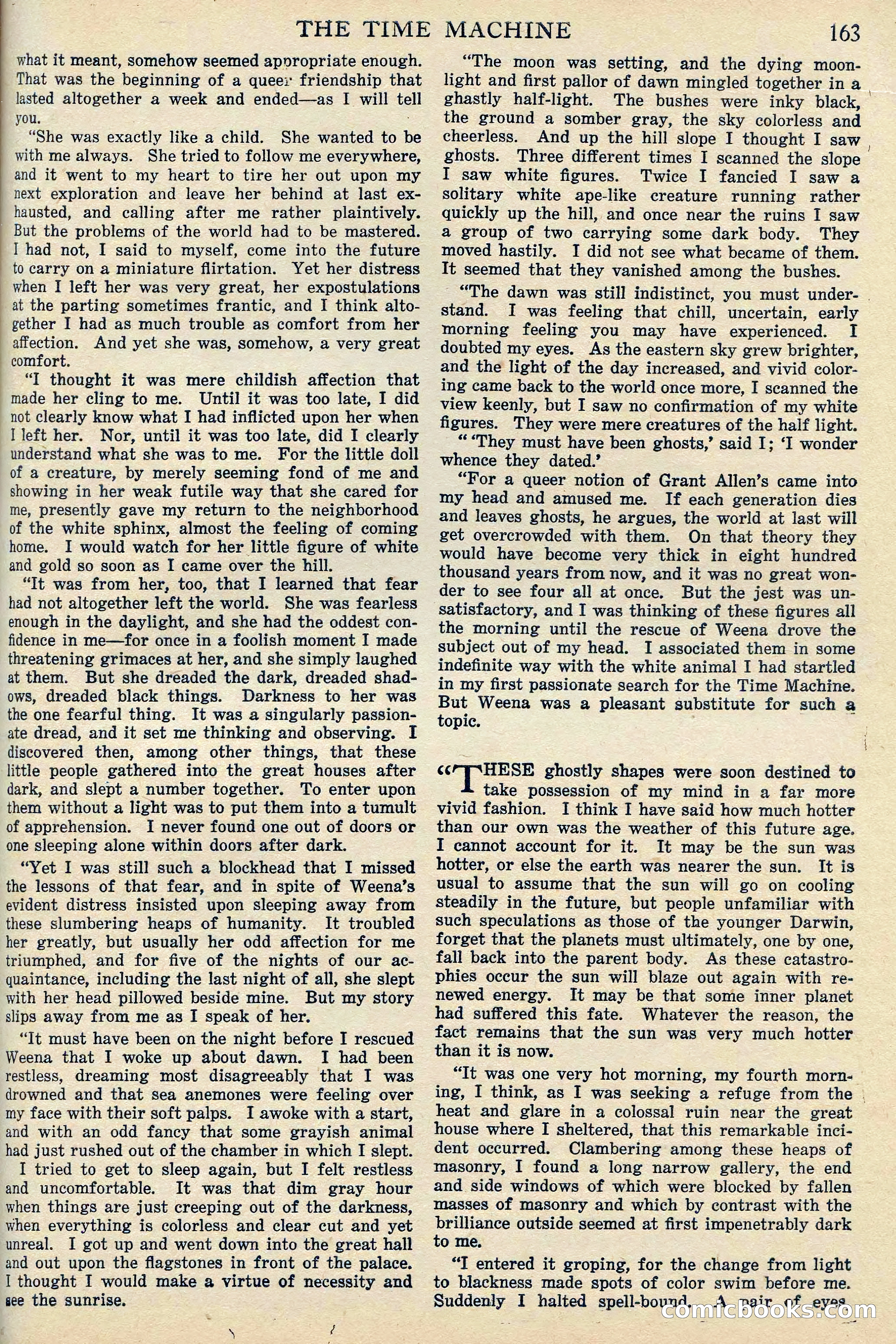
A restored page from Pulp Fiction, 1927. Page through the whole issue in the reader above.
📄 Transcribed text from this page (OCR, searchable)
Machine-transcribed from the original scan — historical spelling and the odd misread are preserved.
THE TIME what it meant, somehow seemed appropriate enough. _ That was the beginning of a quee: friendship that made her cling to me. lasted altogether a week and ended—as I will tell you. : “She was exactly like a child. She wanted to be with me always. She tried to follow me everywhere, and it went to my heart to tire her out upon my next exploration and leave her behind at last ex- hausted, and calling after me rather plaintively. But the problems of the world had to be mastered. I had not, I said to myself, come into the future to carry on a miniature flirtation. Yet her distress when I left her was very great, her expostulations at the parting sometimes frantic, and I think alto- gether I had as much trouble as comfort from her affection. And yet she was, somehow, a very great comfort. “I thought it was mere childish affection that Until it was too late, I did not clearly know what I had inflicted upon her when I left her. Nor, until it was too late, did I clearly understand what she was to me. For the little doll of a creature, by merely seeming fond of me and showing in her weak futile way that she cared for me, presently gave my return to the neighborhood of the white sphinx, almost the feeling of coming home. I would watch for her little figure of white and gold so soon as I came over the hill. | “It was from her, too, that I learned that fear had not altogether left the world. She was fearless enough in the daylight, and she had the oddest con- fidence in me—for once in a foolish moment I made threatening grimaces at her, and she simply laughed at them. But she dreaded the dark, dreaded shad- ows, dreaded black things. Darkness to her was the one fearful thing. It was a singularly passion- ate dread, and it set me thinking and observing. I discovered then, among other things, that these little people gathered into the great houses after dark, and slept a number together. To enter upon them without a light was to put them into a tumult of apprehension. I never found one out of doors or one sleeping alone within doors after dark. “Yet I was still such a blockhead that I missed the lessons of that fear, and in spite of Weena’s evident distress insisted upon sleeping away from these slumbering heaps of humanity. It troubled her greatly, but usually her odd affection for me triumphed, and for five of the nights of our ac- quaintance, including the last night of all, she slept with her head pillowed beside mine. But my story slips away from me as I speak of her. “It must have been on the night before I rescued Weena that I woke up about dawn. I had been restless, dreaming most disagreeably that I was drowned and that sea anemones were feeling over my face with their soft palps. I awoke with a start, and with an odd fancy that some grayish animal had just rushed out of the chamber in which I slept. I tried to get to sleep again, but I felt restless and uncomfortable. It was that dim gray hour when things are just creeping out of the darkness, when everything is colorless and clear cut and yet unreal. I got up and went down into the great hall and out upon the flagstones in front of the palace. I thought I would make a virtue of necessity and gee the sunrise. MACHINE 163 “The moon was setting, and the dying moon- light and first pallor of dawn mingled together in a ghastly half-light. The bushes were inky black, | the ground a somber gray, the sky colorless and cheerless. And up the hill slope I thought I saw ghosts. Three different times I scanned the slope I saw white figures. Twice I fancied I saw a solitary white ape-like creature running rather quickly up the hill, and once near the ruins I saw a group of two carrying some dark body. They moved hastily. I did not see what became of them. It seemed that they vanished among the bushes. “The dawn was still indistinct, you must under- | stand. I was feeling that chill, uncertain, early morning feeling you may have experienced. I doubted my eyes. As the eastern sky grew brighter, and the light of the day increased, and vivid color- ing came back to the world once more, I scanned the view keenly, but I saw no confirmation of my white figures. They were mere creatures of the half light. ““They must have been ghosts,’ said I; ‘I wonder whence they dated.’ “For a queer notion of Grant Allen’s came into my head and amused me. If each generation dies and leaves ghosts, he argues, the world at last will get overcrowded with them. On that theory they would have become very thick in eight hundred thousand years from now, and it was no great won- der to see four all at once. But the jest was un- satisfactory, and I was thinking of these figures all the morning until the rescue of Weena drove the subject out of my head. I associated them in some indefinite way with the white animal I had startled in my first passionate search for the Time Machine. But Weena was a pleasant substitute for such a topic. | 5 Be ghostly shapes were soon destined to take possession of my mind in a far more vivid fashion. I think I have said how much hotter than our own was the weather of this future age. I cannot account for it. It may be the sun was hotter, or else the earth was nearer the sun. It is usual to assume that the sun will go on cooling steadily in the future, but people unfamiliar with such speculations as those of the younger Darwin, forget that the planets must ultimately, one by one, fall back into the parent body. As these catastro- phies occur the sun will blaze out again with re- newed energy. It may be that some inner planet had suffered this fate. Whatever the reason, the fact remains that the sun was very much hotter than it is now. “It was one very hot morning, my fourth morn- ing, I think, as I was seeking a refuge from the | heat and glare in a colossal ruin near the great house where I sheltered, that this remarkable inci- dent occurred. Clambering among these heaps of masonry, I found a long narrow gallery, the end and side windows of which were blocked by fallen masses of masonry and which by contrast with the brilliance outside seemed at first impenetrably dark to me. “I entered it groping, for the change from light to blackness made spots of color swim before me. — Suddenly I halted spell-bopnd, A. books:com