
Pulp Fiction, 1927 · page 57 of 105
Amazing Stories, Vol. 2, No. 2 — page 57: what you’re looking at
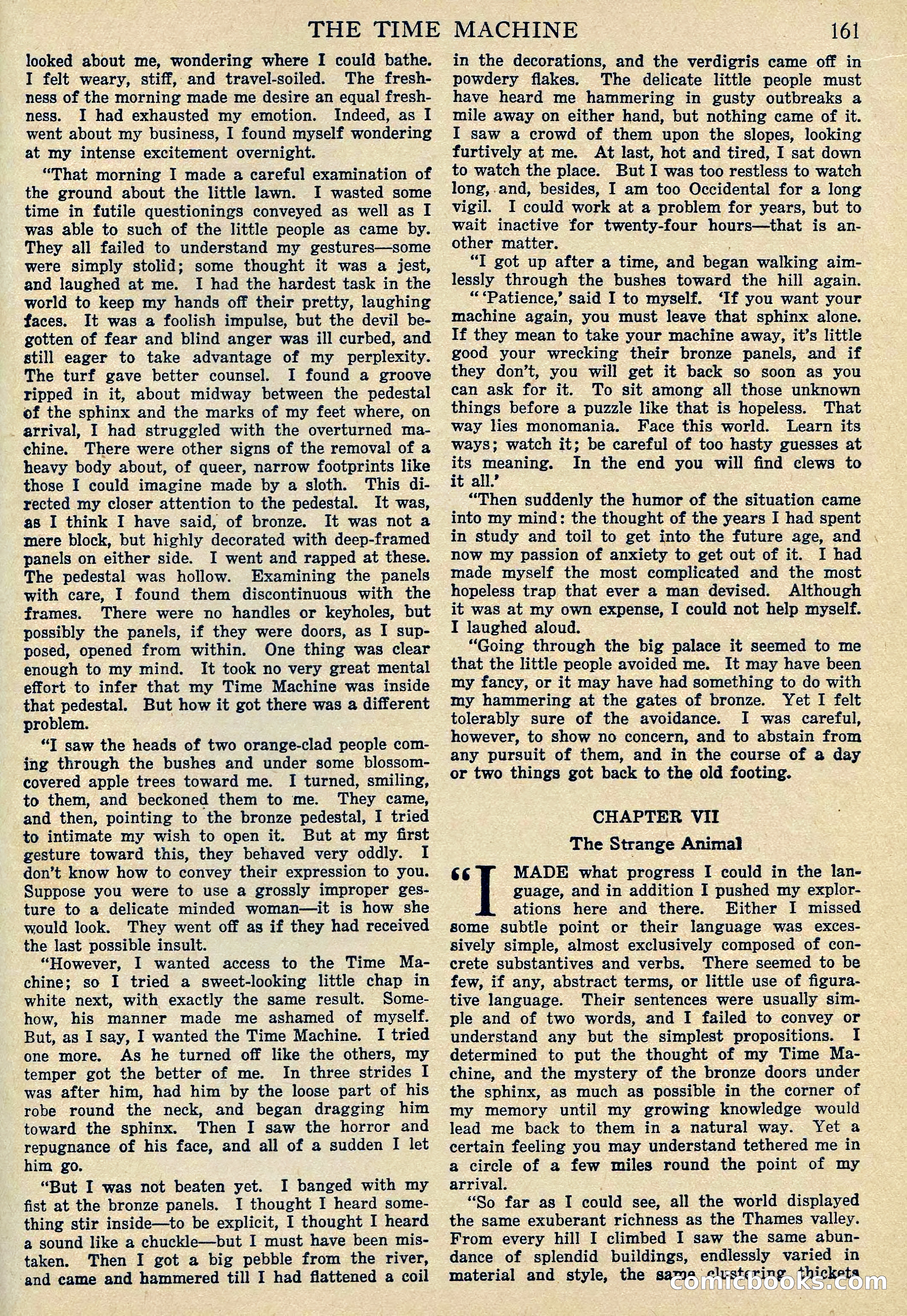
A restored page from Pulp Fiction, 1927. Page through the whole issue in the reader above.
📄 Transcribed text from this page (OCR, searchable)
Machine-transcribed from the original scan — historical spelling and the odd misread are preserved.
THE TIME looked about me, wondering where I could bathe. I felt weary, stiff, and travel-soiled. The fresh- ness of the morning made me desire an equal fresh- ness. I had exhausted my emotion. Indeed, as I went about my business, I found myself wondering at my intense excitement overnight. “That morning I made a careful examination of the ground about the little lawn. I wasted some time in futile questionings conveyed as well as I was able to such of the little people as came by. They all failed to understand my gestures—some were simply stolid; some thought it was a jest, and laughed at me. I had the hardest task in the world to keep my hands off their pretty, laughing faces. It was a foolish impulse, but the devil be- gotten of fear and blind anger was ill curbed, and still eager to take advantage of my perplexity. The turf gave better counsel. I found a groove Tipped in it, about midway between the pedestal of the sphinx and the marks of my feet where, on arrival, I had struggled with the overturned ma- chine. There were other signs of the removal of a heavy body about, of queer, narrow footprints like those I could imagine made by a sloth. This di- rected my closer attention to the pedestal. It was, as I think I have said, of bronze. It was not a mere block, but highly decorated with deep-framed panels on either side. I went and rapped at these. The pedestal was hollow. Examining the panels with care, I found them discontinuous with the frames. There were no handles or keyholes, but possibly the panels, if they were doors, as I sup- posed, opened from within. One thing was clear enough to my mind. It took no very great mental effort to infer that my Time Machine was inside that pedestal. But how it got there was a different problem. “JT saw the heads of two orange-clad people com- ing through the bushes and under some blossom- covered apple trees toward me. I turned, smiling, to them, and beckoned them to me. They came, and then, pointing to the bronze pedestal, I tried to intimate my wish to open it. But at my first gesture toward this, they behaved very oddly. I don’t know how to convey their expression to you. Suppose you were to use a grossly improper ges- ture to a delicate minded woman—it is how she would look. They went off as if they had received the last possible insult. “However, I wanted access to the Time Ma- chine; so I tried a sweet-looking little chap in white next, with exactly the same result. Some- how, his manner made me ashamed of myself. But, as I say, I wanted the Time Machine. I tried one more. As he turned off like the others, my temper got the better of me. In three strides I was after him, had him by the loose part of his robe round the neck, and began dragging him toward the sphinx. Then I saw the horror and repugnance of his face, and all of a sudden I let him go. “But I was not beaten yet. I banged with my fist at the bronze panels. I thought I heard some- thing stir inside—to be explicit, I thought I heard a sound like a chuckle—but I must have been mis- taken. Then I got a big pebble from the river, and came and hammered till I had flattened a coil MACHINE 161 in the decorations, and the verdigris came off in powdery flakes. The delicate little people must have heard me hammering in gusty outbreaks a mile away on either hand, but nothing came of it. I saw a crowd of them upon the slopes, looking furtively at me. At last, hot and tired, I sat down to watch the place. But I was too restless to watch long,.and, besides, I am too Occidental for a long vigil. I could work at a problem for years, but to wait inactive for twenty-four hours—that is an- other matter. “I got up after a time, and began walking aim- lessly through the bushes toward the hill again. ““Patience,’ said I to myself. ‘If you want your machine again, you must leave that sphinx alone. If they mean to take your machine away, it’s little good your wrecking their bronze panels, and if they don’t, you will get it back so soon as you can ask for it. To sit among all those unknown things before a puzzle like that is hopeless. That way lies monomania. Face this world. Learn its ways; watch it; be careful of too hasty guesses at its meaning. In the end you will find clews to it all.’ “Then suddenly the humor of the situation came into my mind: the thought of the years I had spent in study and toil to get into the future age, and . now my passion of anxiety to get out of it. I had made myself the most complicated and the most hopeless trap that ever a man devised. Although it was at my own expense, I could not help myself. I laughed aloud. “Going through the big palace it seemed to me that the little people avoided me. It may have been my fancy, or it may have had something to do with my hammering at the gates of bronze. Yet I felt tolerably sure of the avoidance. I was careful, however, to show no concern, and to abstain from any pursuit of them, and in the course of a day or two things got back to the old footing. 66 | guage, and in addition I pushed my explor- ations here and there. Either I missed some subtle point or their language was exces- sively simple, almost exclusively composed of con- crete substantives and verbs. There seemed to be few, if any, abstract terms, or little use of figura- tive language. Their sentences were usually sim- ple and of two words, and I failed to convey or understand any but the simplest propositions. 1 determined to put the thought of my Time Ma- chine, and the mystery of the bronze doors under the sphinx, as much as possible in the corner of my memory until my growing knowledge would lead me back to them in a natural way. Yet a certain feeling you may understand tethered me in a circle of a few miles round the point of my arrival. “So far as I could see, all the world displayed the same exuberant richness as the Thames valley. From every hill I climbed I saw the same abun- dance of splendid buildings, enalerely varied in material and style, the same ai: CHAPTER VII The Strange Animal MADE what progress I could in the lan-