
Pulp Fiction, 1927 · page 5 of 105
Amazing Stories, Vol. 2, No. 2 — page 5: what you’re looking at
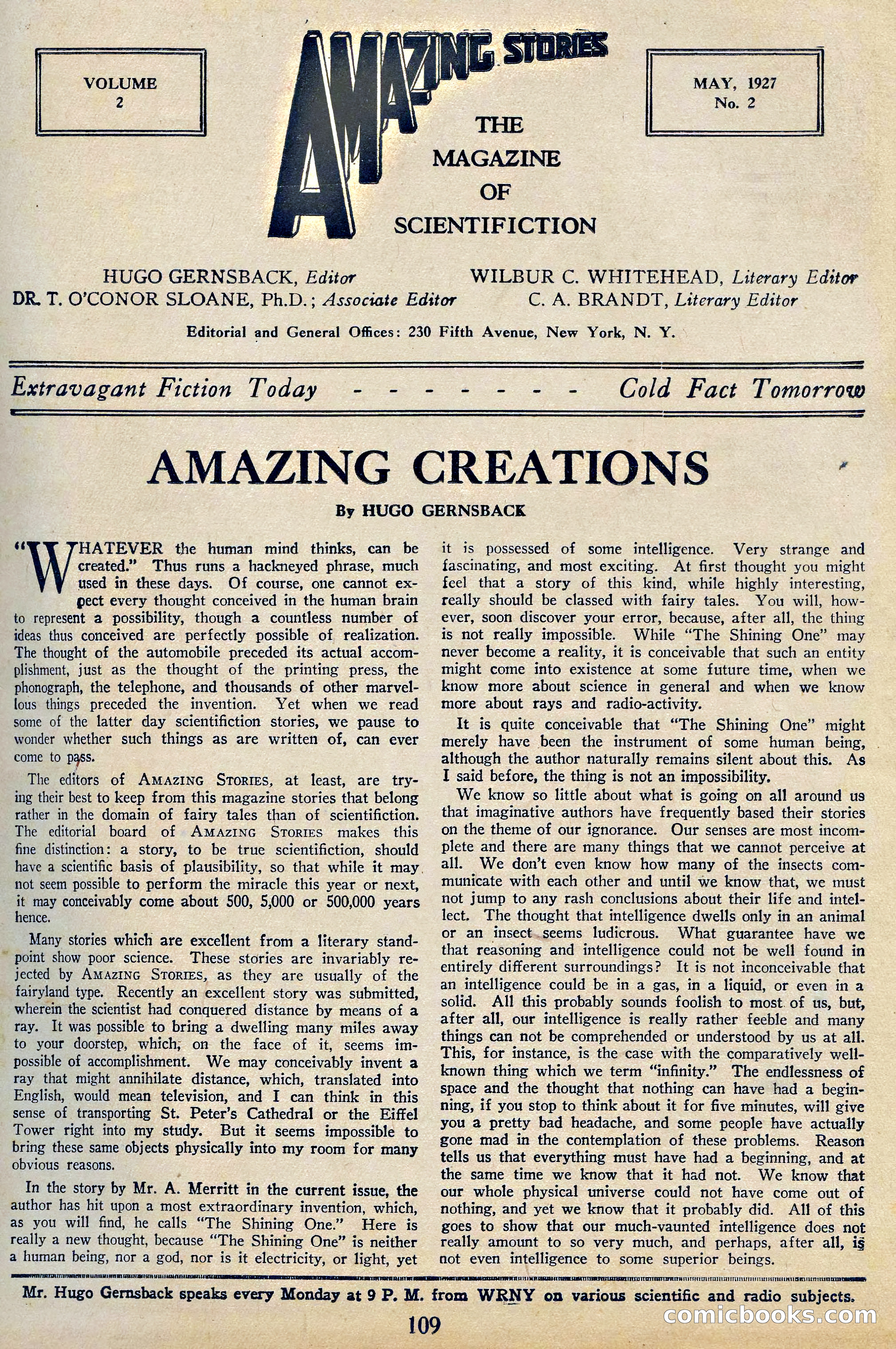
A restored page from Pulp Fiction, 1927. Page through the whole issue in the reader above.
📄 Transcribed text from this page (OCR, searchable)
Machine-transcribed from the original scan — historical spelling and the odd misread are preserved.
HUGO GERNSBACK, Editor DR. T. O°>CONOR SLOANE, Ph.D.; Associate Editor 230 Fifth Avenue, New York, N. Y. Editorial and General Offices: MAY, 1927 No. 2 OF SCIENTIFICTION WILBUR C. WHITEHEAD, Literary Editor C. A. BRANDT, Literary Editor Extravagant Fiction Today - - Cold Fact Tomorrow AMAZING CREATIONS / By HUGO GERNSBACK 66 HATEVER the human mind thinks, can be created.” Thus runs a hackneyed phrase, much used in these days. Of course, one cannot ex- pect every thought conceived in the human brain to represent a possibility, though a countless number of ideas thus conceived are perfectly possible of realization. The thought of the automobile preceded its actual accom- plishment, just as the thought of the printing press, the phonograph, the telephone, and thousands of other marvel- lous things preceded the invention. Yet when we read some of the latter day scientifiction stories, we pause to wonder whether such things as are written of, can ever come to pags. The editors of AMAzING Storres, at least, are try- ing their best to keep from this magazine stories that belong rather in the domain of fairy tales than of scientifiction. The editorial board of AmazInG Srtortrs makes this fine distinction: a story, to be true scientifiction, should have a scientific basis of plausibility, so that while it may. not seem possible to perform the miracle this year or next, it may conceivably come about 500, 5,000 or 500,000 years hence. Many stories which are excellent from a literary stand- " point show poor science. These stories are invariably re- jected by AmMaztnc Stores, as they are usually of the fairyland type. Recently an excellent story was submitted, wherein the scientist had conquered distance by means of a ray. It was possible to bring a dwelling many miles away to your doorstep, which; on the face of it, seems im- possible of accomplishment. We may conceivably invent a ray that might annihilate distance, which, translated into English, would mean television, and I can think in this sense of transporting St. Peter’s Cathedral or the Eiffel Tower right into my study. But it seems impossible to bring these same objects physically into my room for many obvious reasons. In the story by Mr. A. Merritt in the current issue, the author has hit upon a most extraordinary invention, which, as you will find, he calls “The Shining One.’ Here is really a new thought, because “The Shining One” is neither a human being, nor a god, nor is it sae or ae yet 60 META SESE NCUUN SEY VASES EERE TATYG UTA 48 Je it is possessed of some intelligence. Very strange and fascinating, and most exciting. At first thought you might feel that a story of this kind, while highly interesting, really should be classed with fairy tales. You will, how- ever, soon discover your error, because, after all, the thing is not really impossible. While “The Shining One” may never become a reality, it is conceivable that such an entity might come into existence at some future time, when we know more about science in general and when we know more about rays and radio-activity. It is quite conceivable that “The Shining One” might merely have been the instrument of some human being, | although the author naturally remains silent about this. As I said before, the thing is not an impossibility. We know so little about what is going on all around us that imaginative authors have frequently based their stories on the theme of our ignorance. Our senses are most incom- plete and there are many things that we cannot perceive at all. We don’t even know how many of the insects com- municate with each other and until we know that, we must not jump to any rash conclusions about their life and intel- lect. The thought that intelligence dwells only in an animal or an insect.seems ludicrous. What guarantee have we that reasoning and intelligence could not be well found in entirely different surroundings? It is not inconceivable that an intelligence could be in a gas, in a liquid, or even in a solid. All! this probably sounds foolish to most. of us, but, after all, our intelligence is really rather feeble and many things can not be comprehended or understood by us at all. This, for instance, is the case with the comparatively well- known thing which we term “infinity.” The endlessness of space and the thought that nothing can have had a begin- ning, if you stop to think about it for five minutes, will give you a pretty bad headache, and some people have actually gone mad in the contemplation of these problems. Reason tells us that everything must have had a beginning, and at the same time we know that it had not. We know that our whole physical universe could not have come out of nothing, and yet we know that it probably did. Al! of this goes to show that our much-vaunted intelligence does not really amount to so very much, and perhaps, after all, ig not even intelligence to some superior beings. PUTS ICR CC TAPLGTISE CSN GCPIEESTIDAIVEMUYEOL i eperecassi CSC hiteL Addresses itisttsiy 8] Mr. Hugo Gernsback ee. every Monday at 9 P, M. from WRNY on various scientific and radio subjects. 109 Eomick ,IOOKS com