
Pulp Fiction, 1927 · page 48 of 105
Amazing Stories, Vol. 2, No. 2 — page 48: what you’re looking at
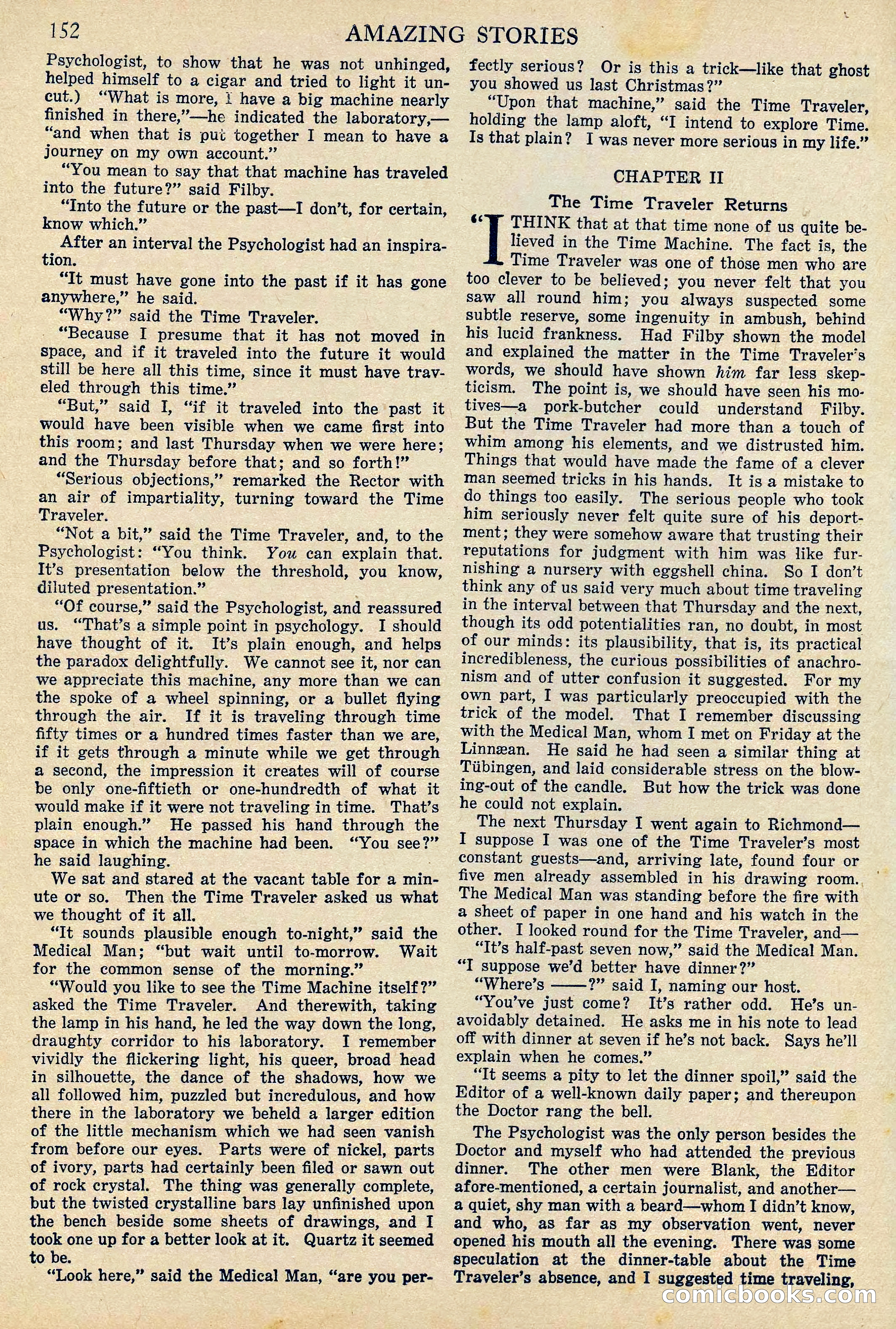
A restored page from Pulp Fiction, 1927. Page through the whole issue in the reader above.
📄 Transcribed text from this page (OCR, searchable)
Machine-transcribed from the original scan — historical spelling and the odd misread are preserved.
152 Psychologist, to show that he was not unhinged, helped himself to a cigar and tried to light it un- cut.) “What is more, ! have a big machine nearly finished in there,”—he indicated the laboratory,— “and when that is put together I mean to have a journey on my own account.” “You mean to say that that machine has traveled — into the future?” said Filby. “Into the future or the past—I don’t, for certain, know which.” After an interval the Psychologist had an inspira- tion. | “It must have gone into the past if it has gone anywhere,” he said. “Why?” said the Time Traveler. _ “Because I presume that it has not moved in space, and if it traveled into the future it would still be here all this time, since it must have trav- eled through this time.’ “But,” said I, “if it traveled into the past it would have been visible when we came first into this room; and last Thursday when we were here; and the Thursday before that: and so forth!” “Serious objections,” remarked the Rector with an air of impartiality, turning toward the Time Traveler. “Not a bit,” said the Time Traveler, and, to the Psychologist: “You think. You can explain that. It’s presentation below the threshold, you know, diluted presentation.” “Of course,” said the Psychologist, and reassured us. “That’s a simple point in psychology. I should have thought of it. It’s plain enough, and helps the paradox delightfully. We cannot see it, nor can we appreciate this machine, any more than we can the spoke of a wheel spinning, or a bullet flying through the air. If it is traveling through time fifty times or a hundred times faster than we are, if it gets through a minute while we get through a second, the impression it creates will of course be only one-fiftieth or one-hundredth of what it would make if it were not traveling in time. That’s plain enough.” He passed his hand through the space in which the machine had been. “You see?” he said laughing. We sat and stared at the vacant table for a min ute or so. Then the Time Traveler asked us what we thought of it all. “It sounds plausible enough to-night,” said the Medical Man; “but wait until to-morrow. Wait for the common sense of the morning.” “Would you like to see the Time Machine itself?” asked the Time Traveler. And therewith, taking the lamp in his hand, he led the way down the long, draughty corridor to his laboratory. I remember vividly the flickering light, his queer, broad head in silhouette, the dance of the shadows, how we all followed him, puzzled but incredulous, and how there in the laboratory we beheld a larger edition of the little mechanism which we had seen vanish from before our eyes. Parts were of nickel, parts of ivory, parts had certainly been filed or sawn out of rock crystal. The thing was generally complete, but the twisted crystalline bars lay unfinished upon the bench beside some sheets of drawings, and I took one up for a better look at it. Quartz it seemed to be. - “Look here,” said the Medical Man, “are you per- AMAZING STORIES fectly serious? Or is this a trick—like that ghost you showed us last Christmas?” “Upon that machine,” said the Time Traveler, holding the lamp aloft, “I intend to explore Time. Is that plain? I was never more serious in my life.’ CHAPTER II The Time Traveler Returns 6“ THINK that at that time none of us quite be- lieved in the Time Machine. The fact is, the Time Traveler was one of those men who are too clever to be believed; you never felt that you saw all round him; you always suspected some subtle reserve, some ingenuity in ambush, behind his lucid frankness. Had Filby shown the model and explained the matter in the Time Traveler’s words, we should have shown him far less skep- ticism. The point is, we should have geen his mo- tives—a pork-butcher could understand Filby. But the Time Traveler had more than a touch of whim among his elements, and we distrusted him. Things that would have made the fame of a clever man seemed tricks in his hands. It is a mistake to do things too easily. The serious people who took him seriously never felt quite sure of his deport- ment; they were somehow aware that trusting their reputations for judgment with him was like fur- nishing a nursery with eggshell china. So I don’t think any of us said very much about time traveling in the interval between that Thursday and the next, though its odd potentialities ran, no doubt, in most of our minds: its plausibility, that is, its practical incredibleness, the curious possibilities of anachro- nism and of utter confusion it suggested. For my own part, I was particularly preoccupied with the trick of the model. That I remember discussing with the Medical Man, whom I met on Friday at the Linnean. He said he had seen a similar thing at Tiibingen, and laid considerable stress on the blow- ing-out of the candle. But how the trick was done he could not explain. The next Thursday I went again to Richmond— I suppose I was one of the Time Traveler’s most constant guests—and, arriving late, found four or five men already assembled in his drawing room. | The Medical Man was standing before the fire with a Sheet of paper in one hand and his watch in the other. I looked round for the Time Traveler, and— “It’s half-past seven now,” said the Medical Man. “I suppose we’d better have dinner?” “Where’s 2?” said I, naming our host. “You’ve just come? It’s rather odd. He’s un- avoidably detained. He asks me in his note to lead off with dinner at seven if he’s not back. Says he'll explain when he comes.” “It seems a pity to let the dinner spoil,” said the Editor of a well-known daily paper; and thereupon the Doctor rang the bell. The Psychologist was the only person besides the Doctor and myself who had attended the previous dinner. The other men were Blank, the Editor afore-mentioned, a certain journalist, and another— a quiet, shy man with a beard—whom I didn’t know, and who, as far as my observation went, never opened his mouth all the evening. There was some speculation at the dinner-table about the Time Traveler’s absence, and I suggested time traveling, eom Eom Eb DO <S