
Pulp Fiction, 1927 · page 39 of 105
Amazing Stories, Vol. 2, No. 2 — page 39: what you’re looking at
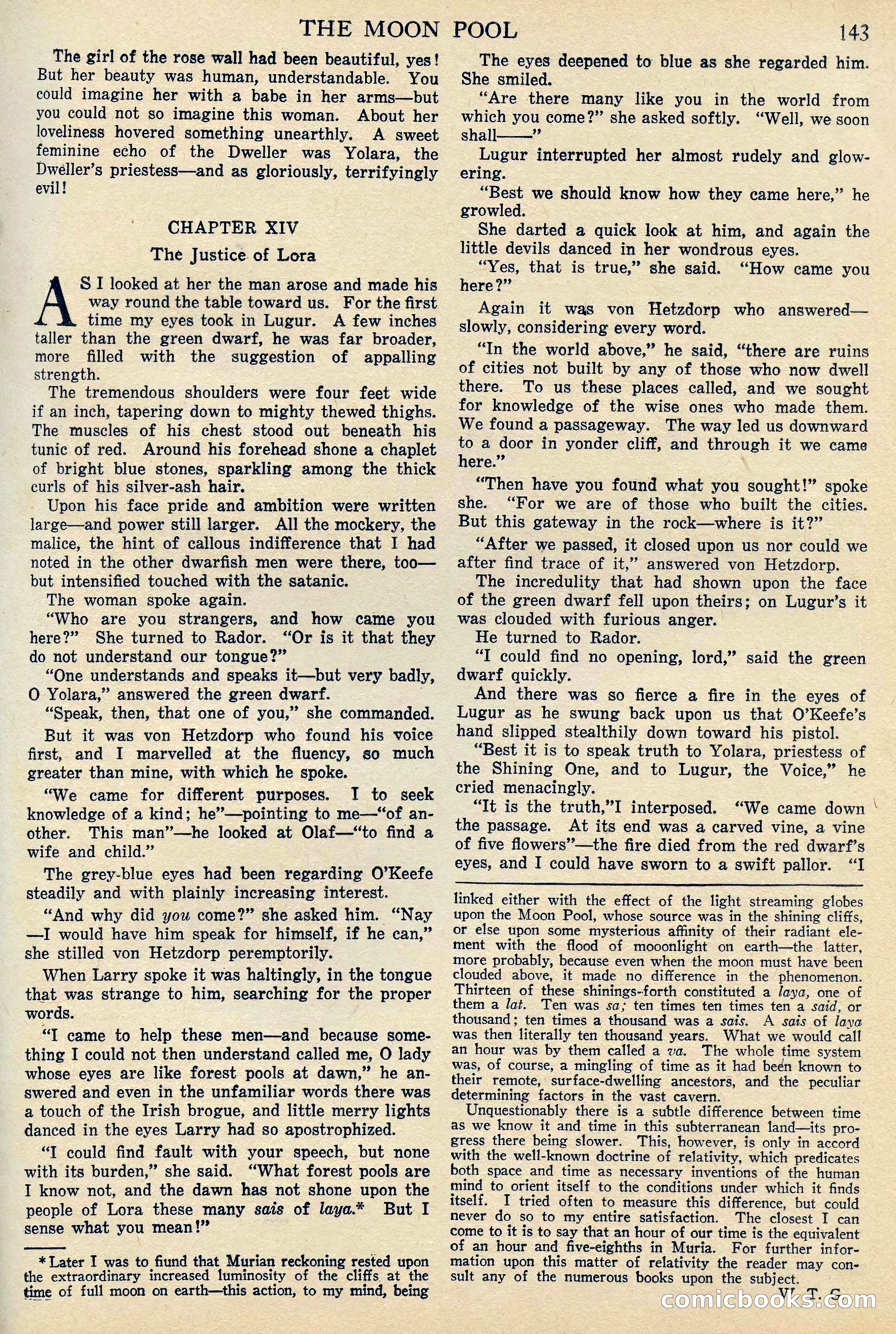
A restored page from Pulp Fiction, 1927. Page through the whole issue in the reader above.
📄 Transcribed text from this page (OCR, searchable)
Machine-transcribed from the original scan — historical spelling and the odd misread are preserved.
THE MOON POOL The girl of the rose wall had been beautiful, yes! But her beauty was human, understandable. You could imagine her with a babe in her arms—but you could not so imagine this woman. About her loveliness hovered something unearthly. A sweet feminine echo of the Dweller was Yolara, the Dweller’s priestess—and as gloriously, terrifyingly evil! CHAPTER XIV The Justice. of Lora @ SI looked at her the man arose and made his A way round the table toward us. For the first time my eyes took in Lugur. A few inches taller than the green dwarf, he was far broader, more filled with the suggestion of appalling strength. The tremendous shoulders were four feet wide if an inch, tapering down to mighty thewed thighs. The muscles of his chest stood out beneath his tunic of red. Around his forehead shone a chaplet of bright blue stones, sparkling among the thick curls of his silver-ash hair. Upon his face pride and ambition were written large—and power still larger. All the mockery, the malice, the hint of callous indifference that I had noted in the other dwarfish men were there, too— but intensified touched with the satanic. The woman spoke again. “Who are you strangers, and how came you here?” She turned to Rador. “Or is it that they do not understand our tongue?” “One understands and speaks it—but very badly, O Yolara,” answered the green dwarf. “Speak, then, that one of you,” she commanded. But it was von Hetzdorp who found his voice first, and I marvelled at the fluency, so much greater than mine, with which he spoke. “We came for different purposes. I to seek knowledge of a kind; he”—pointing to me—‘“of an- other. This man”—he looked at Olaf—“to find a wife and child.” The grey-blue eyes had been regarding O’Keefe steadily and with plainly increasing interest. “And why did you come?” she asked him. “Nay —I would have him speak for himself, if he can,” she stilled von Hetzdorp peremptorily. When Larry spoke it was haltingly, in the tongue that was strange to him, searching for the proper words. “T came to help these men—and because some- thing I could not then understand called me, O lady whose eyes are like forest pools at dawn,” he an- swered and even in the unfamiliar words there was a touch of the Irish brogue, and little merry lights danced in the eyes Larry had so apostrophized. “T could find fault with your speech, but none with its burden,” she said. “What forest pools are I know not, and the dawn has not shone upon the people of Lora these many sais of laya.* But I sense what you mean!” *Later I was to fiund that Murian reckoning rested upon the extraordinary increased luminosity of the cliffs. at the time of full moon on earth—this action, to my mind, being 143 The eyes deepened to blue as she regarded him. She smiled. “Are there many like you in the world from which you come?” she asked softly. “Well, we soon shall oe Lugur interrupted her almost rudely and glow- ering. “Best we should know how they came here,” he growled. She darted a quick look at him, and again the little devils danced in her wondrous eyes. “Yes, that is true,” she said. “How came you here?” Again it was von Hetzdorp who answered— slowly, considering every word. “In the world above,” he said, “there are ruins of cities not built by any of those who now dwell there. To us these places called, and we sought for knowledge of the wise ones who made them. We found a passageway. The way led us downward to a door in yonder cliff, and through it we came here.” “Then have you found what you sought!” spoke she. ‘For we are of those who built the cities. But this gateway in the rock—where is it?” “After we passed, it closed upon us nor could we after find trace of it,” answered von Hetzdorp. The incredulity that had shown upon the face of the green dwarf fell upon theirs; on Lugur’s it was clouded with furious anger. He turned to Rador. | “I could find no opening, lord,” said the green dwarf quickly. And there was so fierce a fire in the eyes of Lugur as he swung back upon us that O’Keefe’s hand slipped stealthily down toward his pistol. “Best it is to speak truth to Yolara, priestess of the Shining One, and to Lugur, the Voice,” he cried menacingly. “It is the truth,”I interposed. “We came down the passage. At its end was a carved vine, a vine of five flowers”—the fire died from the red dwarf’s eyes, and I could have sworn to a swift pallor. “I linked either with the effect of the light streaming globes upon the Moon Pool, whose source was in the shining cliffs, or else upon some mysterious affinity of their radiant ele- ment with the flood of mooonlight on earth—the latter, more probably, because even when the moon must have been clouded above, it made no difference in the phenomenon. Thirteen of these shinings-forth constituted a Jaya, one of them a lat. Ten was sa; ten times ten times ten a said, or thousand; ten times a thousand was a sais. A sais of lava was then literally ten thousand years. What we would call an hour was by them called a va. The whole time system was, of course, a mingling of time as it had beén known to their remote, surface-dwelling ancestors, and the peculiar determining factors in the vast cavern. Unquestionably there is a subtle difference between time as we know it and time in this subterranean land—its pro- gress there being slower. This, however, is only in accord with the well-known doctrine of relativity, which predicates both space and time as necessary inventions of the human mind to orient itself to the conditions under which it finds itself. I tried often to measure this difference, but could never do so to my entire satisfaction. The closest I can come to it is to say that an hour of our time is the equivalent of an hour and five-eighths in Muria. For further infor- mation upon this matter of relativity the reader may con- sult any of the numerous books upon the subject. (ex @) Al G —_— o\(0 oks* com