
Pulp Fiction, 1927 · page 26 of 105
Amazing Stories, Vol. 2, No. 2 — page 26: what you’re looking at
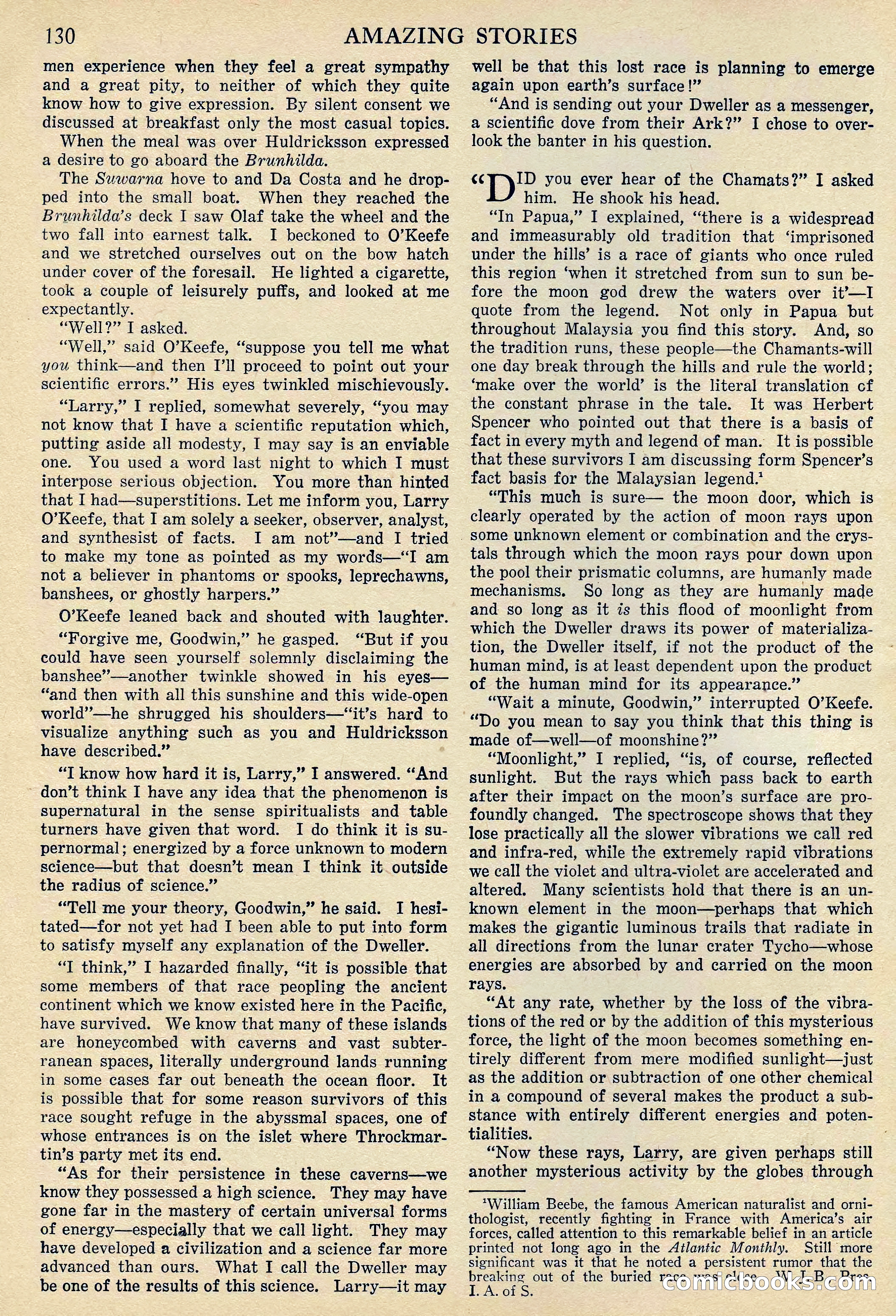
A restored page from Pulp Fiction, 1927. Page through the whole issue in the reader above.
📄 Transcribed text from this page (OCR, searchable)
Machine-transcribed from the original scan — historical spelling and the odd misread are preserved.
130 men experience when they feel a great sympathy and a great pity, to neither of which they quite know how to give expression. By silent consent we discussed at breakfast only the most casual topics. When the meal was over Huldricksson expressed a desire to go aboard the Brunhilda. The Suwarna hove to and Da Costa and he drop- ped into the small boat. When they reached the Brunhilda’s deck I saw Olaf take the wheel and the two fall into earnest talk. I beckoned to O’Keefe and we stretched ourselves out on the bow hatch under cover of the foresail. He lighted a cigarette, took a couple of leisurely puffs, and looked at me expectantly. “Well?” I asked. “Well,” said O’Keefe, “suppose you tell me what you think—and then I’ll proceed to point out your scientific errors.” His eyes twinkled mischievously. “Larry,” I replied, somewhat severely, “you may not know that I have a scientific reputation which, putting aside all modesty, I may say is an enviable one. You used a word last night to which I must interpose serious objection. You more than hinted that I had—superstitions. Let me inform you, Larry O’Keefe, that I am solely a seeker, observer, analyst, and synthesist of facts. I am not’’—and I tried to make my tone as pointed as my words—‘I am not a believer in phantoms or spooks, leprechawns, banshees, or ghostly harpers.” O’Keefe leaned back and shouted with laughter. “Forgive me, Goodwin,” he gasped. “But if you could have seen yourself solemnly disclaiming the banshee’’—another twinkle showed in his eyes— “and then with all this sunshine and this wide-open world”—he shrugged his shoulders—“it’s hard to visualize anything such as you and Huldricksson have described.” “T know how hard it is, Larry,” I answered. “And ~ don’t think I have any idea that the phenomenon is supernatural in the sense spiritualists and table turners have given that word. I do think it is su- pernormal; energized by a force unknown to modern science—but that doesn’t mean I think it outside the radius of science.” “Tell me your theory, Goodwin,” he said. I hesi- tated—for not yet had I been able to put into form to satisfy myself any explanation of the Dweller. “T think,” I hazarded finally, “it is possible that some members of that race peopling the ancient continent which we know existed here in the Pacific, have survived. We know that many of these islands are honeycombed with caverns and vast subter- ranean spaces, literally underground lands running in some cases far out beneath the ocean floor. It is possible that for some reason survivors of this race sought refuge in the abyssmal spaces, one of whose entrances is on the islet where Throckmar- tin’s party met its end. “As for their persistence in these caverns—we know they possessed a high science. They may have gone far in the mastery of certain universal forms of energy—especially that we call light. They may have developed a civilization and a science far more advanced than ours. What I call the Dweller may be one of the results of this science. Larry—it may AMAZING STORIES well be that this lost race is planning to emerge again upon earth’s surface!” “And is sending out your Dweller as a messenger, a scientific dove from their Ark?’ I chose to over- look the banter in his question. ¢CPY\ID you ever hear of the Chamats?” I asked him. He shook his head. “In Papua,” I explained, ‘“‘there is a widespread and immeasurably old tradition that ‘imprisoned under the hills’ is a race of giants who once ruled this region ‘when it stretched from sun to sun be- fore the moon god drew the waters over it’—I quote from the legend. Not only in Papua but throughout Malaysia you find this story. And, so the tradition runs, these people—the Chamants-will one day break through the hills and rule the world; ‘make over the world’ is the literal translation cf the constant phrase in the tale. It was Herbert Spencer who pointed out that there is a basis of fact in every myth and legend of man. It is possible that these survivors I am discussing form Spencer’s fact basis for the Malaysian legend.’ “This much is sure— the moon door, which is clearly operated by the action of moon rays upon _ some unknown element or combination and the crys- tals through which the moon rays pour down upon the pool their prismatic columns, are humanly made mechanisms. So long as they are humanly made and so long as it is this flood of moonlight from which the Dweller draws its power of materializa- tion, the Dweller itself, if not the product of the human mind, is at least dependent upon the product of the human mind for its appearance.” “Wait a minute, Goodwin,” interrupted O’Keefe. “Do you mean to say you think that this thing is made of—well—of moonshine?” “Moonlight,” I replied, “is, of course, reflected sunlight. But the rays which pass back to earth after their impact on the moon’s surface are pro- foundly changed. The spectroscope shows that they lose practically all the slower vibrations we call red and infra-red, while the extremely rapid vibrations we call the violet and ultra-violet are accelerated and altered. Many scientists hold that there is an un- known element in the moon—perhaps that which makes the gigantic luminous trails that radiate in all directions from the lunar crater Tycho—whose energies are absorbed by and carried on the moon rays. “At any rate, whether by the loss of the vibra- tions of the red or by the addition of this mysterious force, the light of the moon becomes something en- tirely different from mere modified sunlight—just as the addition or subtraction of one other chemical in a compound of several makes the product a sub- stance with entirely different energies and poten- tialities. | “Now these rays, Larry, are given perhaps still another mysterious activity by the globes through *William Beebe, the famous American naturalist and orni- thologist, recently fighting in France with America’s air forces, called attention to this remarkable belief in an article printed not long ago in the Atlantic Monthly. Still more significant was it that he noted a persistent rumor that the See ous of the buried ‘Com G sO00KS:GOmM)