
Pulp Fiction, 1927 · page 12 of 105
Amazing Stories, Vol. 2, No. 2 — page 12: what you’re looking at
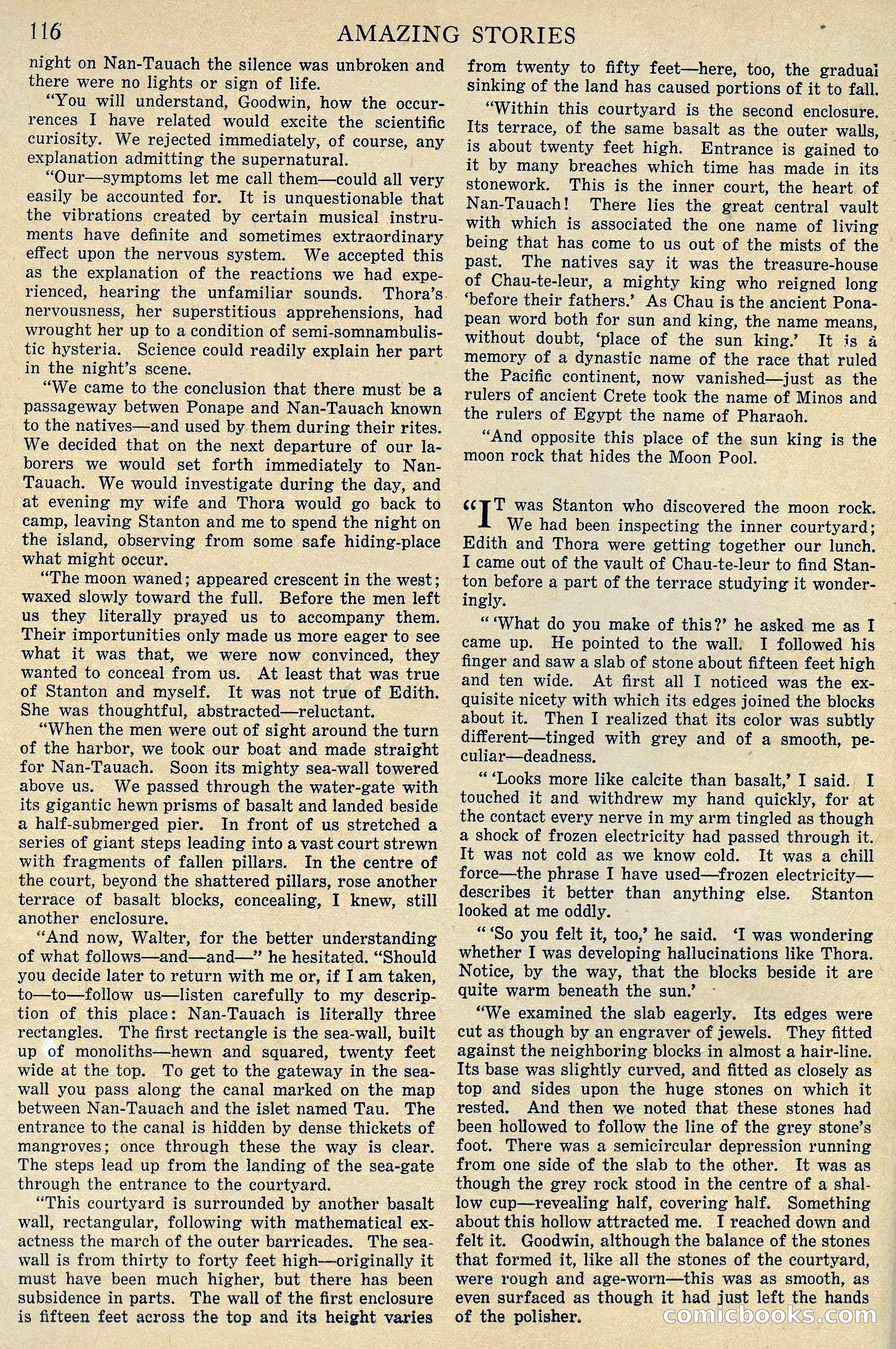
A restored page from Pulp Fiction, 1927. Page through the whole issue in the reader above.
📄 Transcribed text from this page (OCR, searchable)
Machine-transcribed from the original scan — historical spelling and the odd misread are preserved.
116 night on Nan-Tauach the silence was unbroken and there were no lights or sign of life. “You will understand, Goodwin, how the occur- rences I have related would excite the scientific curiosity. We rejected immediately, of course, any explanation admitting the supernatural. “Our—symptoms let me call them—could all very easily be accounted for. It is unquestionable that the vibrations created by certain musical instru- ments have definite and sometimes extraordinary effect upon the nervous system. We accepted this as the explanation of the reactions we had expe- rienced, hearing the unfamiliar sounds. nervousness, her superstitious apprehensions, had wrought her up to a condition of semi-somnambulis- tic hysteria. Science could readily explain her part in the night’s scene. “We came to the conclusion that there must be a passageway betwen Ponape and Nan-Tauach known to the natives—and used by them during their rites. We decided that on the next departure of our la- borers we would set forth immediately to Nan- Tauach. We would investigate during the day, and at evening my wife and Thora would go back to camp, leaving Stanton and me to spend the night on the island, observing from some safe hiding-place what might occur. “The moon waned; appeared crescent in the west; waxed slowly toward the full. Before the men left us they literally prayed us to accompany them. Their importunities only made us more eager to see what it was that, we were now convinced, they wanted to conceal from us. At least that was true of Stanton and myself. It was not true of Edith. She was thoughtful, abstracted—reluctant. “When the men were out of sight around the turn of the harbor, we took our boat and made straight for Nan-Tauach. Soon its mighty sea-wall towered above us. We passed through the water-gate with its gigantic hewn prisms of basalt and landed beside a half-submerged pier. In front of us stretched a series of giant steps leading into a vast court strewn with fragments of fallen pillars. In the centre of the court, beyond the shattered pillars, rose another terrace of basalt blocks, concealing, I knew, still another enclosure. “And now, Walter, for the better understanding of what follows—and—and—” he hesitated. ‘Should you decide later to return with me or, if I am taken, to—to—follow us—listen carefully to my descrip- tion of this place: Nan-Tauach is literally three rectangles. The first rectangle is the sea-wall, built up of monoliths—hewn and squared, twenty feet wide at the top. To get to the gateway in the sea- wall you pass along the canal marked on the map between Nan-Tauach and the islet named Tau. The entrance to the canal is hidden by dense thickets of mangroves; once through these the way is clear. The steps lead up from the landing of the sea-gate through the entrance to the courtyard. “This courtyard is surrounded by another basalt wall, rectangular, following with mathematical ex- actness the march of the outer barricades. The sea- wall is from thirty to forty feet high—originally it must have been much higher, but there has been subsidence in parts. The wall of the first enclosure is fifteen feet across the top and its height varies AMAZING STORIES Thora’s. from twenty to fifty feet—here, too, the graduai sinking of the land has caused portions of it to fall. “Within this courtyard is the second enclosure. Its terrace, of the same basalt as the outer walls, is about twenty feet high. Entrance is gained to it by many breaches which time has made in its stonework. This is the inner court, the heart of Nan-Tauach! There lies the great central vault with which is associated the one name of living being that has come to us out of the mists of the past. The natives say it was the treasure-house of Chau-te-leur, a mighty king who reigned long ‘before their fathers.’ As Chau is the ancient Pona- pean word both for sun and king, the name means, without doubt, ‘place of the sun king,” It is a memory of a dynastic name of the race that ruled the Pacific continent, now vanished—just as the rulers of ancient Crete took the name of Minos and the rulers of Egypt the name of Pharaoh. “And opposite this place of the sun king is the moon rock that hides the Moon Pool. 15 fe was Stanton who discovered the moon rock. We had been inspecting the inner courtyard; Edith and Thora were getting together our lunch. I came out of the vault of Chau-te-leur to find Stan- ton before a part of the terrace studying it wonder- ingly. “What do you make of this?’ he asked me as I came up. He pointed to the wall. I followed his finger and saw a slab of stone about fifteen feet high and ten wide. At first all I noticed was the ex- quisite nicety with which its edges joined the blocks about it. Then I realized that its color was subtly different—tinged with grey and of a smooth, pe- culiar—deadness. ““Looks more like calcite than basalt,’ I said. I touched it and withdrew my hand quickly, for at the contact every nerve in my arm tingled as though a shock of frozen electricity had passed through it. It was not cold as we know cold. It was a chill force—the phrase I have used—frozen electricity— describes it better than anything else. Stanton looked at me oddly. “So you felt it, too,’ he said. ‘I was wondering whether I was developing hallucinations like Thora. Notice, by the way, that the blocks beside it are quite warm beneath the sun.’ “We examined the slab eagerly. Its edges were cut as though by an engraver of jewels. They fitted against the neighboring blocks in almost a hair-line. Its base was slightly curved, and fitted as closely as top and sides upon the huge stones on which it rested. And then we noted that these stones had been hollowed to follow the line of the grey stone’s foot. There was a semicircular depression running from one side of the slab to the other. It was as though the grey rock stood in the centre of a shal- low cup—revealing half, covering half. Something about this hollow attracted me. I reached down and felt it. Goodwin, although the balance of the stones that formed it, like all the stones of the courtyard, were rough and age-worn—this was as smooth, as even surfaced as though it had just left the hands of the polisher. GOMmMIEDOOKS-GOMm