
Pulp Fiction, 1927 · page 82 of 108
Amazing Stories, Vol. 2, No. 1 — page 82: what you’re looking at
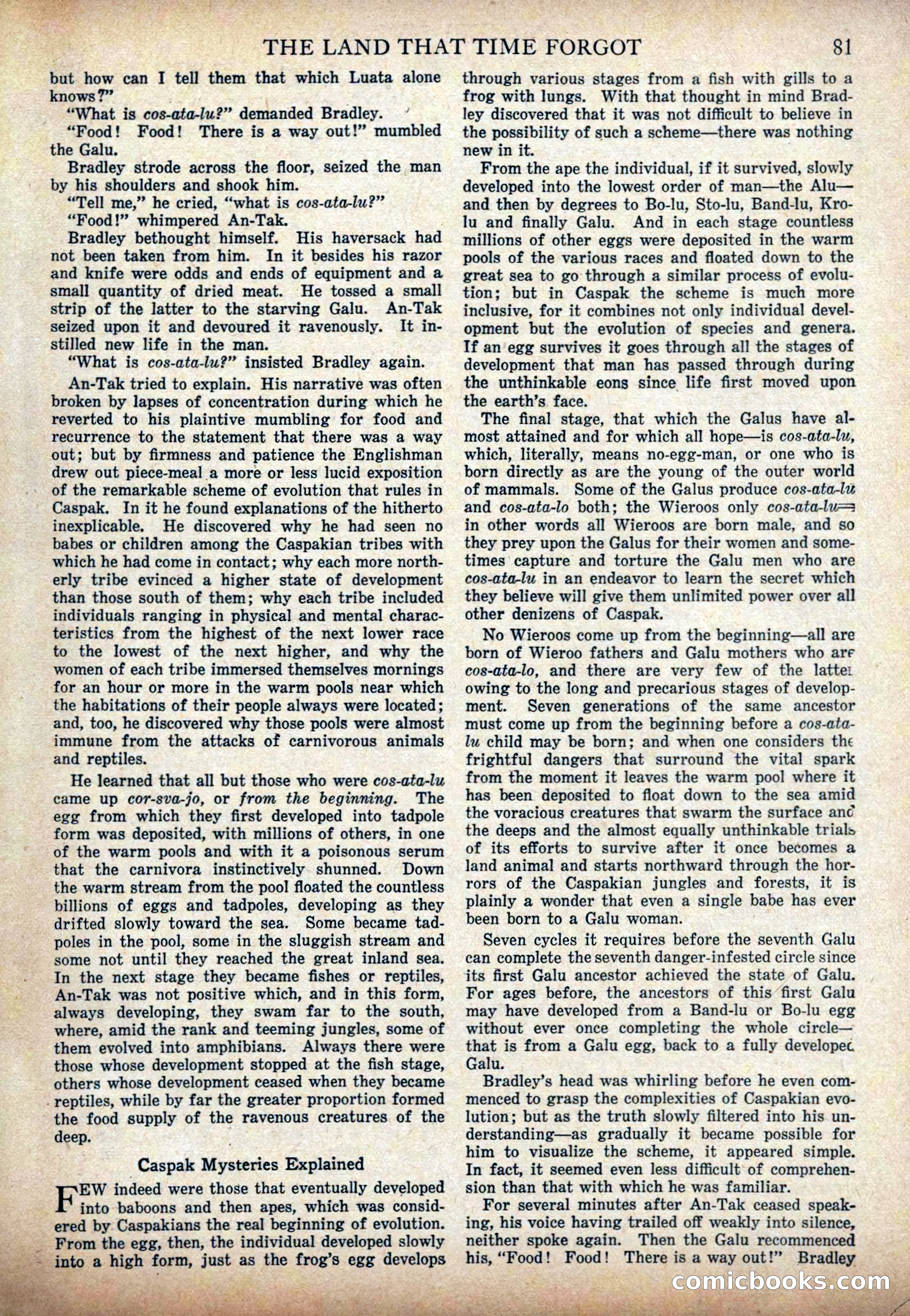
A restored page from Pulp Fiction, 1927. Page through the whole issue in the reader above.
📄 Transcribed text from this page (OCR, searchable)
Machine-transcribed from the original scan — historical spelling and the odd misread are preserved.
se Se ex. nt Geer Mass tea s THE LAND THAT TIME FORGOT 81 but how can I tell them that which Luata alone knows 7?” “What is cos-ata-lu?” demanded Bradley. ” “Food! Food! There is a way out!” mumbled the Galu. Bradley strode across the floor, seized the man by his shoulders and shook him. “Tell me,” he cried, “what is cos-ata-lu?” “Food!” whimpered An-Tak. Bradley bethought himself. His haversack had not been taken from him. In it besides his razor and knife were odds and ends of equipment and a small quantity of dried meat. He tossed a small strip of the latter to the starving Galu. An-Tak seized upon it and devoured it ravenously. It in- stilled new life in the man. “What is cos-ata-lu?” insisted Bradley again. An-Tak tried to explain. His narrative was often broken by lapses of concentration during which he reverted to his plaintive mumbling for food and recurrence to the statement that there was a way out; but by firmness and patience the Englishman drew out piece-meal a more or less lucid exposition of the remarkable scheme of evolution that rules in Caspak. In it he found explanations of the hitherto inexplicable. He discovered why he had seen no babes or children among the Caspakian tribes with which he had come in contact; why each more north- erly tribe evinced a higher state of development than those south of them; why each tribe included individuals ranging in physical and mental charac- teristics from the highest of the next lower race to the lowest of the next higher, and why the women of each tribe immersed themselves mornings for an hour or more in the warm pools near which the habitations of their people always were located; and, too, he discovered why those pools were almost immune from the attacks of carnivorous animals and reptiles. He learned that all but those who were cos-ata-lu came up cor-sva-jo, or from the beginning. The egg from which they first developed into tadpole form was deposited, with millions of others, in one -of the warm pools and with it a poisonous serum that the carnivora instinctively shunned. Down the warm stream from the pool floated the countless billions of eggs and tadpoles, developing as they drifted slowly toward the sea. Some became tad- poles in the pool, some in the sluggish stream and some not until they reached the great inland sea. In the next stage they became fishes or reptiles, An-Tak was not positive which, and in this form, always developing, they swam far to the south, where, amid the rank and teeming jungles, some of them evolved into amphibians. Always there were those whose development stopped at the fish stage, others whose development ceased when they became _reptiles, while by far the greater proportion formed the food supply of the ravenous creatures of the deep. : _Caspak Mysteries Explained EW indeed were those that eventually developed into baboons and then apes, which was consid- BS : s ered by Caspakians the real beginning of evolution. as SS _ From the egg, then, the individual developed slowly into a high form, just as the frog’s egg develops IED P ae ~~ a ee OE tod, Pe DF eye eS ee = : ind 8 Pury WS oe x ~ et. ea, ev. - sae ae 4 * ‘s _ or a ~~ Pe PFE en A 5% through various stages from a fish with gills to a frog with lungs. With that thought in mind Brad- ley discovered that it was not difficult to believe in the possibility of such a scheme—there was nothing new in it. From the ape the individual, if it survived, slowly developed into the lowest order of man—the Alu— and then by degrees to Bo-lu, Sto-lu, Band-lu, Kro- lu and finally Galu. And in each stage countless millions of other eggs were deposited in the warm pools of the various races and floated down to the great sea to go through a similar process of evolu- tion; but in Caspak the scheme is much more inclusive, for it combines not only individual devel- opment but the evolution of species and genera. If an egg survives it goes through all the stages of development that man has passed through during the unthinkable eons since life first moved upon the earth’s face. The final stage, that which the Galus have al- most attained and for which all hope—is cos-ata-lu, which, literally, means no-egg-man, or one who is born directly as are the young of the outer world of mammals. Some of the Galus produce cos-ata-lu and cos-ata-lo both; the Wieroos only cos-ata-lu= in other words all Wieroos are born male, and so they prey upon the Galus for their women and some- times capture and torture the Galu men who are cos-ata-lu in an endeavor to learn the secret which they believe will give them unlimited power over all other denizens of Caspak. No Wieroos come up from the beginning—all are born of Wieroo fathers and Galu mothers who are cos-ata-lo, and there are very few of the latte owing to the long and precarious stages of develop- ment. Seven generations of the same ancestor must come up from the beginning before a cos-ata- lu child may be born; and when one considers the frightful dangers that surround the vital spark from the moment it leaves the warm pool where it has been deposited to float down to the sea amid the voracious creatures that swarm the surface anc the deeps and the almost equally unthinkable trials of its efforts to survive after it once becomes a land animal and starts northward through the hor- rors of the Caspakian jungles and forests, it is plainly a wonder that even a single babe has ever been born to a Galu woman. Seven cycles it requires before the seventh Galu can complete the seventh danger-infested circle since its first Galu ancestor achieved the state of Galu. For ages before, the ancestors of this first Galu may have developed from a Band-lu or Bo-lu egg without ever once completing the whole circle— that is from a Galu egg, back to a fully developec Galu. Bradley’s head was whirling before he even com- menced to grasp the complexities of Caspakian evo- lution; but as the truth slowly filtered into his un- derstanding—as gradually it became possible for him to visualize the scheme, it appeared simple. In fact, it seemed even less difficult of comprehen- sion than that with which he was familiar. For several minutes after An-Tak ceased speak- ing, his voice having trailed off weakly into silence, neither spoke again. Then the Galu recommenced his, “Food! Food! There is a way out!” pen on snags aC