
Pulp Fiction, 1927 · page 69 of 108
Amazing Stories, Vol. 2, No. 1 — page 69: what you’re looking at
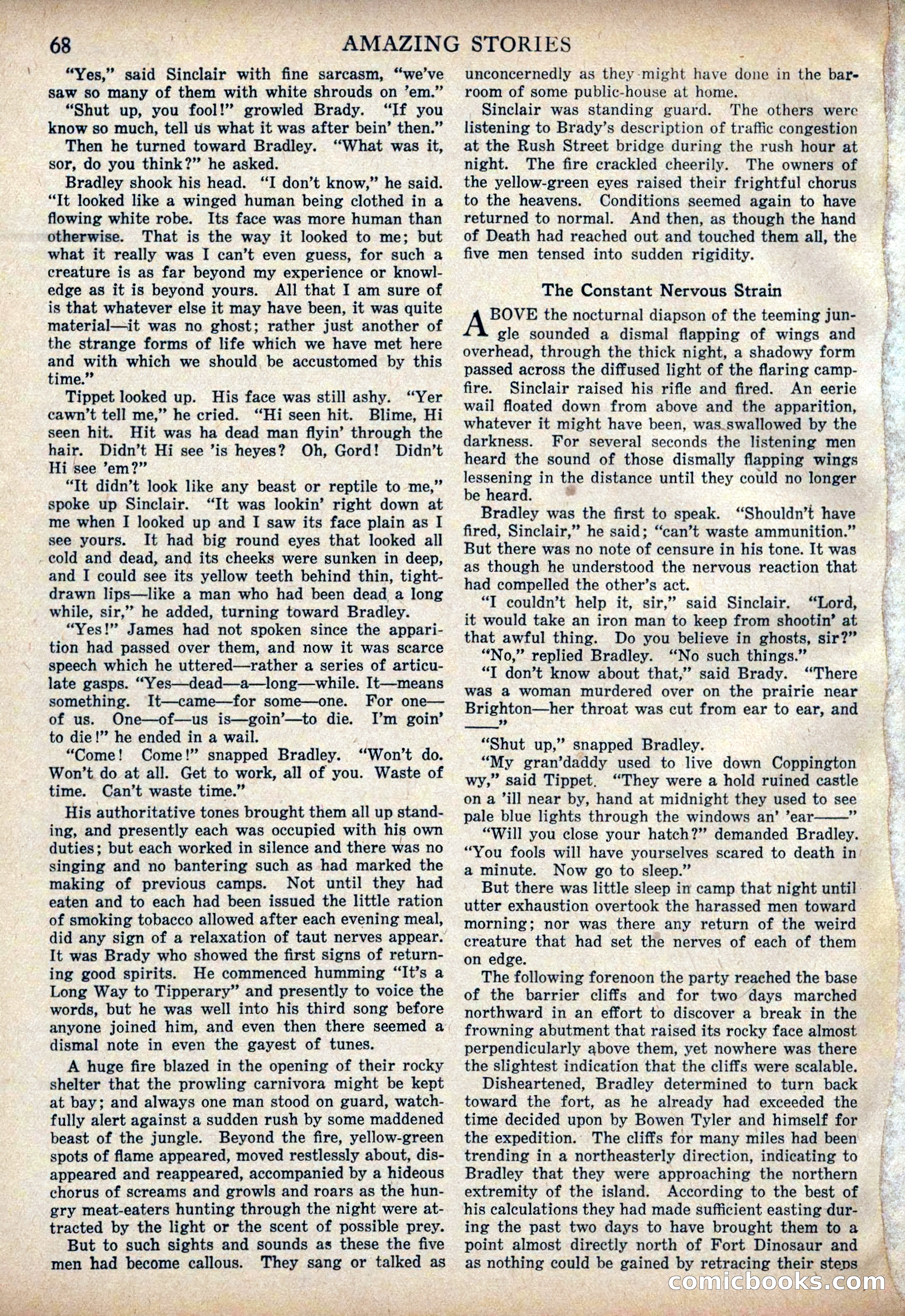
A restored page from Pulp Fiction, 1927. Page through the whole issue in the reader above.
📄 Transcribed text from this page (OCR, searchable)
Machine-transcribed from the original scan — historical spelling and the odd misread are preserved.
Te Fa bn ee eg Mow 4h Doe! Raed 26 Vu, seun Be ree Seeds **, . Ce a’ 4 rh a aoe . st Ae eles a as ak a a “a 4 . m i 68 “Yes,” said Sinclair with fine sarcasm, “‘we’ve saw so many of them with white shrouds on ’em.” “Shut up, you fool!” growled Brady. “If you know so much, tell us what it was after bein’ then.” Then he turned toward Bradley. “What was it, sor, do you think?” he asked. Bradley shook his head. “I don’t know,” he said. “Tt looked like a winged human being clothed in a flowing white robe. Its face was more human than otherwise. That is the way it looked to me; but what it really was I can’t even guess, for such a creature is as far beyond my experience or knowl- edge as it is beyond yours. All that I am sure of is that whatever else it may have been, it was quite material—it was no ghost; rather just another of the strange forms of life which we have met here and with which we should be accustomed by this time.” Tippet looked up. His face was still ashy. “Yer cawn’t tell me,” he cried. “Hi seen hit. Blime, Hi seen hit. Hit was ha dead man flyin’ through the hair. Didn’t Hi see ’is heyes? Oh, Gord! Didn’t Hi see ’em?” “It didn’t look like any beast or reptile to me,” spoke up Sinclair. “It was lookin’ right down at me when I looked up and I saw its face plain as I see yours. It had big round eyes that looked all _eold and dead, and its cheeks were sunken in deep, and I could see its yellow teeth behind thin, tight- drawn lips—like a man who had been dead a long while, sir,” he added, turning toward Bradley. “Yes!” James had not spoken since the appari- tion had passed over them, and now it was scarce speech which he uttered—rather a series of articu- late gasps. “Yes—dead—a—long—while. It—means something. It—came—for some—one. For one— of us. One—of—us is—goin’—to die. I’m goin’ to die!’”’ he ended in a wail. “Come! Come!” snapped Bradley. “Won’t do. Won’t do at all. Get to work, all of you. Waste of time. Can’t waste time.” His authoritative tones brought them all up stand- ing, and presently each was occupied with his own duties; but each worked in silence and there was no singing and no bantering such as had marked the making of previous camps. Not until they had eaten and to each had been issued the little ration of smoking tobacco allowed after each evening meal, did any sign of a relaxation of taut nerves appear. It was Brady who showed the first signs of return- ing good spirits. He commenced humming “It’s a Long Way to Tipperary” and presently to voice the words, but he was well into his third song before anyone joined him, and even then there seemed a dismal note in even the gayest of tunes. A huge fire blazed in the opening of their rocky shelter that the prowling carnivora might be kept at bay; and always one man stood on guard, watch- fully alert against a sudden rush by some maddened beast of the jungle. Beyond the fire, yellow-green spots of flame appeared, moved restlessly about, dis- appeared and reappeared, accompanied by a hideous chorus of screams and growls and roars as the hun- gry meat-eaters hunting through the night were at- tracted by the light or the scent of possible prey. But to such sights and sounds as these the five men had become callous. They sang or talked as AMAZING STORIES Aig) etd fehl tel | prmoes *', > he lea Ne ee ey Pee unconcernedly as they-might have done in the bar- room of some public-house at home. Sinclair was standing guard. The others were listening to Brady’s description of traffic congestion at the Rush Street bridge during the rush hour at night. The fire crackled cheerily. The owners of the yellow-green eyes raised their frightful chorus to the heavens. Conditions seemed again to have returned to normal. And then, as though the hand of Death had reached out and touched them all, the five men tensed into sudden rigidity. The Constant Nervous Strain Scere the nocturnal diapson of the teeming jun- gle sounded a dismal flapping of wings and overhead, through the thick night, a shadowy form passed across the diffused light of the flaring camp- fire. Sinclair raised his rifle and fired. An eerie wail floated down from above and the apparition, whatever it might have been, was.swallowed by the darkness. For several seconds the listening men heard the sound of those dismally flapping wings lessening in the distance until they could no longer be heard. ~ . Bradley was the first to speak. “Shouldn’t have fired, Sinclair,” he said; “can’t waste ammunition.” But there was no note of censure in his tone. It was as though he understood the nervous reaction that had compelled the other’s act. “T couldn’t help it, sir,” said Sinclair. “Lord, it would take an iron man to keep from shootin’ at that awful thing. Do you believe in ghosts, sir?” “No,” replied Bradley. “No such things.” “T don’t know about that,” said Brady. “There was a woman murdered over on the prairie near Brighton—her throat was cut from ear to ear, and “Shut up,” snapped Bradley. “My gran’daddy used to live down Coppington wy,” said Tippet. “They were a hold ruined castle on a ’ill near by, hand at midnight they used to see pale blue lights through the windows an’ ’ear——” “Will you close your hatch?” demanded Bradley. “You fools will have yourselves scared to death in a minute. Now go to sleep.” But there was little sleep in camp that night until utter exhaustion overtook the harassed men toward morning; nor was there any return of the weird creature that had set the nerves of each of them on edge. The following forenoon the party reached the base of the barrier cliffs and for two days marched northward in an effort to discover a break in the frowning abutment that raised its rocky face almost perpendicularly above them, yet nowhere was there the slightest indication that the cliffs were scalable. Disheartened, Bradley determined to turn back toward the fort, as he already had exceeded the time decided upon by Bowen Tyler and himself for the expedition. The cliffs for many miles had been trending in a northeasterly direction, indicating to Bradley that they were approaching the northern extremity of the island. According to the best of his calculations they had made sufficient easting dur- ing the past two days to have brought them to a point almost directly north of Fort Dinosaur and as nothing could be gained by retracing their steps EomIcbooks. com: :