
Pulp Fiction, 1927 · page 60 of 108
Amazing Stories, Vol. 2, No. 1 — page 60: what you’re looking at
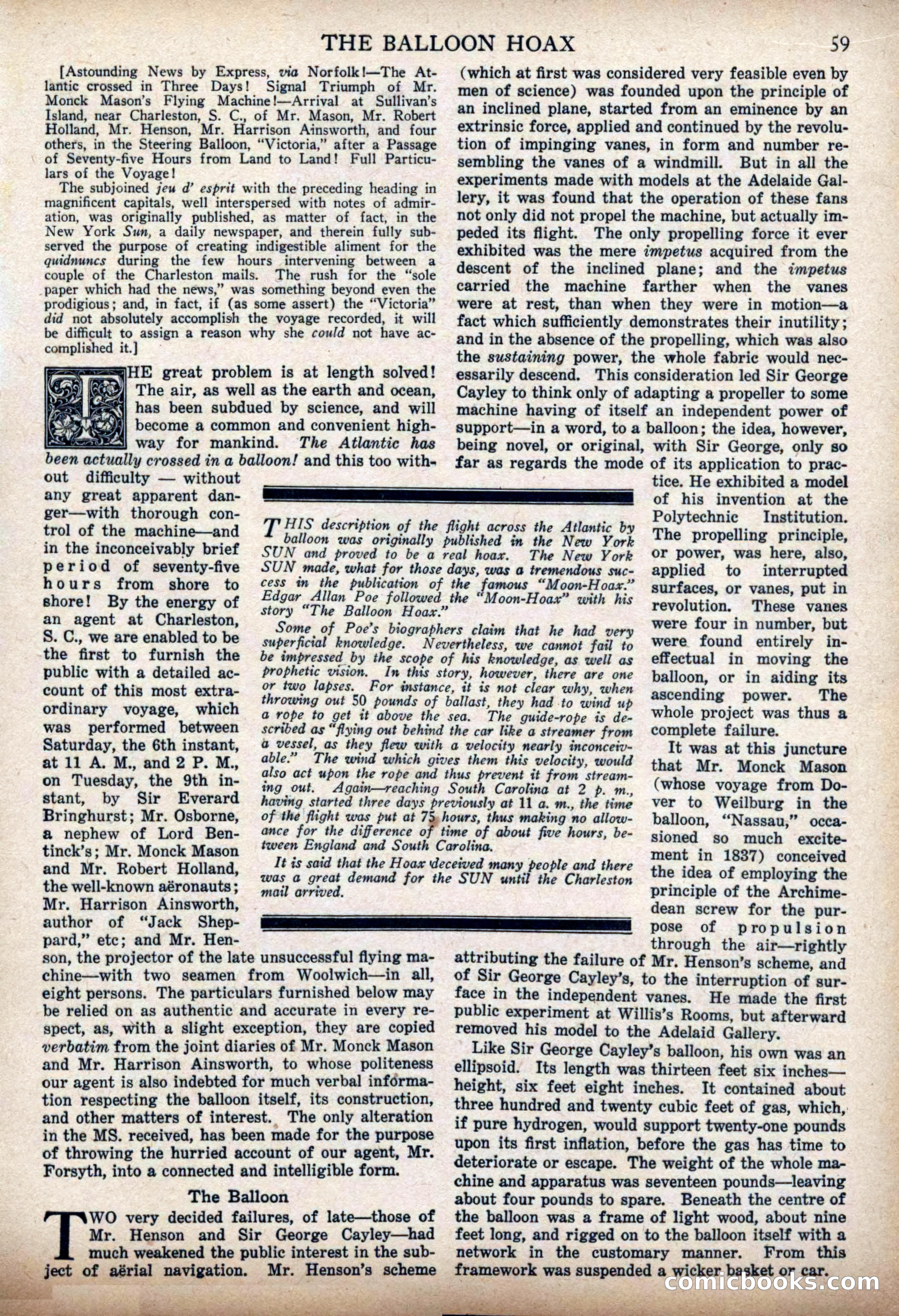
A restored page from Pulp Fiction, 1927. Page through the whole issue in the reader above.
📄 Transcribed text from this page (OCR, searchable)
Machine-transcribed from the original scan — historical spelling and the odd misread are preserved.
mee a wetthy ele «3 re oa THE BALLOON HOAX es" [Astounding News by Express, via Norfolk!—The At- lantic crossed in Three Days! Signal Triumph of Mr. Monck Mason’s Flying Machine!—Arrival at Sullivan’s Island, near Charleston, S. C., of Mr. Mason, Mr. Robert Holland, Mr. Henson, Mr. Harrison Ainsworth, and four others, in the Steering Balloon, “Victoria,” after a Passage of Seventy-five Hours from Land to Land! Full Particu- lars of the Voyage! The subjoined jeu d’ esprit with the preceding heading in magnificent capitals, well interspersed with notes of admir- ation, was originally published, as matter of fact, in the New York Sun, a daily newspaper, and therein fully sub- served the purpose of creating indigestible aliment for the guidnuncs during the few hours intervening between a couple of the Charleston mails. The rush for the “sole _paper which had the news,” was something beyond even the prodigious; and, in fact, if (as some assert) the “Victoria” did not absolutely accomplish the voyage recorded, it will be difficult to assign a reason why she could not have ac- complished it.] @=x==— HE great problem is at length solved! The air, as well as the earth and ocean, f has been subdued by science, and will Ses ‘ . ~{34)| become a common and convenient high- ewes} way for mankind. The Atlantic has been actually crossed in a balloon! and this too with- out difficulty — without (which at first was considered very feasible even by men of science) was founded upon the principle of an inclined plane, started from an eminence by an extrinsic force, applied and continued by the revolu- tion of impinging vanes, in form and number re- sembling the vanes of a windmill. But in all the experiments made with models at the Adelaide Gal- lery, it was found that the operation of these fans not only did not propel the machine, but actually im- peded its flight. The only propelling force it ever exhibited was the mere impetus acquired from the descent of the inclined plane; and the impetus carried the machine farther when the vanes were at rest, than when they were in motion—a fact which sufficiently demonstrates their inutility; and in the absence of the propelling, which was also the sustaining power, the whole fabric would nec- essarily descend. This consideration led Sir George Cayley to think only of adapting a propeller to some machine having of itself an independent power of support—in a word, to a balloon; the idea, however, being novel, or original, with Sir George, only so far as regards the mode of its application to prac- . tice. He exhibited a model any great apparent dan- ger—with thorough con- trol of the machine—and in the inconceivably brief period of seventy-five hours from shore to shore! By the energy of an agent at Charleston, S. C., we are enabled to be the first to furnish the public with a detailed ac- count of this most extra- ordinary voyage, which was performed between Saturday, the 6th instant, at 11 A. M., and 2 P. M., on Tuesday, the 9th in- stant, by Sir Everard Bringhurst; Mr. Osborne, a nephew of Lord Ben- tinck’s; Mr. Monck Mason and Mr. Robert Holland, the well-known aéronauts; Mr. Harrison Ainsworth, author of “Jack Shep- pard,” etc; and Mr. Hen- son, the projector of the late unsuccessful flying ma- chine—with two seamen from Woolwich—in all, eight persons. The particulars furnished below may HIS description of the flight across the Atlantic by balloon was originally published in the New York SUN and proved to be a real hoar. The New York SUN made, what for those days, was a tremendous suc- cess in the publication of the famous “Moon-Hoax.” Edgar Allan Poe followed the “Moon-Hoax” with his story “The Balloon Hoax.” Some. of Poe’s biographers claim that he had very superficial knowledge. Nevertheless, we cannot fail to be impressed by the scope of his knowledge, as well as prophetic vision. In this story, however, there are one or two lapses. For instance, it is not clear why, when throwing out 50 pounds of ballast, they had to wind up a rope to get tt above the sea. The guide-rope is de- scribed as “flying out behind the car like a streamer from a vessel, as they flew with a velocity nearly inconceiv- able.” The wind which gives them this velocity, would also act upon the rope and thus prevent it from stream- ing out. Agaim—reaching South Carolina at 2 p. m., having started three days previously at 11 a. m., the time of the flight was put at 7S,hours, thus making no allow- ance for the difference of time of about five hours, be- tween England and South Carolina. It is said that the Hoax deceived many people and there was a great demand for the SUN until the Charleston mail arrived. of his invention at the Polytechnic Institution. The propelling principle, or power, was here, also, applied to interrupted surfaces, or vanes, put in revolution. These vanes were four in number, but were found entirely in- effectual in moving the balloon, or in aiding its ascending power. The whole project was thus a complete failure. It was at this juncture that Mr. Monck Mason (whose voyage from Do- ver to Weilburg in the balloon, “Nassau,” occa- sioned so much excite- ment in 1837) conceived the idea of employing the principle of the Archime- dean screw for the pur- pose of propulsion through the air—rightly attributing the failure of Mr. Henson’s scheme, and of Sir George Cayley’s, to the interruption of sur- face in the independent vanes. He made the first _ ject of aérial navigation. be relied on as authentic and accurate in every re- spect, as, with a slight exception, they are copied verbatim from the joint diaries of Mr. Monck Mason and Mr. Harrison Ainsworth, to whose politeness our agent is also indebted for much verbal informa- tion respecting the balloon itself, its construction, and other matters of interest. The only alteration in the MS. received, has been made for the purpose of throwing the hurried account of our agent, Mr. Forsyth, into a connected and intelligible form. The Balloon WO very decided failures, of late—those of Mr. Henson and Sir George Cayley—had | much weakened the public interest in the sub- Mr. Henson’s scheme > a aS ~~ ‘ “Ye. LS ni . » > wr . tii & . A re en F ee ea i ee a mater ed ae ad a 4. etm 4 eu ee ee eee ee : “a 4 ee ta ~ par * * Le A xo " ey sf hes 25 bs ee REN” eat eset a aes eae “ zt ae nl emia On Bh, Rated : — Mee a pe sc ¢ ie ee public experiment at Willis’s Rooms, but afterward removed his model to the Adelaid Gallery. Like Sir George Cayley’s balloon, his own was an ellipsoid. Its length was thirteen feet six inches— height, six feet eight inches. It contained about three hundred and twenty cubic feet of gas, which, if pure hydrogen, would support twenty-one pounds upon its first inflation, before the gas has time to deteriorate or escape. The weight of the whole ma- chine and apparatus was seventeen pounds—leaving about four pounds to spare. Beneath the centre of the balloon was a frame of light wood, about nine feet long, and rigged on to the balloon itself with a network in the customary manner. From this he Po, PR: | <n at oe a a oe te Tae 4f4. ‘eat _ at he ees, Ps Se SS gS ee ere) ie a eRe Ee aAe, ae a te Be, : > os = < > : r, tg See nigh ge get: = ety =. - dl ‘ ‘ “ fe ae oT Se CPt st ‘ Sat oS oe i eae ie ee ahs ve wee < ote, 3 LS eee a > ¥ <4, 455g a oS Eeomicbooks.co — af , oa =) \ie [| = = wg a fe ©