
Pulp Fiction, 1927 · page 52 of 108
Amazing Stories, Vol. 2, No. 1 — page 52: what you’re looking at
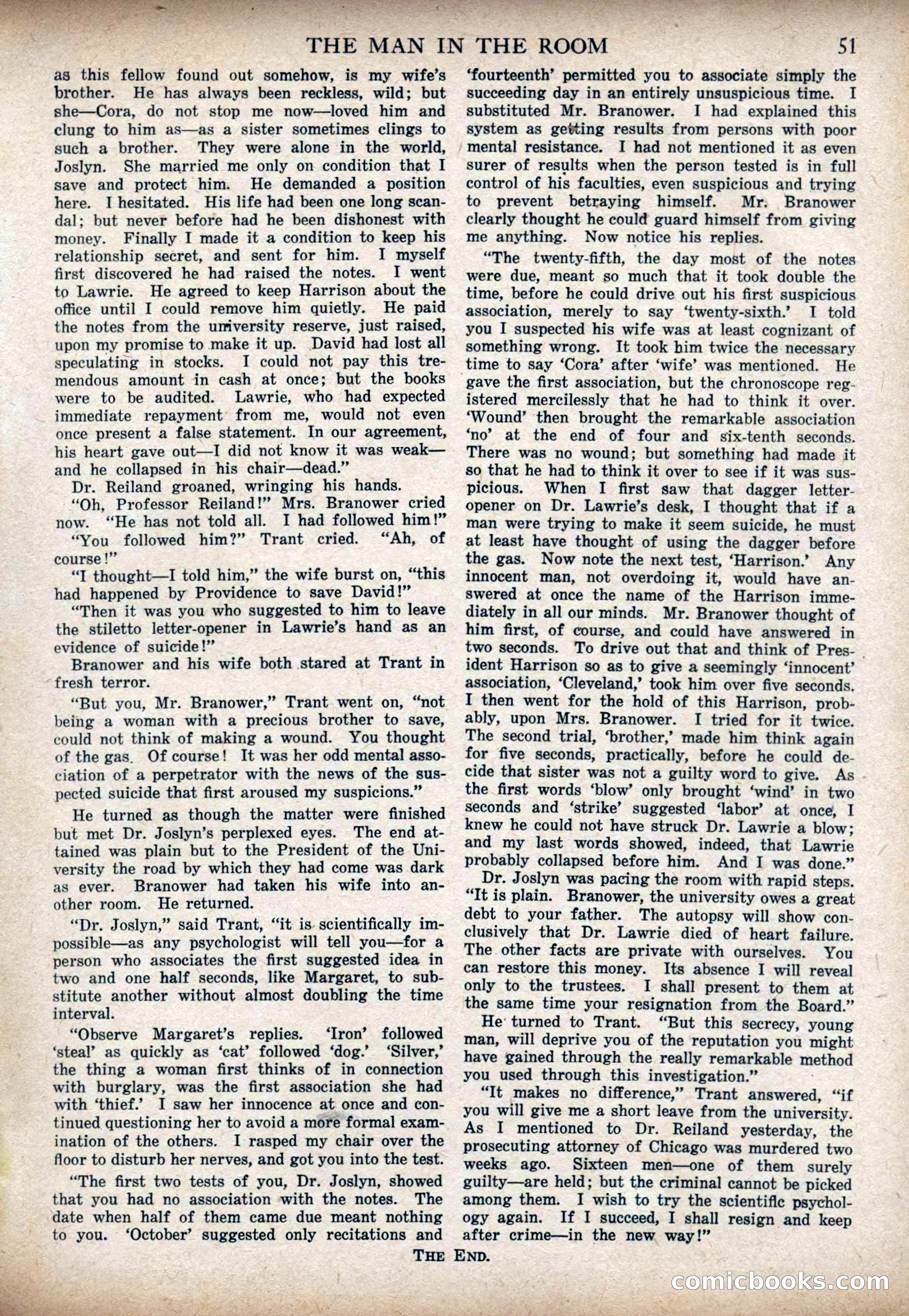
A restored page from Pulp Fiction, 1927. Page through the whole issue in the reader above.
📄 Transcribed text from this page (OCR, searchable)
Machine-transcribed from the original scan — historical spelling and the odd misread are preserved.
ocr ait rite Li eae - So es ¢ ie > a ie >" a cy - ‘=~ ee THE MAN IN THE ROOM as this fellow found out somehow, is my wife’s brother. He has always been reckless, wild; but she—Cora, do not stop me now—loved him and clung to him as—as a sister sometimes clings to such a brother. They were alone in the world, Joslyn. She married me only on condition that I save and protect him. He demanded a position here. I hesitated. His life had been one long scan- dal: but never before had he been dishonest with money. Finally I made it a condition to keep his relationship secret, and sent for him. I myself first discovered he had raised the notes. I went to Lawrie. He agreed to keep Harrison about the office until I could remove him quietly. He paid the notes from the urriversity reserve, just raised, upon my promise to make it up. David had lost all speculating in stocks. I could not pay this tre- mendous amount in cash at once; but the books were to be audited. Lawrie, who had expected immediate repayment from me, would not even once present a false statement. In our agreement, his heart gave out—I did not know it was weak— and he collapsed in his chair—dead.” Dr. Reiland groaned, wringing his hands. “Oh, Professor Reiland!” Mrs. Branower cried now. “He has not told all. I had followed him!” “You followed him?” Trant cried. “Ah, of course !”’ “I thought—I told him,” the wife burst on, “this had happened by Providence to save David!” “Then it was you who suggested to him to leave the stiletto letter-opener in Lawrie’s hand as an evidence of suicide!” Branower and his wife both stared at Trant in fresh terror. “But you, Mr. Branower,” Trant went on, “not being a woman with a precious brother to save, could not think of making a wound. You thought of the gas. Ofcourse! It was her odd mental asso- ciation of a perpetrator with the news of the sus- pected suicide that first aroused my suspicions.” He turned as though the matter were finished but met Dr. Joslyn’s perplexed eyes. The end at- tained was plain but to the President of the Uni- versity the road by which they had come was dark as ever. Branower had taken his wife into an- other room. He returned. “Dr. Joslyn,” said Trant, “it is scientifically im- possible—as any psychologist will tell you—for a person who associates the first suggested idea in two and one half seconds, like Margaret, to sub- stitute another without almost doubling the time interval. “Observe Margaret’s replies. ‘Iron’ followed ‘steal’ as quickly as ‘cat’ followed ‘dog.’ ‘Silver,’ the thing a woman first thinks of in connection with burglary, was the first association she had with ‘thief.’ I saw her innocence at once and con- tinued questioning her to avoid a more formal exam- ination of the others. I rasped my chair over the 66 floor to disturb her nerves, and got you into the test. “The first two tests of you, Dr. Joslyn, showed that you had no association with the notes. The date when half of them came due meant nothing to you. ‘October’ suggested only recitations and THE 51 ‘fourteenth’ permitted you to associate simply the succeeding day in an entirely unsuspicious time. I substituted Mr. Branower. I had explained this system as getting results from persons with poor mental resistance. I had not mentioned it as even surer of results when the person tested is in full control of his faculties, even suspicious and trying to prevent betraying himself. Mr: Branower clearly thought he could guard himself from giving me anything. Now notice his replies. “The twenty-fifth, the day most of the notes were due, meant so much that it took double the time, before he could drive out his first suspicious association, merely to say ‘twenty-sixth.’ I told you I suspected his wife was at least cognizant of something wrong. It took him twice the necessary time to say ‘Cora’ after ‘wife’ was mentioned. He gave the first association, but the chronoscope reg- istered mercilessly that he had to think it over. ‘Wound’ then brought the remarkable association ‘no’ at the end of four and six-tenth seconds. There was no wound; but something had made it so that he had to think it over to see if it was sus- picious. When I first saw that dagger letter- opener on Dr. Lawrie’s desk, I thought that if a man were trying to make it seem suicide, he must at least have thought of using the dagger before the gas. Now note the next test, ‘Harrison.’ Any innocent man, not overdoing it, would have an- swered at once the name of the Harrison imme- diately in all our minds. Mr. Branower thought of him first, of course, and could have answered in two seconds. To drive out that and think of Pres- | ident Harrison so as to give a seemingly ‘innocent’ association, ‘Cleveland,’ took him over five seconds. I then went for the hold of this Harrison, prob- ably, upon Mrs. Branower. I tried for it twice. The second trial, ‘brother,’ made him think again for five seconds, practically, before he could de- cide that sister was not a guilty word to give. As the first words ‘blow’ only brought ‘wind’ in two seconds and ‘strike’ suggested ‘labor’ at once, I knew he could not have struck Dr. Lawrie a blow; and my last words showed, indeed, that Lawrie probably collapsed before him. And I was done.” Dr. Joslyn was pacing the room with rapid steps. “It is plain. Branower, the university owes a great debt to your father. The autopsy will show con- clusively that Dr. Lawrie died of heart failure. The other facts are private with ourselves. You can restore this money. Its absence I will reveal only to the trustees. I shall present to them at the same time your resignation from the Board.” He’ turned to Trant. “But this secrecy, young man, will deprive you of the reputation you might have gained through the really remarkable method you used through this investigation.” “It makes no difference,” Trant answered, “if you will give me a short leave from the university. As I mentioned to Dr. Reiland yesterday, the prosecuting attorney of Chicago was murdered two weeks ago. Sixteen men—one of them surely guilty—are held; but the criminal cannot be picked among them. I wish to try the scientifle psychol- ogy again. If I succeed, I shall resign and keep after crime—in the new way!” END. EComlebooks:com