
Pulp Fiction, 1927 · page 49 of 108
Amazing Stories, Vol. 2, No. 1 — page 49: what you’re looking at
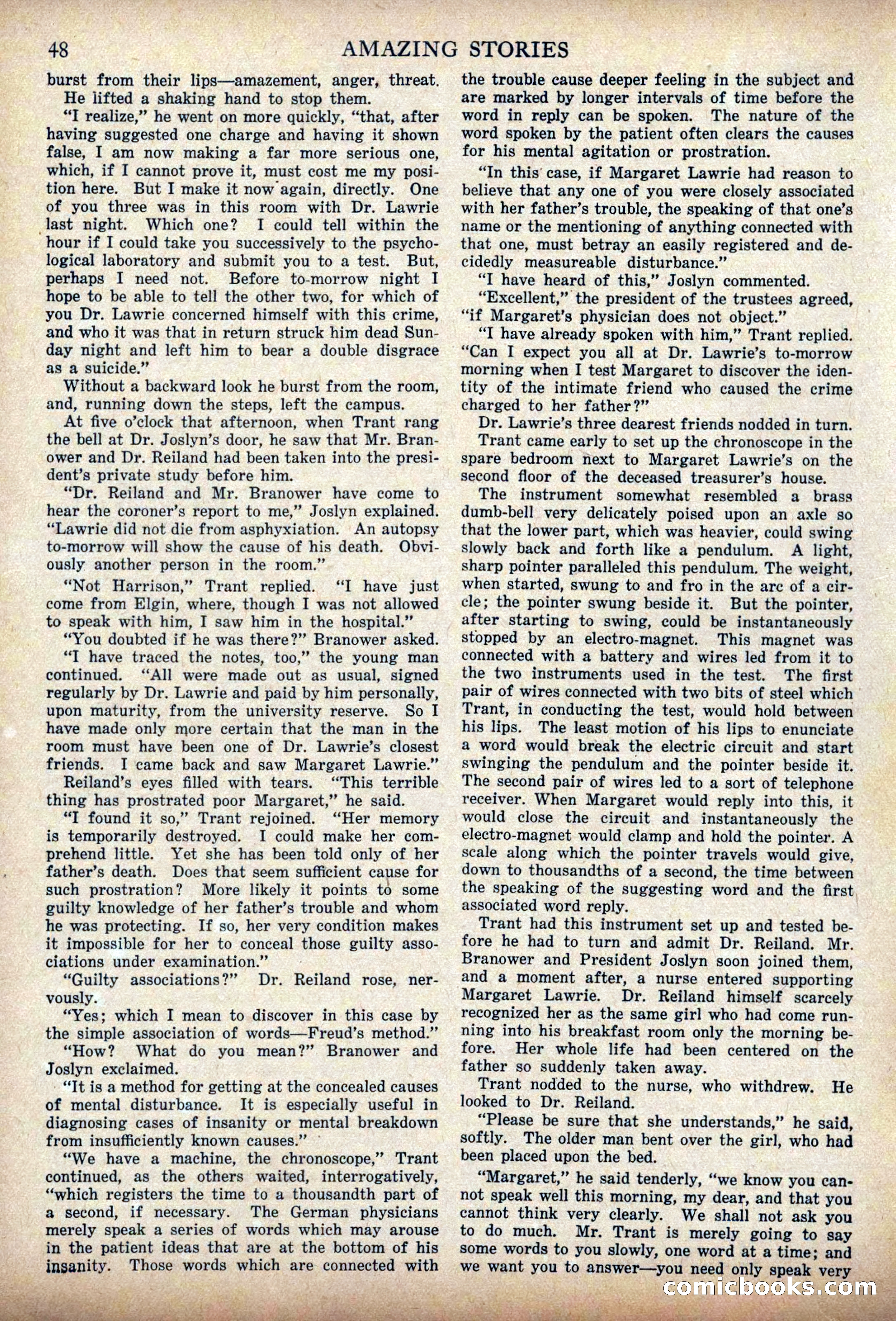
A restored page from Pulp Fiction, 1927. Page through the whole issue in the reader above.
📄 Transcribed text from this page (OCR, searchable)
Machine-transcribed from the original scan — historical spelling and the odd misread are preserved.
last night. 48 : burst from their lips—amazement, anger, threat. He lifted a shaking hand to stop them. “T realize,” he went on more quickly, “that, after having suggested one charge and having it shown false, I am now making a far more serious one, which, if I cannot prove it, must cost me my posi- tion here. But I make it now again, directly. One of you three was in this room with Dr. Lawrie Which one? I could tell within the hour if I could take you successively to the psycho- logical laboratory and submit you to a test. But, perhaps I need not. Before to-morrow night I hope to be able to tell the other two, for which of you Dr. Lawrie concerned himself with this crime, and who it was that in return struck him dead Sun- day night and left him to bear a double disgrace as a suicide.” Without a backward look he burst from the room, and, running down the steps, left the campus. At five o’clock that afternoon, when Trant rang the bell at Dr. Joslyn’s door, he saw that Mr. Bran- ower and Dr. Reiland had been taken into the presi- dent’s private study before him. “Dr. Reiland and Mr. Branower have come to hear the coroner’s report to me,” Joslyn explained. “Lawrie did not die from asphyxiation. An autopsy to-morrow will show the cause of his death. Obvi- ously another person in the room.” “Not Harrison,” Trant replied. “I have just come from Elgin, where, though I was not allowed to speak with him, I saw him in the hospital.” “You doubted if he was there?” Branower asked. “T have traced the notes, too,” the young man continued. “All were made out as usual, signed regularly by Dr. Lawrie and paid by him personally, upon maturity, from the university reserve. So I have made only more certain that the man in the room must have been one of Dr. Lawrie’s closest friends. I came back and saw Margaret Lawrie.” Reiland’s eyes filled with tears. “This terrible thing has prostrated poor Margaret,” he said. “I found it so,” Trant rejoined. “Her memory is temporarily destroyed. I could make her com- prehend little. Yet she has been told only of her father’s death. Does that seem sufficient cause for such prostration? More likely it points to some guilty knowledge of her father’s trouble and whom he was protecting. If so, her very condition makes it impossible for her to conceal those guilty asso- ciations under examination.” “Guilty associations?” Dr. Reiland rose, ner- vously. “Yes; which I mean to discover in this case by the simple association of words—Freud’s method.” “How? What do you mean?” Branower and Joslyn exclaimed. - “Tt is a method for getting at the concealed causes of mental disturbance. It is especially useful in diagnosing cases of insanity or mental breakdown from insufficiently known causes.” ° “We have a machine, the chronoscope,” Trant continued, as the others waited, interrogatively, “which registers the time to a thousandth part of a second, if necessary. The German physicians merely speak a series of words which may arouse in the patient ideas that are at the bottom of his insanity. Those words which are connected with sie, 22 >_>? ~ rr . * Fat’ ley » et Rah: , “% PTA Dig tia ae “Pre *i ~~ u be Ti, as Oy ier a CR eh ee * % £. g-% ‘ j By ee > Ete oe eT 4s x geet . at ee Sete i ae” .* Loves ‘ 4 toe " + ry iy a * A ; I > > Pe Venn! ro Se e* MV x > Sse a ake ay AMAZING STORIES the trouble cause deeper feeling in the subject and are marked by longer intervals of time before the word in reply can be spoken. The nature of the word spoken by the patient often clears the causes for his mental agitation or prostration. “In this’ case, if Margaret Lawrie had reason to believe that any one of you were closely associated with her father’s trouble, the speaking of that one’s name or the mentioning of anything connected with that one, must betray an easily registered and de- cidedly measureable disturbance.” “T have heard of this,” Joslyn commented. “Excellent,” the president of the trustees agreed, “if Margaret’s physician does not object.” “I have already spoken with him,” Trant replied. “Can I expect you all at Dr. Lawrie’s to-morrow morning when I test Margaret to discover the iden- tity of the intimate friend who caused the crime charged to her father?” Dr. Lawrie’s three dearest friends nodded in turn. Trant came early to set up the chronoscope in the spare bedroom next to Margaret Lawrie’s on the second floor of the deceased treasurer’s house. The instrument somewhat resembled a brass dumb-bell very delicately poised upon an axle so that the lower part, which was heavier, could swing Slowly back and forth like a pendulum. A light, sharp pointer paralleled this pendulum. The weight, when started, swung to and fro in the are of a cir- cle; the pointer swung beside it. But the pointer, after starting to swing, could be instantaneously stopped by an electro-magnet. This magnet was connected with a battery and wires led from it to the two instruments used in the test. The first pair of wires connected with two bits of steel which Trant, in conducting the test, would hold between his lips. The least motion of his lips to enunciate a word would break the electric circuit and start swinging the pendulum and the pointer beside it. The second pair of wires led to a sort of telephone receiver. When Margaret would reply into this, it would close the circuit and instantaneously the electro-magnet would clamp and hold the pointer. A scale along which the pointer travels would give, down to thousandths of a second, the time between the speaking of the suggesting word and the first associated word reply. Trant had this instrument set up and tested be- fore he had to turn and admit Dr. Reiland. Mr. Branower and President Joslyn soon joined them, and a moment after, a nurse entered supporting Margaret Lawrie. Dr. Reiland himself scarcely recognized her as the same girl who had come run- ning into his breakfast room only the morning be- fore. Her whole life had been centered on the father so suddenly taken away. Trant nodded to the nurse, who withdrew. He looked to Dr. Reiland. | “Please be sure that she understands,” he said, softly. The older man bent over the girl, who had been placed upon the bed. “Margaret,” he said tenderly, “we know you can- not speak well this morning, my dear, and that you cannot think very clearly. We shall not ask you to do much. Mr. Trant is merely going to say some words to you slowly, one word at a time; and we want you to answer—you need only speak very __ 0 . z & rt Se. ra (E(0) Af) iG JOOKS. s on eter ted eae Te Ros, GU An Lie eae b> ig sal ate 7 at