
Pulp Fiction, 1927 · page 45 of 108
Amazing Stories, Vol. 2, No. 1 — page 45: what you’re looking at
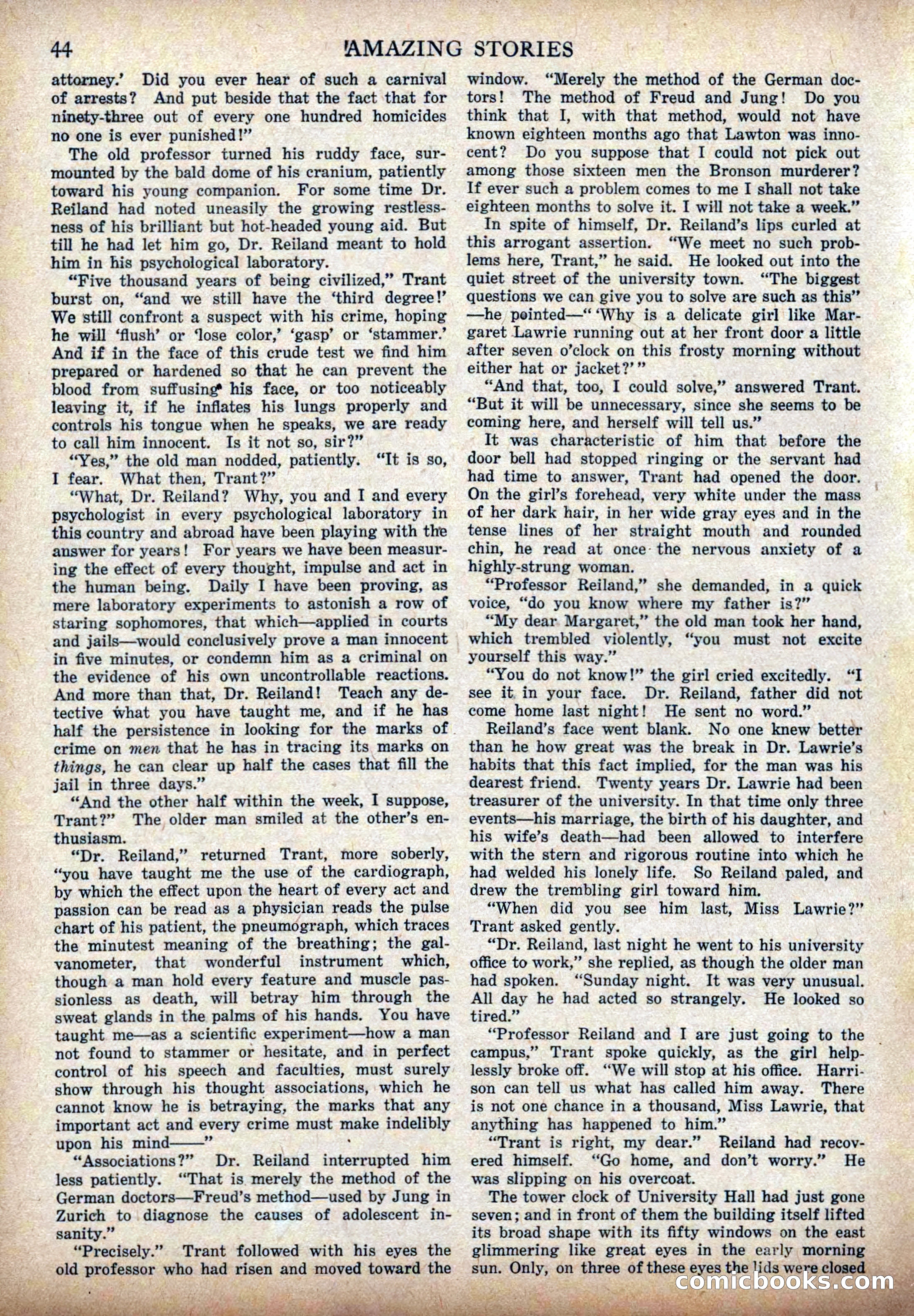
A restored page from Pulp Fiction, 1927. Page through the whole issue in the reader above.
📄 Transcribed text from this page (OCR, searchable)
Machine-transcribed from the original scan — historical spelling and the odd misread are preserved.
i a | ~ a, f 6-8? & vn" 4 w he - Fade 4 ¥ ft re ar tats ve 8) a oe - attorney.’ Did you ever hear of such a carnival of arrests? And put beside that the fact that for ninety-three out of every one hundred homicides no one is ever punished!” The old professor turned his ruddy face, sur- mounted by the bald dome of his cranium, patiently toward his young companion. For some time Dr. Reiland had noted uneasily the growing restless- ness of his brilliant but hot-headed young aid. But till he had let him go, Dr. Reiland meant to hold him in his psychological laboratory. “Five thousand years of being civilized,” Trant burst on, “and we still have the ‘third degree!’ We still confront a suspect with his crime, hoping he will ‘flush’ or ‘lose color,’ ‘gasp’ or ‘stammer.’ And if in the face of this crude test we find him prepared or hardened so that he can prevent the blood from suffusing* his face, or too noticeably leaving it, if he inflates his lungs properly and controls his tongue when he speaks, we are ready to call him innocent. Is it not so, sir?” “Yes,” the old man nodded, patiently. I fear. What then, Trant?” “What, Dr. Reiland? Why, you and I and every psychologist in every psychological laboratory in this country and abroad have been playing with the answer for years! For years we have been measur- ing the effect of every thought, impulse and act in the human being. Daily I have been proving, as mere laboratory experiments to astonish a row of staring sophomores, that which—applied in courts and jails—would conclusively prove a man innocent in five minutes, or condemn him as a criminal on the evidence of his own uncontrollable reactions. And more than that, Dr. Reiland! Teach any de- tective what you have taught me, and if he has “It is so, half the persistence in looking for the marks of. crime on men that he has in tracing its marks on things, he can clear up half the cases that fill the jail in three days.” “And the other half within the week, I suppose, Trant?” The older man smiled at the other’s en- thusiasm. “Dr. Reiland,’ returned Trant, more soberly, “vou have taught me the use of the cardiograph, by which the effect upon the heart of every act and passion can be read as a physician reads the pulse chart of his patient, the pneumograph, which traces the minutest meaning of the breathing; the gal- vanometer, that wonderful instrument which, though a man hold every feature and muscle pas- sionless as death, will betray him through the sweat glands in the palms of his hands. You have taught me—as a scientific experiment—how a man not found to stammer or hesitate, and in perfect control of his speech and faculties, must surely show through his thought associations, which he cannot know he is betraying, the marks that any important act and every crime must make indelibly upon his mind * : “Associations?” Dr. Reiland interrupted him less patiently. “That is merely the method of the German doctors—Freud’s method—used by Jung in Zurich to diagnose the causes of adolescent in- sanity.” “Precisely.” Trant followed with his eyes the ge ae { ‘ a ty » “= < ae > nh + Mele RA [a bid id iF ft pe if a rt “7f “4 » bee # A ' 7+ ¢ y~ é ! ot Ps Ae a bet | et a Y. S > es ‘ Be ae 2X. 5, a ? =; a Skye re ‘ : ld professor who had risen and moved toward the sun. Only, on three of these eyes the lids we -e close¢ A . 4 Pe ei, 4 ry my ‘ eS ons Vee y io ie ys i Da Se) PT A ate yf! ~s _ - * AMAZING STORIES window. “Merely the method of the German doc- tors! The method of Freud and Jung! Do you think that I, with that method, would not have known eighteen months ago that Lawton was inno- cent? Do you suppose that I could not pick out among those sixteen men the Bronson murderer? If ever such a problem comes to me I shall not take eighteen months to solve it. I will not take a week.” In spite of himself, Dr. Reiland’s lips curled at this arrogant assertion. “We meet no such prob- lems here, Trant,” he said. He looked out into the quiet street of the university town. “The biggest questions we can give you to solve are such as this” —he pointed—“ ‘Why is a delicate girl like Mar- garet Lawrie running out at her front door a little after seven o’clock on this frosty morning without either hat or jacket?’” “And that, too, I could solve,” answered Trant. “But it will be unnecessary, since she seems to be coming here, and herself will tell us.” It was characteristic of him that before the door bell had stopped ringing or the servant had had time to answer, Trant had opened the door. On the girl’s forehead, very white under the mass of her dark hair, in her wide gray eyes and in the tense lines of her straight mouth and rounded chin, he read at once- the nervous anxiety of a highly-strung woman. “Professor Reiland,” she demanded, in a quick voice, “do you know where my father is?” “My dear Margaret,” the old man took her hand, which trembled violently, “you must not excite yourself this way.” “You do not know!” the girl cried excitedly. “I see it. in your face. Dr. Reiland, father did not come home last night! He sent no word.” Reiland’s face went blank. No one knew better than he how great was the break in Dr. Lawrie’s habits that this fact implied, for the man was his dearest friend. Twenty years Dr. Lawrie had been treasurer of the university. In that time only three events—his marriage, the birth of his daughter, and his wife’s death—had been allowed to interfere with the stern and rigorous routine into which he had welded his lonely life. So Reiland paled, and drew the trembling girl toward him. “When did you see him last, Miss Lawrie?” Trant asked gently. “Dr. Reiland, last night he went to his university office to work,” she replied, as though the older man had spoken. “Sunday night. It was very unusual. All day he had acted so strangely. He looked so tired.” “Professor Reiland and I are just going to the campus,” Trant spoke quickly, as the girl help- lessly broke off. “‘We will stop at his office. Harri- son can tell us what has called him away. There is not one chance in a thousand, Miss Lawrie, that anything has happened to him.” “Trant is right, my dear.” Reiland had recov- ered himself. “Go home, and don’t worry.” He was slipping on his overcoat. The tower clock of University Hall had just gone seven; and in front of them the building itself lifted its broad shape with its fifty windows on the east glimmering like great eyes in the early morning ny -) oa. ed A Fant ta gti tek SE 7 . it. B eg ee ae ee evr Bay at owe fay * . At r Peo ~ hie - > * — -> Me i as ! . } 4 = ss. ook eg | \ | - \e