
Pulp Fiction, 1927 · page 36 of 108
Amazing Stories, Vol. 2, No. 1 — page 36: what you’re looking at
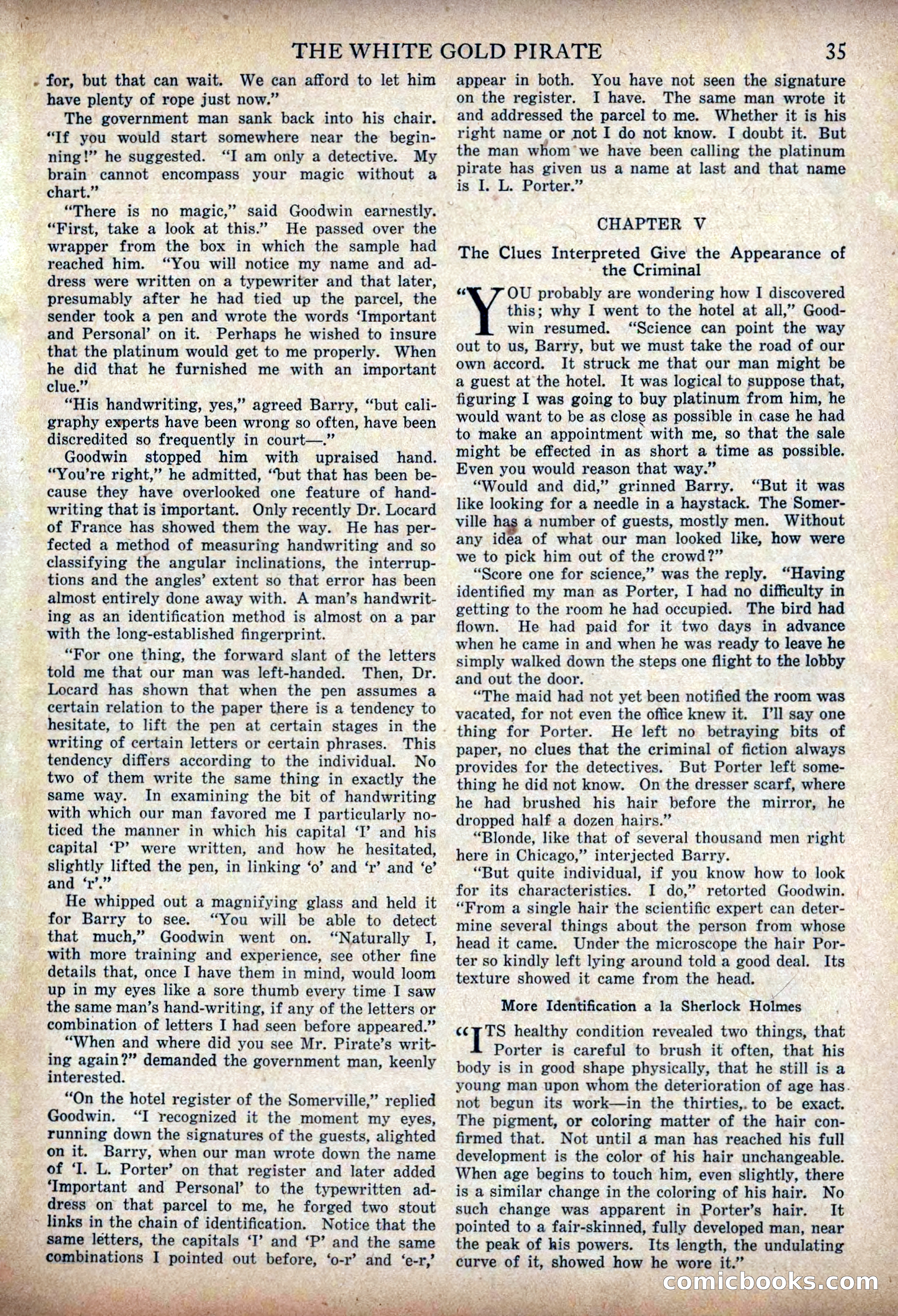
A restored page from Pulp Fiction, 1927. Page through the whole issue in the reader above.
📄 Transcribed text from this page (OCR, searchable)
Machine-transcribed from the original scan — historical spelling and the odd misread are preserved.
Ai es a rf eye aTS ure 3 * —— » ~, ’ ; ae | : e (*% i) . for, but that can wait. We can afford to let him - that much,” - chart.” have plenty of rope just now.” The government man sank back into his chair. “If you would start somewhere near the begin- ning!” he suggested. “I am only a detective. My brain cannot encompass your magic without a “There is no magic,” said Goodwin earnestly. “First, take a look at this.” He passed over the wrapper from the box in which the sample had reached him. “You will notice my name and ad- dress were written on a typewriter and that later, presumably after he had tied up the parcel, the sender took a pen and wrote the words ‘Important and Personal’ on it. Perhaps he wished to insure that the platinum would get to me properly. When he did that he furnished me with an important clue.” “His handwriting, yes,” agreed Barry, “but cali- _ graphy experts have been wrong so often, have been discredited so frequently in court—.” Goodwin stopped him with upraised hand. “You’re right,” he admitted, “but that has been be- cause they have overlooked one feature of hand- writing that is important. Only recently Dr. Locard of France has showed them the way. He has per- fected a method of measuring handwriting and so classifying the angular inclinations, the interrup- tions and the angles’ extent so that error has been almost entirely done away with. A man’s handwrit- ing as an identification method is almost on a par with the long-established fingerprint. “For one thing, the forward slant of the letters told me that our man was left-handed. Then, Dr. Locard has shown that when the pen assumes a certain relation to the paper there is a tendency to hesitate, to lift the pen at certain stages in the . writing of certain letters or certain phrases. This tendency differs according to the individual. No two of them write the same thing in exactly the same way. In examining the bit of handwriting with which our man favored me I particularly no- ticed the manner in which his capital ‘I’ and his capital ‘P’ were written, and how he hesitated, _ slightly lifted the pen, in linking ‘o’ and ‘r’ and ‘e’ and ‘r’.” He whipped out a magnifying glass and held it for Barry to see. “You will be able to detect Goodwin went on. “Naturally I, with more training and experience, see other fine details that, once I have them in mind, would loom up in my eyes like a sore thumb every time I saw the same man’s hand-writing, if any of the letters or combination of letters I had seen before appeared.” “When and where did you see Mr. Pirate’s writ- ing again?” demanded the government man, keenly interested. “On the hotel register of the Somerville,” replied Goodwin. “I recognized it the moment my eyes, running down the signatures of the guests, alighted on it. Barry, when our man wrote down the name _ of ‘I. L. Porter’ on that register and later added & StS Pe i 8 PE AAW, a . ae pe “ars & ~~ > ‘Important and Personal’ to the typewritten ad- dress on that parcel to me, he forged two stout links in the chain of identification. Notice that the Same letters, the capitals ‘I’ and ‘P’ and the same _ combinations I pointed out before, ‘o-r’ and ‘e-r,’ » s . Lg >? wn 2 > 4 = - * * * » 4] : 4 yp ot SE Sere aw © hae! =, oe ee S ¢ a, * y fe “ Anes TO d bs 1) wu ide | THE WHITE GOLD PIRATE - % —. r Sasd ia AGA? + 4 Pe RS cee Fn 4 Pata ds ~~ oF ¥ + 1 , 4 re ‘e ~ as =: ‘2 . o * r vo : ,, ‘te ee bY f ¥ , yy a \ ? 4 i. < - b. > Jatt > ae a, a. ewe ee , Ran fad ~ € . oon 4 ¥ ne Me oe 4 ~~ sik i ae Pg Pee ee sey Oe Lee oD rae oye ens SPO mTE A ae ee ek he PS ea en ek ag ny ee re in +64 . = * 7 seo é 4 at, PRP tl “¢ a Piet nk ‘ x ee ‘ > < 3 sy! ier eye 2 F, 5 35 appear in both. You have not seen the signature on the register. I have. The same man wrote it and addressed the parcel to me. Whether it is his right name or not I do not know. I doubt it. But the man whom’ we have been calling the platinum pirate has given us a name at last and that name is I. L. Porter.” CHAPTER V The Clues Interpreted Give the Appearance of - the Criminal a OU probably are wondering how I discovered this; why I went to the hotel at all,” Good- win resumed. “Science can point the way out to us, Barry, but we must take the road of our own accord. It struck me that our man might be a guest at the hotel. It was logical to suppose that, figuring I was going to buy platinum from him, he would want to be as close as possible in case he had to make an appointment with me, so that the sale might be effected in as short a time as possible. Even you would reason that way.” “Would and did,” grinned Barry. “But it was like looking for a needle in a haystack. The Somer- ville hag a number of guests, mostly men. Without any idea of what our man looked like, how were we to pick him out of the crowd?” “Score one for science,” was the reply. “Having identified my man as Porter, I had no difficulty in getting to the room he had occupied. The bird had flown. He had paid for it two days in advance when he came in and when he was ready to leave he simply walked down the steps one flight to the lobby and out the door. © “The maid had not yet been notified the room was vacated, for not even the office knew it. I’ll say one thing for Porter. He left no betraying bits of paper, no clues that the criminal of fiction always provides for the detectives. But Porter left some- thing he did not know. On the dresser scarf, where he had brushed his hair before the mirror, he dropped half a dozen hairs.” “Blonde, like that of several thousand men right here in Chicago,” interjected Barry. “But quite individual, if you know how to look for its characteristics. I do,” retorted Goodwin. | “From a single hair the scientific expert can deter- mine several things about the person from whose head it came. Under the microscope the hair Por- ter so kindly left lying around told a good deal. Its texture showed it came from the head. More Identification a la Sherlock Holmes ta Kos healthy condition revealed two things, that Porter is careful to brush it often, that his body is in good shape physically, that he still is a young man upon whom the deterioration of age has. not begun its work—in the thirties,. to be exact. The pigment, or coloring matter of the hair con- firmed that. Not until a man has reached his full development is the color of his hair unchangeable. When age begins to touch him, even slightly, there is a similar change in the coloring of his hair. No such change was apparent in Porter’s hair. It pointed to a fair-skinned, fully developed man, near the peak of his powers. Its length, the undulating curve of it, showed how he wore it.” : Eomicboo ‘ 7 + . = + oa ‘s €4 oe ur® Ks ° i * ., | ae? foe | okay | oi lie wee —* e's " % > x ‘ ye ete Se it tok Be Dy , ~ ane Fes i hae: % +Pa* 17 a's fi) *. 7 LS et ad tm a . + yy oe od S's a Ss ad he fe a BE 7 * \ A "4 ?