
Pulp Fiction, 1927 · page 25 of 108
Amazing Stories, Vol. 2, No. 1 — page 25: what you’re looking at
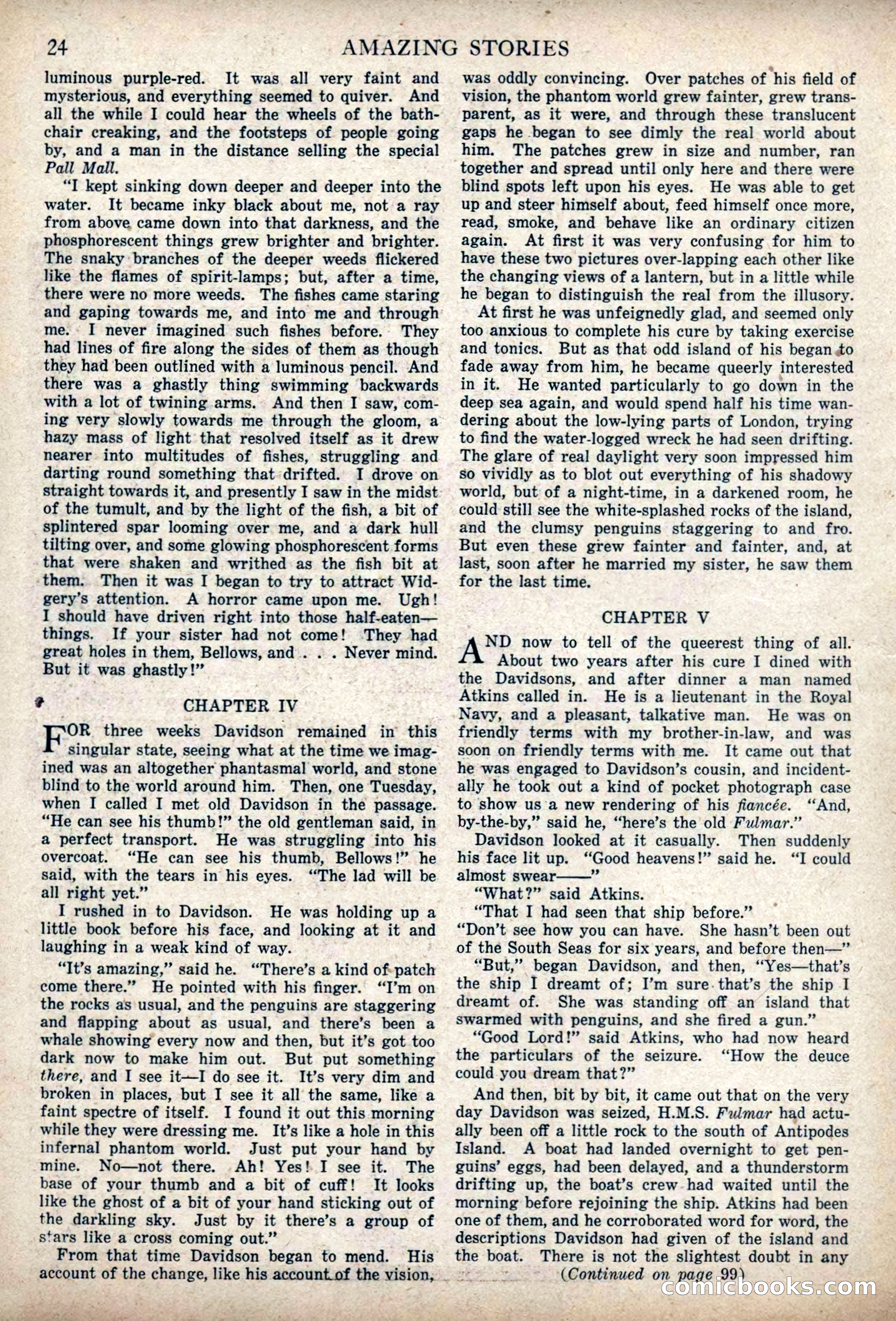
A restored page from Pulp Fiction, 1927. Page through the whole issue in the reader above.
📄 Transcribed text from this page (OCR, searchable)
Machine-transcribed from the original scan — historical spelling and the odd misread are preserved.
24 luminous purple-red. It was all very faint and mysterious, and everything seemed to quiver. And all the while I could hear the wheels of the bath- chair creaking, and the footsteps of people going by, and a man in the distance selling the special Pall Mall. “I kept sinking down deeper and deeper into the water. It became inky black about me, not a ray from above came down into that darkness, and the phosphorescent things grew brighter and brighter. The snaky branches of the deeper weeds flickered like the flames of spirit-lamps; but, after a time, there were no more weeds. The fishes came staring and gaping towards me, and into me and through me. I never imagined such fishes before. They had lines of fire along the sides of them as though they had been outlined with a luminous pencil. And there was a ghastly thing swimming backwards with a lot of twining arms. And then I saw, com- ing very slowly towards me through the gloom, a hazy mass of light that resolved itself as it drew nearer into multitudes of fishes, struggling and darting round something that drifted. I drove on straight towards it, and presently I saw in the midst. of the tumult, and by the light of the fish, a bit of splintered spar looming over me, and a dark hull tilting over, and some glowing phosphorescent forms that were shaken and writhed as the fish bit at ‘them. Then it was I began to try to attract Wid- gery’s attention. A horror came upon me. Ugh! I should have driven right into those half-eaten— things. If your sister had not come! They had great holes in them, Bellows, and.. . . Never mind. But it was ghastly!” BR CHAPTER IV OR three weeks Davidson remained in’ this singular state, seeing what at the time we imag- ined was an altogether phantasmal world, and stone blind to the world around him. Then, one Tuesday, when I called I met old Davidson in the passage. “He can see his thumb!” the old gentleman said, in a perfect transport. He was struggling into his overcoat. “He can see his thumb, Bellows!” he said, with the tears in his eyes. “The lad will be all right yet.” I rushed in to Davidson. He was holding up a little book before his face, and looking at it and laughing in a weak kind of way. “It’s amazing,” said he. “There’s a kind of-patch come there.” He pointed with his finger. “I’m on the rocks as usual, and the penguins are staggering and flapping about as usual, and there’s been a whale showing every now and then, but it’s got too dark now to make him out. But put something there, and I see it~I do see it. It’s very dim and broken in places, but I see it all the same, like a faint spectre of itself. I found it out this morning while they were dressing me. It’s like a hole in this infernal phantom world. Just put your hand by mine. No—not there. Ah! Yes! I see it. The base of your thumb and a bit of cuff! It looks like the ghost of a bit of your hand sticking out of the darkling sky. Just by it there’s a group of stars like a cross coming out.” From that time Davidson began to mend. | His account of the change, like his account.of the vision, = _- a 3 : _ - ha | » ed » : a « r — <a e e Pie. 4 eps < éi : ; ~ “i PR ee SS - . Fe -- ee Sy” AMAZING STORIES was oddly convincing. Over patches of ‘his field of vision, the phantom world grew fainter, grew trans- parent, as it were, and through these translucent gaps he began to see dimly the real world about him. The patches grew in size and number, ran together and spread until only here and there were blind spots left upon his eyes. He was able to get up and steer himself about, feed himself once more, read, smoke, and behave like an ordinary citizen again. At first it was very confusing for him to have these two pictures over-lapping each other like the changing views of a lantern, but in a little while he began to distinguish the real from the illusory. At first he was unfeignedly glad, and seemed only too anxious to complete his cure by taking exercise and tonics. But as that odd island of his began .to fade away from him, he became queerly interested in it. He wanted particularly to go down in the deep sea again, and would spend half his time wan- dering about the low-lying parts of London, trying to find the water-logged wreck he had seen drifting. The glare of real daylight very soon impressed him So vividly as to blot out everything of his shadowy world, but of a night-time, in a darkened room, he could still see the white-splashed rocks of the island, and the clumsy penguins staggering to and fro. But even these grew fainter and fainter, and, at last, soon after he married my sister, he saw them for the last time. CHAPTER V Ap now to tell of the queerest thing of all. About two years after his cure I dined with the Davidsons, and after dinner a man named Atkins called in. He is a lieutenant in the Royal Navy, and a pleasant, talkative man. He was on friendly terms with my brother-in-law, and was soon on friendly terms with me. It came out that he was engaged to Davidson’s cousin, and incident- ally he took out a kind of pocket photograph case to show us a new rendering of his fiancée. “And, by-the-by,” said he, “here’s the old Fulmar.” Davidson looked at it casually. Then suddenly his face lit up. “Good heavens!” said he. “I could almost swear re “What?” said Atkins. “That I had seen that ship before.” “Don’t see how you can have. She hasn’t been out of the South Seas for six years, and before then—” “But,” began Davidson, and then, “Yes—that’s the ship I dreamt of; I’m sure. that’s the ship I dreamt of. She was standing off an island that swarmed with penguins, and she fired a gun.” “Good Lord!” said Atkins, who had now heard the particulars of the seizure. ‘How the deuce could you dream that?” And then, bit by bit, it came out that on the very day Davidson was seized, H.M.S. Fulmar had actu- ally been off a little rock to the south of Antipodes Island. A boat had landed overnight to get pen- guins’ eggs, had been delayed, and a thunderstorm drifting up, the boat’s crew had waited until the morning before rejoining the ship. Atkins had been one of them, and he corroborated word for word, the descriptions Davidson had given of the island and the boat. There is not the slightest doubt in any To pepecomicbooks.co ‘ ao te 2 i a, DX 48 be