
Pulp Fiction, 1927 · page 23 of 108
Amazing Stories, Vol. 2, No. 1 — page 23: what you’re looking at
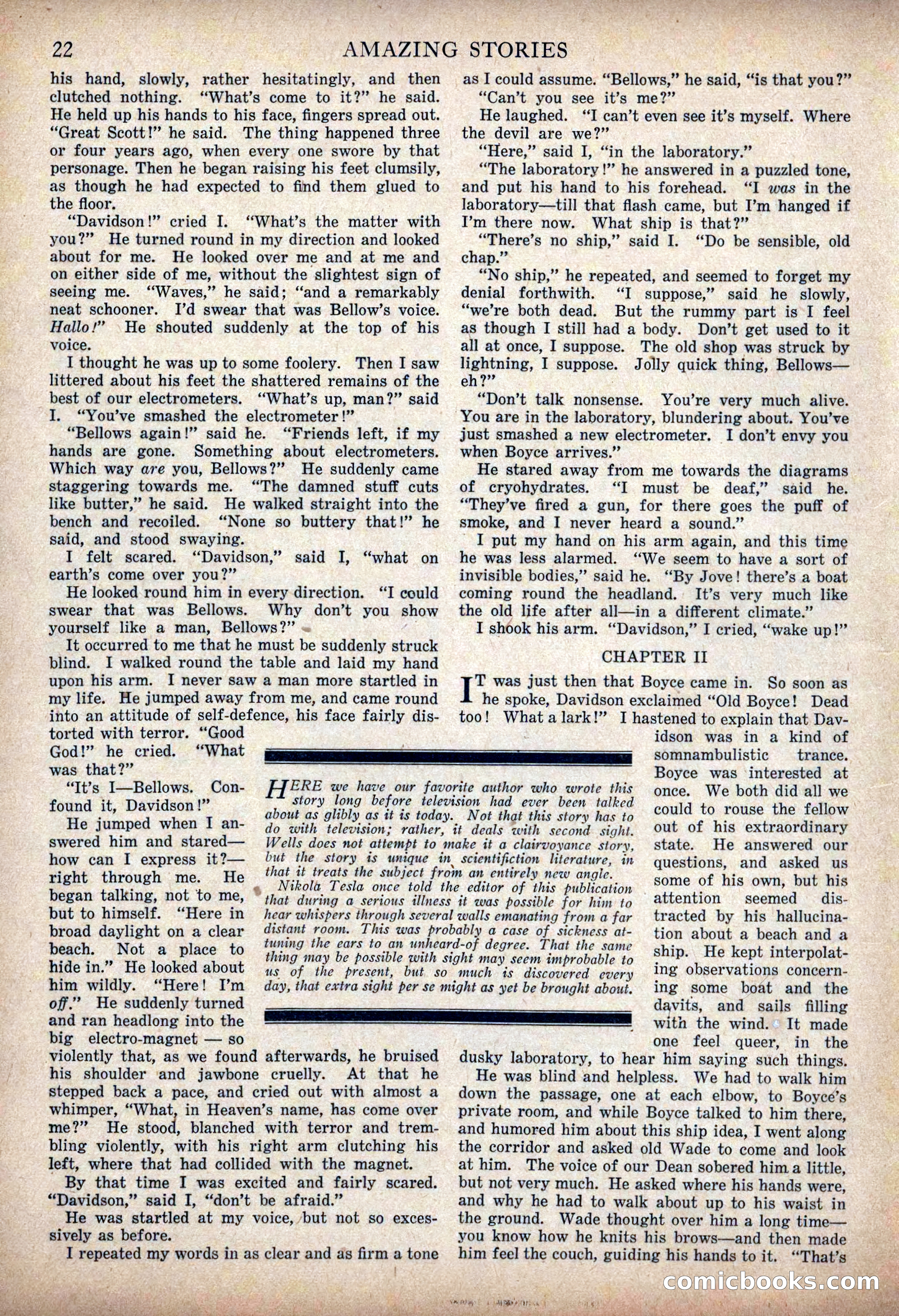
A restored page from Pulp Fiction, 1927. Page through the whole issue in the reader above.
📄 Transcribed text from this page (OCR, searchable)
Machine-transcribed from the original scan — historical spelling and the odd misread are preserved.
% eae * ‘ Sn coat are ee “Lp ble his hand, slowly, rather hesitatingly, and then clutched nothing. ‘“‘What’s come to it?” he said. He held up his hands to his face, fingers spread out. “Great Scott!” he said. The thing happened three or four years ago, when every one swore by that personage. Then he began raising his feet clumsily, as though he had expected to find them glued to the floor, “Davidson!” cried I. “What’s the matter with you?” He turned round in my direction and looked about for me. He looked over me and at me and on either side of me, without the slightest sign of seeing me. “Waves,” he said; “and a remarkably neat schooner. I’d swear that was Bellow’s voice. Hallo!” He shouted suddenly at the top of his voice. I thought he was up to some foolery. Then I saw littered about his feet the shattered remains of the best of our electrometers. ‘‘What’s up, man?” said I. “You’ve smashed the electrometer!” “Bellows again!” said he. “Friends left, if my hands are gone. Something about electrometers. Which way are you, Bellows?” He suddenly came staggering towards me. “The damned stuff cuts like butter,” he said. He walked straight into the bench and recoiled. “None so buttery that!’ he said, and stood swaying. I felt scared. “Davidson,” said I, “what on earth’s come over you?” He looked round him in every direction. “I could swear that was Bellows. Why don’t you show yourself like a man, Bellows?” « | It occurred to me that he must be suddenly struck blind. I walked round the table and laid my hand upon his arm. I never saw a man more startled in my life. He jumped away from me, and came round into an attitude of self-defence, his face fairly dis- torted with terror. “Good God!” he cried. ‘What was that?” “Tt’s I—Bellows. found it, Davidson!” He jumped when I an- swered him and stared— how can I express it?— right through me. He began talking, not to me, but to himself. “Here in broad daylight on a clear beach. Not a place to hide in.” He looked about him wildly. “Here! I’m off.’ He suddenly turned and ran headlong into the big electro-magnet — so Con- us of his shoulder and jawbone cruelly. At that he stepped back a pace, and cried out with almost a whimper, “What, in Heaven’s name, has come over me?” He stood, blanched with terror and trem- bling violently, with his right arm clutching his left, where that had collided with the magnet. By that time I was excited and fairly scared. “Davidson,” said I, “don’t be afraid.” He was startled at my voice, but not so exces- sively as before. I repeated my words in as clear and as firm a tone CPDL EE EE SRE ETL H ERE we have our favorite author who wrote this story long before television had ever been talked about as glibly as it is today. Not that this story has to do with television; rather, it deals with second sight. Wells does not attempt to make it a clairvoyance story, but the story is unique in scientifiction literature, in that it treats the subject from an entirely new angle. « Nikola Tesla once told the editor of this publication that during a serious illness it was possible for him to hear whispers through several walls emanating from a far distant room. This was probably a case of sickness at- tuning the ears to an unheard-of degree. That the same thing may be possible with sight may seem improbable to the present, but so much ts discovered every day, that extra sight per se might as yet be brought about. - violently that, as we found afterwards, he bruised - .. ES OAM OL RBM A One by % ae. 4 : f > . «§ wate rd ‘ ) : 7 ibe + os nero a og 8st BERL iy ae . ees a) fa 4” “hey ee i TOL EUS te = Lig ‘ _#! Ye sy bee batty t ‘2 : A Sere ec ome MLS S55 ah feeble n Powe tit a nage as ahiel “Y pi thees fa wy, Yee La Ne Sy An et ; Rye aetee ak tt IS Aaa ee See ae see, pated ek aS es aa SNAIL TES aS Rie. Rte pee te eS a oe aYomaret Meme |) See a Gs ee nantes. Cie SIO ee SAT Si ahs BEN OONS oe ATES Pate IGE et te. Rhy Sree He eos Cah aun Hp SNR YS ia) aed AMAZING STORIES as I could assume. “Bellows,” he said, “is that you?” “Can’t you see it’s me?” He laughed. “I can’t even see it’s myself. Where the devil are we?” “Here,” said I, “in the laboratory.” “The laboratory !” he answered in a puzzled tone, and put his hand to his forehead. “I was in the laboratory—till that flash came, but I’m hanged if I’m there now. What ship is that?” “There’s no ship,” said I. “Do be sensible, old chap.” “No ship,” he repeated, and seemed to forget my denial forthwith. “I suppose,” said he slowly, “we’re both dead. But the rummy part is I feel as though I still had a body. Don’t get used to it all at once, I suppose. The old shop was struck by lightning, I suppose. Jolly quick thing, Bellows— eh?” : “Don’t talk nonsense. You’re very much alive. You are in the laboratory, blundering about. You’ve just smashed a new electrometer. when Boyce arrives.” He stared away from me towards the diagrams of cryohydrates. “I must be deaf,” said he. “They’ve fired a gun, for there goes the puff of smoke, and I never heard a sound.” I put my hand on his arm again, and this time he was less alarmed. ‘We seem to have a sort of invisible bodies,” said he. “By Jove! there’s a boat coming round the headland. It’s very much like the old life after all—in a different climate.” I shook his arm. “Davidson,” I cried, “wake up!” CHAPTER II | fe was just then that Boyce came in. So soon as he spoke, Davidson exclaimed “Old Boyce! Dead too! Whata lark!” I hastened to explain that Dav- idson was in a kind of somnambulistic trance. Boyce was ‘interested at once. We both did all we I don’t envy you out of his extraordinary state. He answered our questions, and asked us some of his own, but his attention seemed dis- tracted by his hallucina- tion about a beach and a ship. He kept interpolat- ing observations concern- ing some boat and the davits, and sails filling witn the wind. It made one feel queer, in the dusky laboratory, to hear him saying such things. He was blind and helpless. We had to walk him down the passage, one at each elbow, to Boyce’s private room, and while Boyce talked to him there, and humored him about this ship idea, I went along the corridor and asked old Wade to come and look at him. The voice of our Dean sobered hima little, but not very much. He asked where his hands were, and why he had to walk about up to his waist in the ground. Wade thought over him a long time— you know how he knits his brows—and then made him feel the couch, guiding his hands to it. “That’s comicboo could to rouse the fellow a et a o? ane ? ie Rare Ute. j { , 7 a