
Pulp Fiction, 1920 · page 97 of 164
All-Story Weekly, Vol. 112, No. 1 — page 97: what you’re looking at
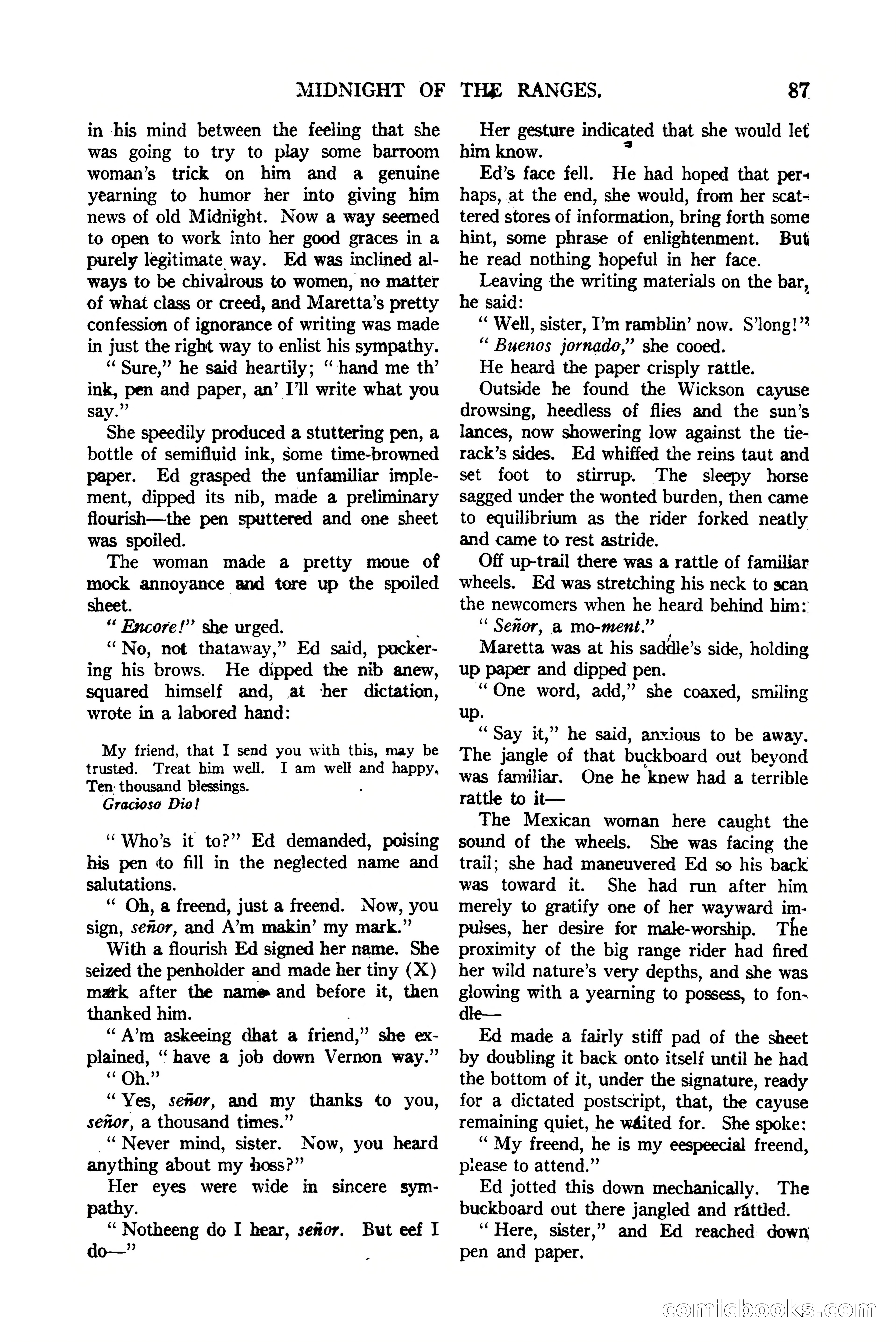
A restored page from Pulp Fiction, 1920. Page through the whole issue in the reader above.
📄 Transcribed text from this page (OCR, searchable)
Machine-transcribed from the original scan — historical spelling and the odd misread are preserved.
MIDNIGHT OF in his mind between the feeling that she was going to try to play some barroom woman’s trick on him and a genuine yearning to humor her into giving him news of old Midnight. Now a way seemed to open to work into her good graces in a purely legitimate way. Ed was inclined al- ways to be chivalrous to women, no matter of what class or creed, and Maretta’s pretty confession of ignorance of writing was made in just the right way to enlist his sympathy. ‘“‘ Sure,” he said heartily; ‘“ hand me th’ ink, pen and paper, an’ I'll write what you say.” She speedily produced a stuttermg pen, a bottle of semifluid ink, some time-browned paper. Ed grasped the unfamiliar imple- ment, dipped its nib, made a preliminary flourish—the pen sputtered and one sheet was spoiled. The woman made a pretty moue of mock annoyance and tere up the spoiled sheet. “ Encore!’ she urged. “No, not thataway,” Ed said, pucker- ing his brows. He dipped the mb anew, squared himself and, at her dictation, wrote in a labored hand: My friend, that I send you with this, may be trusted. Treat him well. I am well and happy, Ten: thousand blessings. , Gracioso Dio! ‘“Who’s it to?” Ed demanded, poising his pen to fill in the neglected name and salutations. | ‘* Oh, a freend, just a freend. Now, you sign, senor, and A’m makin’ my mark.” With a flourish Ed signed her name. She seized the penholder and made her tiny (X) matk after the name and before it, then thanked him. . ‘“‘ A’m askeeing dhat a friend,” she ex- plained, “ have a job down Vernon way.” cc Oh.”’ “Yes, senor, and my thanks to you, senor, a thousand times.” _“ Never mind, sister. Now, you heard anything about my toss?” Her eyes were wide in sincere sym- pathy. ‘“‘ Notheeng do I hear, sexor. do—”’ But eef I THE RANGES, 87 Her gesture indicated that she would let him know. i Ed’s face fell. He had hoped that per- haps, at the end, she would, from her scat- tered stores of information, bring forth some hint, some phrase of enlightenment. But he read nothing hopeful in her face. Leaving the writing materials on the bar, he said: , ‘Well, sister, I’m ramblin’ now. S’long!” “ Buenos jornado,”’ she cooed. He heard the paper crisply rattle. Outside he found the Wickson cayuse drowsing, heedless of flies and the sun’s lances, now showering low against the tie- rack’s sides. Ed whiffed the reins taut and set foot to stirrup. The sleepy horse sagged under the wonted burden, then came to equilibrium as the rider forked neatly and came to rest astride. Off up-trail there was a rattle of familiar wheels. Ed was stretching his neck to scan the newcomers when he heard behind him: ‘“ Senor, a mo-ment,” | Maretta was at his saddle’s side, holding up paper and dipped pen. “One word, add,” she coaxed, smiling up. “Say it,” he said, anxious to be away. The jangle of that buckboard out beyond was familiar. One he knew had a terrible rattle to it— The Mexican woman here caught the sound of the wheels. She was facing the trail; she had maneuvered Ed so his back was toward it. She had run after him merely to gratify one of her wayward im- pulses, her desire for male-worship. The proximity of the big range rider had fired her wild nature’s very depths, and she was glowing with a yearning to possess, to fon- dle— Ed made a fairly stiff pad of the sheet by doubling it back onto itself until he had the bottom of it, under the signature, ready for a dictated postscript, that, the cayuse remaining quiet, he waited for. She spoke: ‘“ My freend, he is my eespeecial freend, pease to attend.” Ed jotted this down mechanically. The buckboard out there jangled and rattled. ‘Here, sister,” and Ed reached down pen and paper. comiclboolk C©