
Pulp Fiction, 1920 · page 60 of 164
All-Story Weekly, Vol. 112, No. 1 — page 60: what you’re looking at
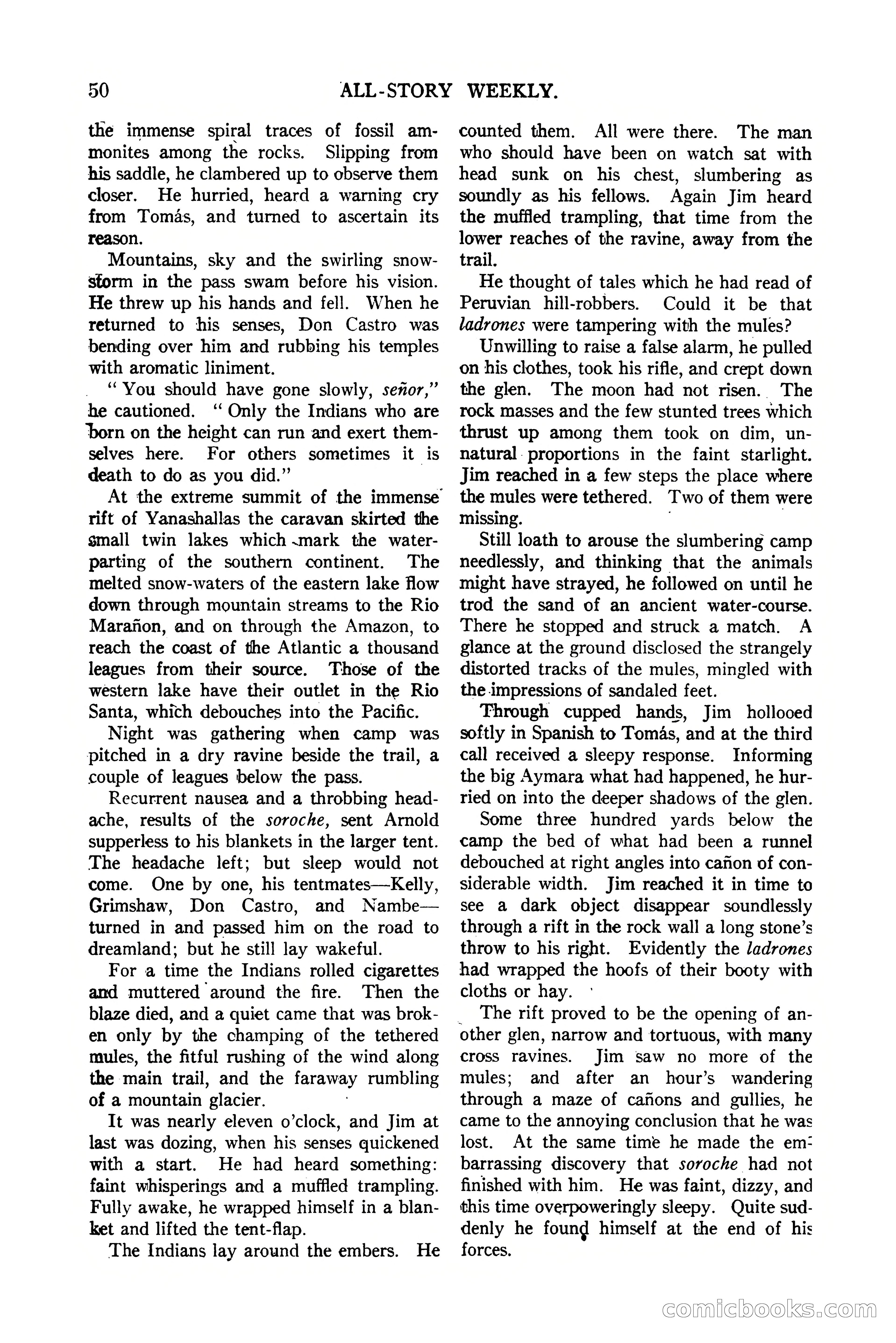
A restored page from Pulp Fiction, 1920. Page through the whole issue in the reader above.
📄 Transcribed text from this page (OCR, searchable)
Machine-transcribed from the original scan — historical spelling and the odd misread are preserved.
50 the immense spiral traces of fossil am- monites among the rocks. Slipping from his saddle, he clambered up to observe them closer. He hurried, heard a warning cry from Tomas, and turned to ascertain its reason. Mountains, sky and the swirling snow- storm in the pass swam before his vision. He threw up his hands and fell. When he returned to his senses, Don Castro was bending over him and rubbing his temples with aromatic liniment. ‘“You should have gone slowly, senor,” he cautioned. ‘‘ Only the Indians who are Dorn on the height can run and exert them- selves here. For others sometimes it is death to do as you did.” At the extreme summit of the immense rift of Yanashallas the caravan skirted the small twin lakes which ~mark the water- parting of the southern continent. The melted snow-waters of the eastern lake flow down through mountain streams to the Rio Maranon, and on through the Amazon, to reach the coast of the Atlantic a thousand leagues from their source. Those of the western lake have their outlet in the Rio Santa, which debouches into the Pacific. Night was gathering when camp was pitched in a dry ravine beside the trail, a couple of leagues below the pass. Recurrent nausea and a throbbing head- ache, results of the soroche, sent Arnold supperless to his blankets in the larger tent. The headache left; but sleep would not come. One by one, his tentmates—Kelly, Grimshaw, Don Castro, and Nambe— turned in and passed him on the road to dreamland; but he still lay wakeful. For a time the Indians rolled cigarettes and muttered around the fire. Then the blaze died, and a quiet came that was brok- en only by the champing of the tethered mules, the fitful rushing of the wind along the main trail, and the faraway rumbling of a mountain ‘glacier. It was nearly eleven o’clock, and Jim at last was dozing, when his senses quickened with a start. He had heard something: faint whisperings and a muffled trampling. Fully awake, he wrapped himself in a blan- ket and lifted the tent-flap. The Indians lay around the embers. He ALL-STORY WEEKLY. counted them. All were there. The man who should have been on watch sat with head sunk on his chest, slumbering as soundly as his fellows. Again Jim heard the muffled trampling, that time from the lower reaches of the ravine, away from the trail. He thought of tales which he had read of Peruvian hill-robbers. Could it be that ladrones were tampering with the mules? Unwilling to raise a false alarm, he pulled on his clothes, took his rifle, and crept down the glen. The moon had not risen. The rock masses and the few stunted trees which thrust up among them took on dim, un- natural: proportions in the faint starlight. Jim reached in a few steps the place where the mules were tethered. Two of them were missing. Still loath to arouse the slumbering camp needlessly, and thinking that the animals might have strayed, he followed on until he trod the sand of an ancient water-course. There he stopped and struck a match. A glance at the ground disclosed the strangely distorted tracks of the mules, mingled with the impressions of sandaled feet. Through cupped hands, Jim hollooed softly in Spanish to Tomas, and at the third call received a sleepy response. Informing the big Aymara what had happened, he hur- ried on into the deeper shadows of the glen. Some three hundred yards below the camp the bed of what had been a runnel debouched at right angles into cafion of con- siderable width. Jim reached it in time to see a dark object disappear soundlessly through a rift in the rock wall a long stone’s throw to his right. Evidently the ladrones had wrapped the hoofs of their booty with cloths or hay. The rift proved to be the opening of an- other glen, narrow and tortuous, with many cross ravines. Jim saw no more of the mules; and after an hour’s wandering through a maze of canons and gullies, he came to the annoying conclusion that he was lost. At the same time he made the em: barrassing discovery that soroche had not finished with him. He was faint, dizzy, and this time overpoweringly sleepy. Quite sud- denly he found himself at the end of his forces. CO DOOK nn C©